






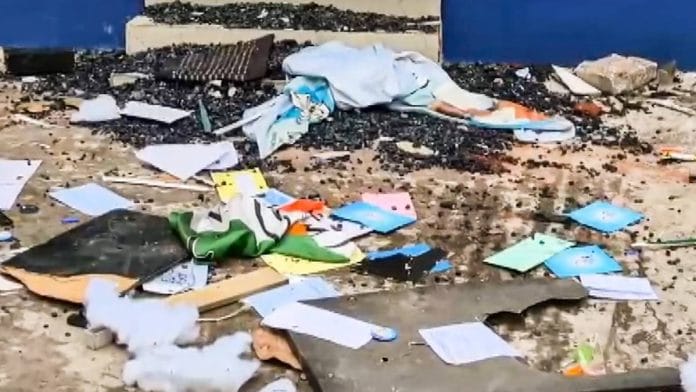


A bloody new chapter has just begun in West Bengal’s dark history of political violence. Trouble had started soon after the BJP won a decisive mandate on 4 May, dislodging the Mamata Banerjee-led TMC from power, with sporadic incidents of political violence reported from across the state.
But what has shaken both the political stakeholders and the civil society is the murder of BJP leader Suvendu Adhikari’s personal assistant in Madhyamgram, two days after the party’s historic win in the Assembly election. It brought back fears of a vicious cycle of political violence like what the state witnessed after the 2021 Assembly polls.
It will take some time before all political stakeholders in West Bengal begin following Prime Minister Narendra Modi’s call for ‘badlav’ (change), and not ‘badla’ (revenge), in his victory speech after the election results.
A bloody beginning
Of the four bullets fired at Chandranath Rath, the personal assistant of Adhikari, three hit him. Rath was in a moving car in Madhyamgram at approximately 10:30 pm on 6 May when the attack took place. The suspects reportedly followed his car and opened fire as it slowed down. Visuals showed the car’s left front window cracked with bullet holes.
The murder of Rath, considered part of Adhikari’s inner circle, has shaken the state. While the police have detained three people for questioning, the BJP has pointed to the abysmal state of law and order under the outgoing Mamata Banerjee government that has led to such killings.
Rath’s murder is not the only such incident after 4 May. The post-poll violence has made global headlines. Al Jazeera reported that at least four people have been killed in political unrest even as BJP and TMC have blamed each other. “The BJP said two party workers were killed, while the TMC said two of their workers were beaten to death,” the report said.
Taking a dig at the BJP, Trinamool Congress MP Mahua Moitra wrote on X that lumpen violence and hooliganism are happening in every corner of Bengal today. “The communal slogans, the hate speech even before oath-taking should prepare Bengalis for the Parivartan ahead,” she wrote.
The Trinamool Congress has also blamed the BJP for targeting meat shops and their party offices. TMC Rajya Sabha MP Derek O’Brien alleged that a bulldozer was brought in to demolish meat shops. “In central Kolkata, near New Market. With police permission. As part of victory celebrations, a bulldozer was brought in to demolish meat shops. CAPF standing around,” he said.
Veteran journalist and policy analyst Pratim Ranjan Bose sees a dangerous plot at play. In a now-viral Facebook post, Bose said the attack on the meat shop happened on the evening of 4 May (result day). Bose blamed it on the rivalry among two TMC groups.
“One declared themselves as BJP and attacked the office on an encroached space in New Market. The chicken shop was next to it. It became collateral damage to the destruction. The use of JCB was the strangest part. The incident was made viral in Bangladesh on 6 May. Suvendu’s CA was killed on the same evening,” Bose wrote.
The BJP has also accused the TMC of attempting to incite post-poll violence in the state by disguising its workers as BJP supporters and using saffron party symbols to malign it. In a surprising twist, a video by TMC spokesperson Riju Dutta has gone viral where he is heard saying that some TMC workers have indeed indulged in violence pretending to be BJP workers.
Also read: By refusing to resign, Mamata Banerjee isn’t resisting authoritarianism—she is becoming it
A dark past
West Bengal, which has often prided itself for its intellectual heritage, is notoriously prone to election violence. Memories of what happened after the TMC won the 2021 Assembly elections defeating the BJP are still fresh in people’s minds. Commenting on the violence that began immediately after the BJP lost to the TMC, Adhikari said his party had to make 355 safe houses, even as 1,10,000 people were forced to leave their homes.
Delhi journalist Nishant Azad, who had travelled to West Bengal’s hinterland to talk to victims, wrote that murders, rapes, burning of business establishments and houses, loss of benefits from government schemes became commonplace for those who dared to vote against the TMC in 2021.
The history of political violence, though, did not begin with the rivalry between the TMC and the BJP. A 2024 BBC Eye documentary titled ‘Children of the Bombs’ quoted local newspaper archives to show that between 1996 and 2024, at least 565 children were killed, maimed, or injured by crude bombs in West Bengal.
Used by political parties for election violence, these homemade bombs, thrown by political rivals at one another, do not often explode immediately and are later picked up by children playing cricket or other games to horrific consequences.
Anthropologist Ayan Guha told ThePrint that in a largely rural economy like West Bengal, afflicted by a massive unemployment crisis, political patronage in the form of doles and benefits from government schemes disbursed through panchayats has become a principal means of survival for a large section of the rural masses. Which is why political violence begins from panchayat polls and carries on till Assembly polls.
Guha said the necessity of capturing panchayats and other political institutions — and of excluding political opponents from control of scarce resources at any cost — lies at the root of the culture of political violence in West Bengal, a trend that has persisted since the Left Front’s consolidation of power over rural society.
Deba Pratim Ghatak, the author of 2024 book The Original Lynch Mob, which documents incidents of political violence during the 34 years of Left Front’s rule in West Bengal, told ThePrint that the history of political violence began with the rise of the Left in West Bengal.
“The Bhadralok is never the victim. Nor are his kids. While we talk about the bombings in Gaza, we conveniently ignore the maiming and killing of the children and the poor in our hinterland. Maybe that is why this culture of political violence will not end anytime soon,” he said.
Even as Suvendu Adhikari called Chandranath Rath’s death a personal loss, he has appealed to all BJP workers to maintain peace. That should be the first order of the day for his party as soon as it forms a new government in the state: to end the vicious cycle of West Bengal’s political violence.
Deep Halder is an author and a contributing editor at ThePrint. He tweets @deepscribble. Views are personal.
(Edited by Aamaan Alam Khan)