






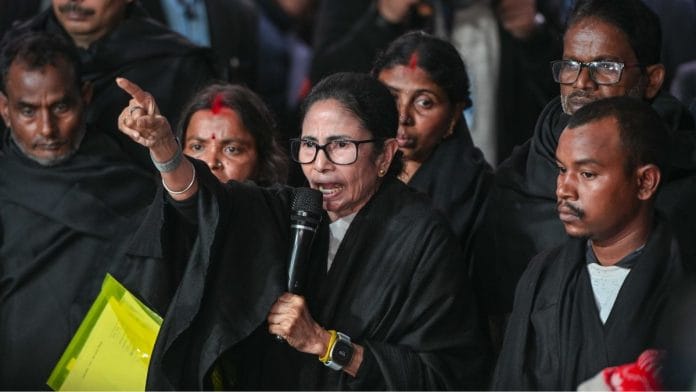

Universal adult franchise, the right of every Indian citizen to vote and to have that vote count, is not a rhetorical device. It is the cornerstone of Articles 326 and 327 of the Constitution. When Chief Minister Mamata Banerjee, after losing an election conducted under the supervision of the Election Commission of India, declares that she “hasn’t lost,” she is not resisting authoritarianism, as argued by TMC Rajya Sabha MP Sagarika Ghose in her column in ThePrint. She is becoming it. Banerjee is telling millions of voters in West Bengal that their verdict is illegitimate and their democratic exercise was a sham. If that is “resistance”, it is resistance directed not at the BJP, but at the people of Bengal themselves. What Ghose calls resistance, the Indian Constitution calls something far less poetic: a refusal to honour the sovereign verdict of the people.
Let us examine this clearly.
Ghose makes much of the deployment of 2.5 lakh central security forces in West Bengal, comparing it to US troop deployments — a rhetorical flourish that collapses under scrutiny. Those security forces were not there because the central government distrusts Bengal. They were there because Bengal’s own documented electoral history demanded it.
After the 2021 Assembly elections, a batch of PILs filed by lawyers and civil society members came before the Calcutta High Court, documenting incidents of murder, rape, arson, and mass displacement of political workers across the state. The National Human Rights Commission (NHRC), constituted following a five-judge bench order, visited 311 spots and received nearly 1,979 complaints representing over 15,000 victims. Its report concluded that what had occurred was “retributive violence” causing “disruption of life and livelihood of thousands of people and their economic strangulation”, language that went publicly unrebutted by any senior TMC leader.
On 19 August 2021, the Calcutta High Court ordered a CBI probe into all cases of murder and rape, with a court-monitored SIT for all other offences. The CBI registered 43 cases pursuant to that direction. In a 2026 plea before the Supreme Court, petitioners noted that FIRs had gone unregistered in 60 per cent of cases examined by the high court-appointed committee, and that compensation to victims remained unpaid years later.
The 2026 post-poll period has reproduced this pattern with grim fidelity. At least four workers — two each from TMC and BJP — have been reportedly killed and violence has spread across Birbhum, Howrah, South 24 Parganas and Nadia. TMC offices have been ransacked allegedly by BJP workers and clashes between the two parties have been reported across districts. The Election Commission has once again issued a “zero tolerance” directive. On Wednesday, the personal assistant of Leader of Opposition Suvendu Adhikari was shot dead in Madhyamgram on a public road within days of the results. Against this documented backdrop, the deployment of 2.5 lakh security forces is not central overreach, it is an empirical response to a pattern West Bengal has repeated across consecutive electoral cycles. Comparing it to military deployments abroad is not just glib, it is a studied evasion of what the courts, the NHRC, and ground realities have consistently recorded.
Also read: Mamata’s ‘I haven’t lost’ verdict will haunt the BJP. Resistance is her grammar
Own the Constitution in its entirety
Ghose invokes the Constitution to frame Banerjee as its defender. Very well. Then let us talk about the Constitution’s guarantee of personal safety and dignity under Article 21, and ask what happened in Sandeshkhali. In early 2024, allegations of systemic sexual assault and land grab emerged. TMC leaders Shibaprasad Hazra and Uttam Sardar have been arrested, while the prime accused, Sheikh Shahjahan, remained a fugitive for 55 days, sheltered by a system that was supposed to protect the very women he allegedly preyed upon. Section pertaining to gang-rape was added to the case after survivor testimony. Where was the constitutional grammar of resistance when women of Sandeshkhali were allegedly calling for help and the police refused to register FIRs?
And then came RG Kar. On 9 August 2024, a 31-year-old postgraduate trainee doctor was raped and murdered inside the seminar room of RG Kar Medical College and Hospital in Kolkata. The case was so egregiously mishandled that first the Calcutta High Court transferred the investigation to the CBI, and then the Supreme Court took suo motu cognisance as the nation erupted in protest. Women marched in a “Reclaim the Night” campaign against the state government’s failure to protect one of their own. Banerjee was specifically criticised for allegedly shielding the now-arrested ex-principal of RG Kar, Sandip Ghosh. When the Constitution is invoked by those who presided over these failures, the invocation must be weighed against the record.
Ghose also implies in her article that the Special Intensive Revision (SIR) of voter rolls was a BJP tool to suppress TMC votes. But data analysis reported by ThePrint suggests that the SIR had minimal to no discernible impact on the election results. In a fiercely contested election with massive security deployment and Supreme Court-monitored processes, the BJP’s sweep of 207 seats out of 294 reflects a genuine electoral verdict, not an engineered one. To argue otherwise is to argue that the Election Commission, the Supreme Court, and the central security apparatus together manufactured the results of an election watched by the entire country. That is not a credible claim.
The ghost of 1975
Mamata Banerjee is not the first powerful leader in India to be tempted by the logic that her personal political survival matters more than the system’s rules. In June 1975, the Allahabad High Court delivered one of the most consequential verdicts in Indian legal history. Justice Jagmohan Lal Sinha declared Indira Gandhi’s 1971 Lok Sabha election null and void, finding her guilty of misusing government machinery under the Representation of the People Act, 1951. She was disqualified from elected office for six years. The Supreme Court granted only a conditional stay. What did Indira Gandhi do? She invoked Article 352 to declare the Emergency, on 25 June 1975, citing internal threats, effectively suspending the Constitution. Opposition leaders, Jayaprakash Narayan, Morarji Desai, Atal Bihari Vajpayee, and LK Advani were among those arrested under MISA. Nearly 35,000 people were detained without trial. Press censorship was imposed. Sterilisation was coerced.
Indira Gandhi’s supporters also spoke of threats to the Constitution, of conspiracies, of enemies of the people. The Emergency lasted until 1977, when, humbled by elections, the authoritarian experiment collapsed. We know how history judged Emergency. Mamata Banerjee does not have the powers of a Prime Minister under Article 352. But the instinct is recognisably the same: when the system delivers an unwanted verdict, declare the system illegitimate. That is not resistance. That is the first syllable of authoritarianism.
Credit where it’s due and accountability where it’s owed
It would be intellectually dishonest not to acknowledge what Mamata Banerjee genuinely achieved. She broke the stranglehold of a CPI(M) government that ruled West Bengal for 34 years, a political feat of remarkable personal courage and popular mobilisation. She was, in her own Lok Sabha tenure, among the early voices raising the issue of illegal infiltration from Bangladesh in Bengal. In August 2006, she actually threw her resignation papers at the deputy speaker of the Lok Sabha when her adjournment motion on illegal Bangladeshi infiltration was rejected. On that issue, she was ahead of the political curve.
Here is the simplest test: if a BJP chief minister, say, in Rajasthan or Madhya Pradesh, lost an election and declared, “I haven’t lost, I won’t resign,” would Ghose have written an ode to his “grammar of resistance”? Would she have celebrated it as a defiant stand against majoritarianism? Or would they have (correctly) condemned it as an assault on democracy?
The answer is obvious. And that asymmetry exposes the real grammar at play — not Banerjee’s grammar of resistance, but a grammar of selective outrage. Losing is not a betrayal. Losing is part of democracy; it is, in fact, what makes democracy meaningful. The right to vote is inseparable from the right to have that vote result in a transfer of power.
Mamata Banerjee spent decades fighting for that right for millions of Bengalis. It would be a tragedy for her legacy, and for the Republic, if she became the person who told those same Bengalis that their vote didn’t count when it went against her. The Constitution does not have a “grammar of resistance” clause that excuses the powerful from its commands. It has Article 326. It has an EVM. And it has the ancient, simple truth that in a democracy, when you lose, you leave.
Shashank Maheshwari is an assistant professor at Jindal Global Law School.
(Edited by Prashant Dixit)