






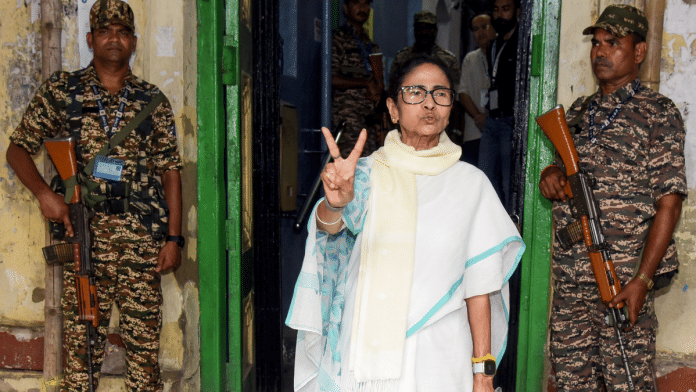


I haven’t lost, and I won’t resign.” This sentence reveals an important fact: chutzpah comes naturally to Mamata Banerjee. She walks in courage, and the language of resistance is her grammar. Again and again she reaches for the broad arc of democratic possibility, brushing aside the grime of fear, intimidation and threat hurled at her.
In attention-deficient times, Banerjee, at her first press meet after the Bengal election results, made the world stand still. “I haven’t lost, and I won’t resign,” she announced.
The BJP and its echo chamber celebrated its 200-plus seat haul in West Bengal. TV studios were filled with the frenzy of graphics, projections and triumphalism. Talking heads frothed with analyses.
Yet it was this single sentence that electrified the air. A single sentence froze the moment. A single sentence became a searing indictment of the way the Narendra Modi-Amit Shah-led BJP and the Election Commission of India (ECI) had brazenly manipulated the Bengal assembly polls of 2026. The sentence will linger. It will be quoted. It will haunt.
Her words threw her opponents into visible panic. BJP worthies erupted in shrill outrage about Banerjee’s failure to “respect the Constitution.” BJP-friendly legal luminaries appeared on TV, brows furrowed and jowls quivering, trembling with indignation. How dare she? How can she? Does she not understand “constitutional morality?”
Shrieking BJP spokespersons, comical in their discombobulation, crowded TV studios to lecture her on “grace” and “constitutional propriety.” Why could she not simply accept defeat “gracefully,” they demanded. “Grace?” “Constitutional propriety.” Really?
Discrepancies of SIR
In a viciously partisan Special Intensive Revision (SIR) exercise, as many as 90 lakh were excluded from Bengal’s electoral rolls. At least 27 lakh were placed in a list of “Logical Discrepancies” despite submitting documents proving their identity. Many had been flagged only because of spelling mistakes or trivial inconsistencies in family details. Appellate Tribunals were meant to examine and clear these cases before polling. Yet before the first phase in Bengal, only 138 (out of 27 lakhs) were examined, of which 136 were found to be genuine voters. If 98 per cent of those examined were legitimate voters, how many more genuine citizens remain excluded?
Lakhs are still waiting to get a fair hearing. Shockingly, scandalously, lakhs have been deprived of the right to vote by executive fiat. Was this constitutional morality, was this “grace”, was this respect for Article 326 guaranteeing universal franchise in India?
The SIR plunged countless ordinary citizens into fear and anxiety. Elderly citizens were dragged to verification centres. Booth Level Officers (BLOs) were placed under inhuman pressure. Those sermonising about “constitutional values” remained silent through it all. In half the seats that the BJP won in Bengal, the party’s winning margin was far less than the staggering number of SIR deletions. If even a small fraction of the SIR-deleted voters had voted against the BJP, its candidate would not have won; instead, it would have lost. This was not SIR; it was careful electoral engineering.
How viciously and nastily sanctimonious, how wicked are the oh-so-pious shouts that Banerjee must now quietly submit to what they want her to do. They don’t know that defiance and confrontation are hardwired into her DNA.
US President Donald Trump has sent 50,000 troops to be deployed in the West Asian region in the US war with Iran. By contrast, Prime Minister Narendra Modi sent in 2.5 lakh security forces into Bengal against Banerjee. Elections were transformed into a militarised operation. A preposterously posturing “Singham” style “encounter cop” from the Uttar Pradesh police came swaggering into Bengal, making self-aggrandising reels and promising to “fix” troublemakers. Was this “respect” for the Constitution?
In Bengal, hate speech and polarisation were pumped out on an industrial scale by BJP leaders and visiting ministers and BJP MLAs. WhatsApp groups streamed out memes and videos on “infiltrators” and “ghuspetiyas” and so-called “Bangladeshis” flooding into Bengal. Communal language was ratcheted up to a fever pitch with a smirking Suvendu Adhikari of the Bengal BJP even saying “I thank every Hindu and every sanatani” voter for his victory over Banerjee in the Bhabanipur assembly constituency. Hindu-Muslim hate became a central narrative in Bengal 2026. Is this “respecting” the Constitution?
The Bengal election became saturated with the BJP’s rhetoric of “ghuspetiyas”, and the need to “cleanse ” electoral rolls—a euphemism widely used to target Muslims. But neither the ECI nor the Home Ministry has so far clearly informed the public on how many illegal migrants/“ghuspetiyas” or infiltrators have been uncovered in SIR? Or have the “ghuspetiyas” now miraculously evaporated now that the BJP has managed a 200-seat tally in Bengal?
Also read: Next epic election will be UP 2027. Akhilesh Yadav is hardly ready for Yogi Adityanath
Leading from the front
A flame has risen in Bengal, a figure unbowed by all the intimidation and suspicion—she is fierce, stubborn and unyielding. Where any other politician might have crumbled under the Modi-Shah-led Delhi establishment’s onslaught, while conventional politicians might have retreated before the suffocating institutional and political pressure, the three-time Bengal chief minister Banerjee stands firm.
She challenged the ECI in court, forcing it to make at least some changes to its citizen-terrorising rules. School leaving certificates and Aadhaar cards were eventually accepted. In February, in a first for a sitting chief minister, Mamata Banerjee herself appeared before the Supreme Court to challenge the legality of the SIR. In March, she sat on a week-long dharna in the streets of Kolkata, holding up public testimonies of ordinary citizens fearing disenfranchisement.
In January, when the Enforcement Directorate (ED) launched a “raid” on the offices of I-PAC, the political consultancy firm that works with the TMC, Banerjee arrived on the premises in person to demand to know why the ED was concerning itself with party matters.
Language is always slyly subverted in an autocracy. Banerjee’s arrival on the scene was seen as “interfering with official agencies.” Oh really. Will the ED ever “raid” a BJP party think tank? Has the ED ever “officially” targeted any BJP politician? Is the ED an “official” agency or an arm of the BJP?
In April, the founder of I-PAC was even arrested in Kolkata, but once the voting was done, he was, outrageously enough, released on bail. The ED’s barefaced motive was clear: to stop I-PAC’s work for the duration of the election.
Then came the extraordinary night of 1 May. During the incomprehensible and bizarre four-day gap between the polls and counting, reports emerged that CCTV cameras at the strong rooms—where EVMs were stored—at the Netaji Indoor Stadium had briefly gone dark. Once footage resumed, unexplained activity was allegedly visible in the strong room. In an act that no other sitting chief minister would have had the spirit to do, Banerjee herself rushed to the counting centre at Shekhawat Memorial Girls School, remaining for most of the night, herself maintaining vigil. On the result day, she again went herself to the counting centre in Bhabanipur where she was badly pushed and shoved.
Critics scoffed that she was being theatrical, smirking in that condescending way male politicians and commentators often do when speaking of Banerjee. They misunderstand her. For a grassroots democrat like her, democracy is not an abstraction; it is visceral, daily lived politics. It’s spending-nights-on-the-streets politics.
“No identity card, no vote,” she had screamed in 1993 on that burning 21 July afternoon when the then Congress leader Banerjee led protests demanding the introduction of photo identity cards for voters, to prevent the notorious electoral fraud under the Left Front. The police fired on her. At least 13 of her party members were killed. She herself was injured, but, blood streaming from her head, she would not stop marching. “No identity card, no vote,” she kept shouting.
The Voter Identity Card or the EPIC card with photos that we routinely carry today is a result of those protests. She has shed blood for the right to vote.
Where others compromise or capitulate, she confronts. Where others throw up their hands, she fights back.
Also read: BJP’s West Bengal win doesn’t mean 2029 Lok Sabha election is in the bag
Mamata Banerjee vs BJP
Today’s BJP is not a “normal” political party. It’s a centralised political machine, armed with vast financial power, relentless propaganda and narrative-building skills, investigative agencies and aggressive religious hatred. Many opposition forces have crumbled before it.
But Bengal has always produced resistance to empires, and it has produced resistance again.
In 2023, all opposition parties came together in alliance to take on the wrecking ball of democracy that is the BJP. Autocrats thrive amid division; solidarity weakens tyranny.
In Hungary this year, a united opposition movement brought down a despot. When every institution is bent, when fear is weaponised, and the level playing field is blown up, resistance cannot remain fragmented.
In the 2024 elections, a window of democracy was opened when the BJP was slashed down to 240 seats, but since then the party has been using every means to shut that door.
But today, a highly sophisticated and consummate politician, a leader forged by fire, blazes against the BJP. This is the larger significance of her sentence: “I haven’t lost, and I won’t resign.” It’s not a procedural statement, but a political symbol. A refusal to legitimise what was a nasty, totally distorted election.
Of course, the BJP will claim the formal instruments of power. Of course, constitutional procedures will proceed. But Banerjee’s statement was never about office alone; it wasn’t about grabbing a kursi. She has already made it clear: “I am free of the chair.”
Instead, her words were about refusing submission.
Her words will travel beyond Bengal. The sentence will echo—becoming not merely a slogan but a political mood, a marker of resistance and a challenge to the horrifying destruction of democratic norms in India. ‘I haven’t lost, and I won’t resign.’
Sagarika Ghose is a Rajya Sabha MP, All India Trinamool Congress. She tweets @sagarikaghose. Views are personal.
(Edited by Saptak Datta)