





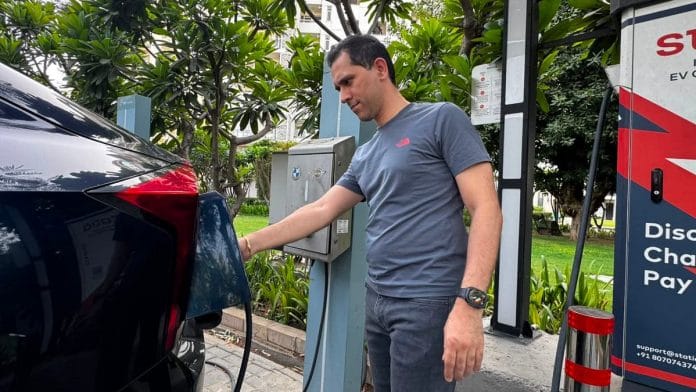

Gurugram: Every evening, Gurugram’s DLF The Ultima turns into a battleground for charging electric cars. Owners of swanky BMWs, Kias, and XUVs jostle, honk, and bargain for first access to one of the condominium’s three electric vehicle charging points. What starts as polite coordination in the upscale society devolves into an argument that stretches into the night.
“A luxurious society like DLF turns into a vegetable market every evening,” said 41-year-old Mohit Wadhwa, who drives an XUV400 EV. The fast charger doesn’t work and slow chargers take 6-7 hours depending on the vehicle.
The scramble for charging slots is part of a bigger tussle playing out across NCR. EV owners are not just pitted against each other for scarce charging points, but also against non-EV owners over basement space and fire safety. Desperate residents are petitioning the Supreme Court, writing to district magistrates, and lodging grievances with ministers. What appears to be an RWA problem is really a uniquely Indian cauldron: grand sustainability ambitions, new wealth, limited resources, and a legal maze, all colliding in the parking basement.
The mismatch is a result of the pace of EV adoption outstripping preparedness. And now there are even more urgent calls for going green. On 13 May, Prime Minister Narendra Modi addressed the nation and exhorted citizens to cut petrol and diesel use and switch to electric vehicles in the wake of the West Asia energy crisis. He also reduced the size of his convoy and asked officials to include EVs where feasible, without buying new vehicles. But on the ground, compliance issues and a lack of EV infra are making adoption a nightmare.
More than 50 per cent of the charging infrastructure in India is either defunct or not functioning properly. That’s a very low base to support this growth
-Deb Mukherjee, automotive sector veteran
At the centre of the chaos at Ultima — which has more than 85 EVs among its roughly 900 households — is a fire no-objection certificate (NOC). For two years, residents had been charging their vehicles through 75 personal chargers installed in the basement. But two weeks ago the fire department refused to renew the society’s NOC as long as those chargers remained, citing safety hazards. Non-EV owners formed a front and individual chargers were quickly removed by the condominium management.
“There was a huge backlash. EV owners were accused of ignoring fire safety and being selfish. We gave in. The chargers were removed on the promise that more surface-level ones will be installed,” said Wadhwa. “It’s been two weeks. Nothing has come up. And this is DLF we’re talking about.”
In April, the Haryana government ordered that “electric charging slots (ECS) may be provided in basements or stilts, subject to adherence to suitable fire safety norms.” But those norms remain hard to pin down, leaving government departments and RWAs to interpret them on a case-by-case basis.
“As per the order, the EV chargers can be installed in basement 1 and the ground floor. So, if a condominium comes for renewal of their NOCs, we first check compliance with the fire safety norms before issuing the certificate,” said Gurugram Fire Station Officer Narendra Yadav.
But fire safety is not the only barrier, and nor is it limited to Gurugram. In Greater Noida’s Nirala Estate, with over 60 EVs and just two charging points, residents queue up at odd hours, past midnight or in the sweltering afternoon, trying to find a slot. The society management stonewalled requests to install personal chargers for six months. Resident Rachit Katyal took that fight to the Supreme Court, which took up his petition on February 24. He was asking for the right to install a charger in his own parking slot in the basement.
Through advocate Sriram Parakkat, Katyal’s petition cited September 2024 guidelines issued by the Ministry of Power for the installation and operation of EV charging infrastructure.
“Residents can install private EV charging stations in their designated parking spaces. The Distribution Licensee will ensure electricity supply through the resident’s existing meter or a separate sub-meter, depending on the consumer’s choice,” it reads.
For Deb Mukherjee, a veteran of the automotive sector with four decades of experience, India’s EV surge is unfolding on a fragile foundation.
“More than 50 percent of the charging infrastructure in India is either defunct or not functioning properly. That’s a very low base to support this growth,” he said. “If you look at China, there is roughly one charger for every six cars. But in India, it’s closer to one charger for every 1,000 cars.”
Also Read: In NCR high rises, EWS residents face daily discrimination—security, sanitation to park access
RWA vs EV owners
At Nirala Estate, the first signs of friction came when Krishna Bhatia’s sister bought a Tiago EV in 2024—the condo’s first. A Tata survey team visited the society, inspected the basement, and cleared it for the installation of a private charger. But the next day, when the installation team arrived, the society’s management turned them away.
“The Tata team said they would even provide a safety certificate,” Bhatia recalled. “But the management insisted the EV would blow up the building.”
He claimed that after the incident some previously installed charging points in the basement were removed as well. Yet, over time, people kept buying EVs. There are now 65 EVs in the complex and the charging queue is only growing longer.
EV charging guidelines from the central government were issued in 2019. Since then they have not been implemented. Why? Because in India, issuing guidelines is easy and enforcing them is a big task.”
-Rachit Katyal, Nirala Estate resident and Supreme Court petitioner
In the condominium’s courtyard, two Terra chargers — 7 kW and 5 kW — stand in a separate bay. Both are slow, residents say, and the parking space in front of them is occupied by non-EV cars. To get the charging gun to reach their vehicles, EV owners have to use extension cables across the lot.
The society’s EV owners have since set up a WhatsApp group called “NIRALA EV OWNERS,” which doubles as a virtual charging queue.
“I want to use the charger. Is anyone in the queue right now?” reads one message.
“I’ll be free in 90 minutes,” comes the reply.
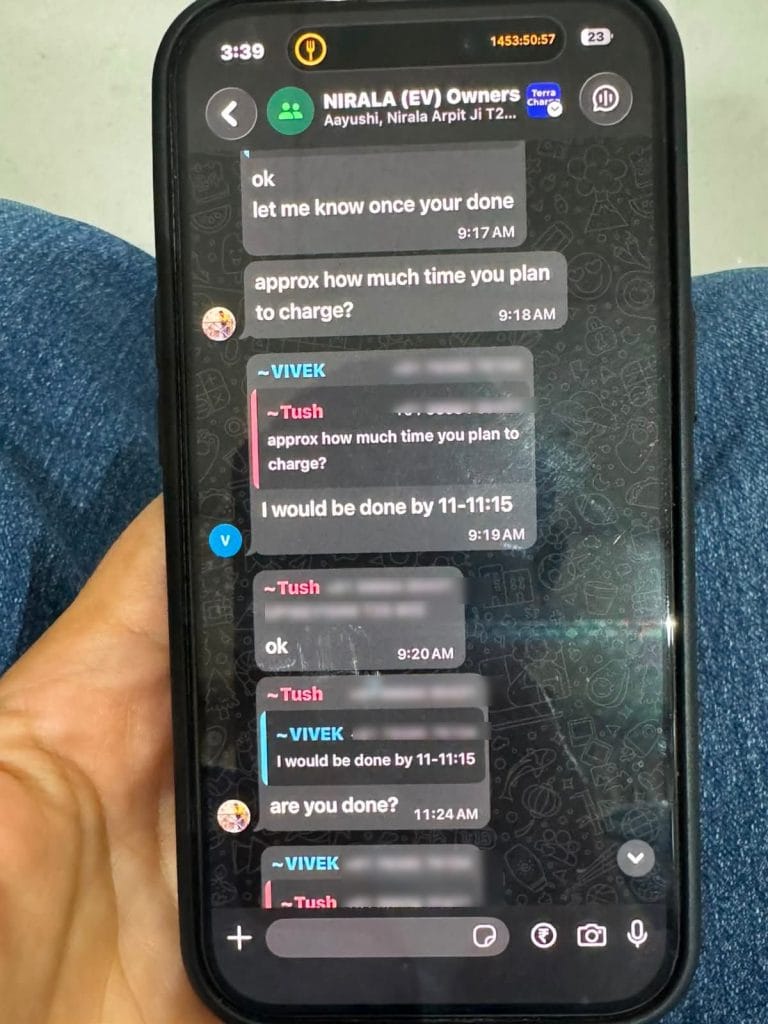
Frustration and helplessness are palpable in many of the messages.
“It’s very unfortunate that I am not able to charge my vehicle… fast charger is either not working or not available. What to do in such a scenario?” complained one resident.
Sumit Saurav, another resident, has been planning to buy an EV. In preparation, he has been writing to the management about installing a private charging point.
“I am awaiting your formal confirmation and consent for installation of the EV charger in my allotted parking space in Nirala World. In case, I do not receive any response from your side in a day or two, it shall be presumed that there is no objection to the installation of the EV charger in my designated parking area at Basement-1,” he wrote in an email on 21 May.
The response to this email was prompt: “Please be informed that our current infrastructure is not designed for additional heavy loads.”
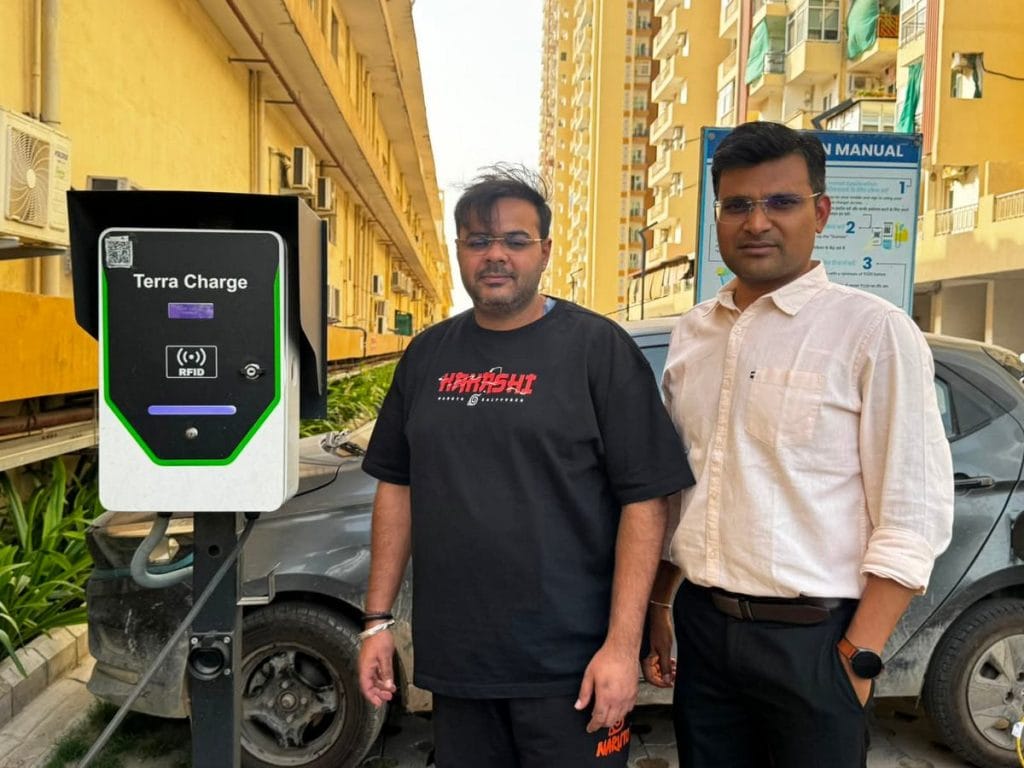
It was this kind of obstruction that drove Rachit Katyal, another fed-up resident, to the Supreme Court earlier this year.
“Many societies allow residents to install their own charger. In our society, which is new, they say we don’t have sufficient infrastructure. Didn’t they construct the building as per the latest guidelines?” he told ThePrint.
His petition asks the court for four things: an immediate order directing the builder and authority to grant him an NOC; nationwide implementation of the central guidelines; heavy penalties on the Nirala builder; and strict action against others who flout the guidelines in future.
In February, the Supreme Court issued notice to the Centre and the Uttar Pradesh government on the implementation of the 2024 EV guidelines. The next hearing was scheduled for 22 May but has been deferred, with no new date yet.
Since filing the petition, Katyal says, at least 300 EV owners from Gurugram and Noida have reached out to him, many of them confronting the removal of chargers from their basements.
“EV charging guidelines from the central government were issued in 2019,” Katyal said. “Since then they have not been implemented. Why? Because in India, issuing guidelines is easy and enforcing them is a big task.”
ThePrint emailed the Ministry of Heavy Industries for comment on barriers to EV adoption in housing societies. This report will be updated if a response is received.
Designed to fail?
Between inadequate building infrastructure, NOC requirements, and a groaning grid, owning an EV is turning out to be quite different from running one.
“Older societies lack the infrastructure. Although newer societies have been provisioned under the UP Apartment Act, the central regulations that exist have not been implemented for high-rise societies,” said Rajiva Singh, former president of the Noida Federation of Apartment Owners’ Associations (NOFAA).
These vehicles use lithium batteries. In case of an explosion, basement sprinklers are not equipped to extinguish such fires.”
-Rajiva Singh, former president, NOFAA
The biggest sticking point is fire safety. Wherever there is a basement charging point, the local administration is refusing to grant fire safety NOCs, according to Singh.
“These vehicles use lithium batteries. In case of an explosion, basement sprinklers are not equipped to extinguish such fires,” he added.
The disputes are turning punitive. Last month, Saurabh Srivastava, a resident of Amarpali Princely Estate in Noida, was fined Rs 25,000 by his Apartment Owners Association (AOA) for charging his EV using his domestic power connection.
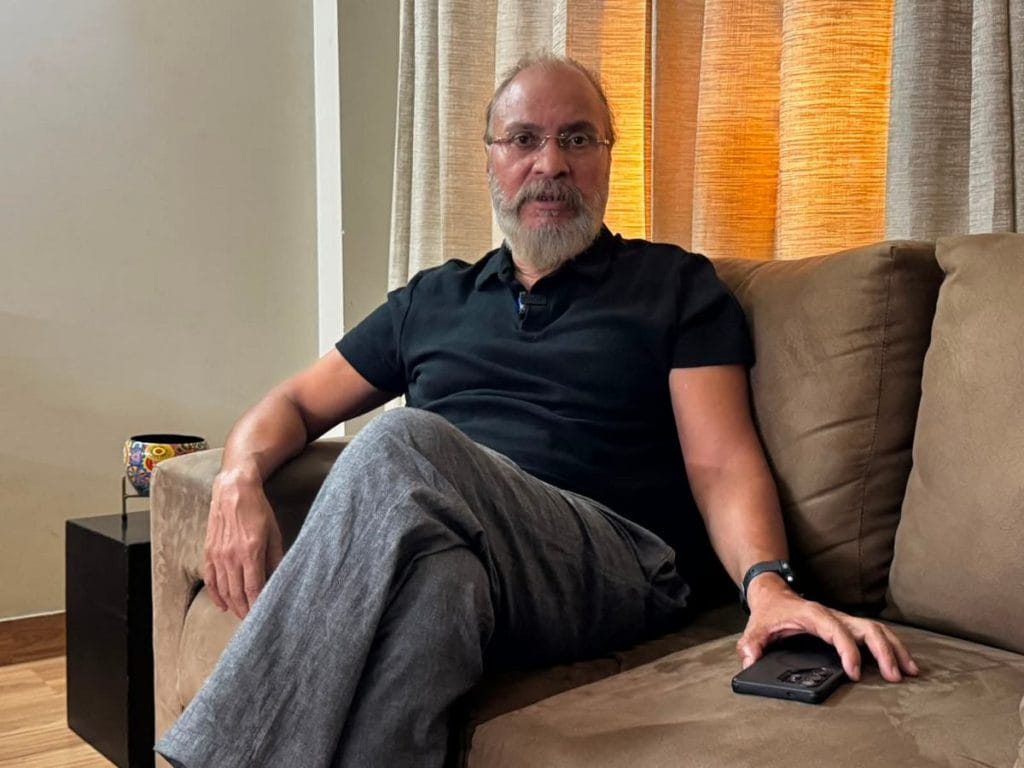
In another case last year, Pramod Chauhan, a resident of Sunworld Vanalika in Noida’s Sector 107, ran into a strange double standard. His society was letting existing EV owners use personal chargers they had installed years ago, but refused to let him, a new EV owner, install one of his own. The AOA’s reason: the society’s sanctioned electricity load wasn’t built for it, and the matter needed the district administration’s directive.
Chauhan then wrote to the DM. Additional district magistrate Atul Kumar acknowledged that several societies had raised similar complaints and that a report would be sent to the government after discussions with various stakeholders.
At Nirala, Saurav is preparing to follow the DM route too. He plans to meet District Magistrate Medha Rupam, hoping administrative intervention will help make some headway.
“Am I left with any option? I am being forced to meet the DM and speak to the higher-ups because all my requests have failed,” said Saurav.
For automotive sector veteran Mukherjee, the fixes cannot be engineered at the society level alone.
“The buildings have not been designed to take care of charging, especially bigger vehicles like SUVs, which consume a lot of power. So, regulations have to be put in place when buildings are made. Now, the government has come up with regulations and it’s a work in progress,” he said.
The grid at large “comes under intense pressure”, he added, especially between 6 pm and 11 pm when most owners return home and plug in at the same time.
Ultimately, these systemic failures could choke consumer demand, even as private owners and commercial taxi fleets rapidly switch to electric vehicles for their lower running costs.
“We need to develop a full ecosystem or else it will collapse and this demand will obviously die down because nobody wants the car to sit idle in the garage,” he added.
Costs rack up
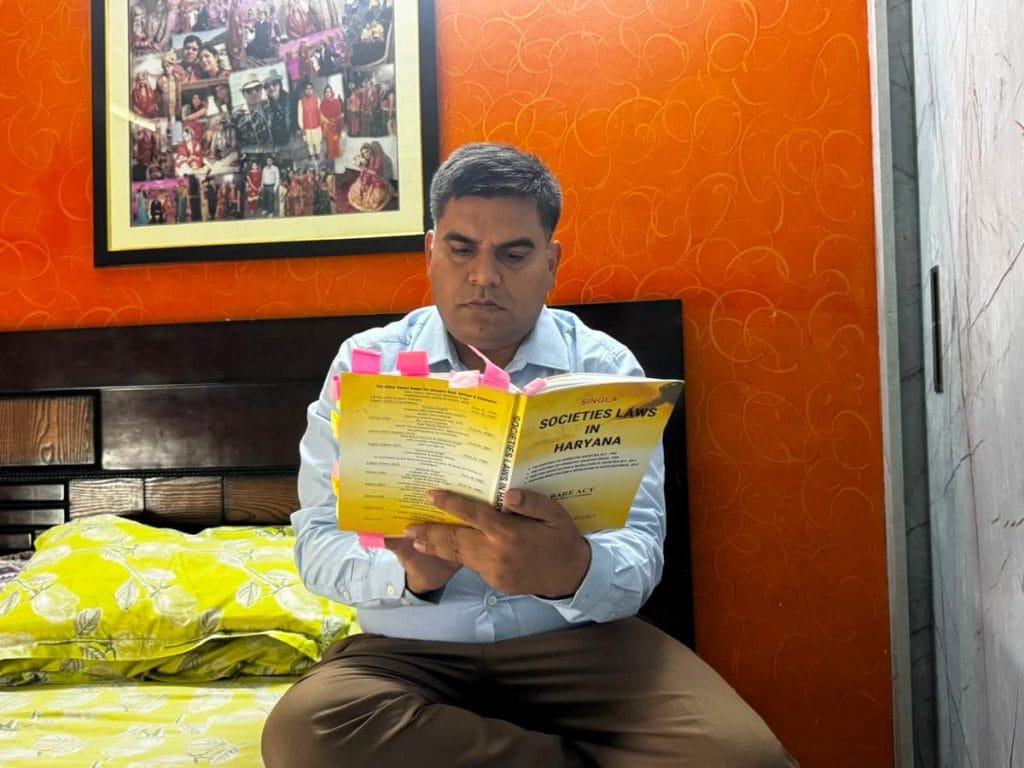
Rishi Shukla, 41, is on a mission — not just to install private chargers in his society, but to push for a wider EV charging network across New Gurugram. He has done his homework, poring over Haryana’s building bylaws and central government policies on EV infrastructure.
Shukla lives in ROF Ananda, an affordable housing society in Sector 95, where a single charger serves a dozen EVs. What sets him apart is the fight he has chosen. He has filed multiple complaints at the Chief Minister’s Window portal, written to Haryana’s Industries and Commerce Minister Rao Narbir Singh, and lodged enough grievances against the previous RWA to get it dissolved. The society is now under the builder’s management, but Shukla’s battle continues. He says he is still waiting to hear from the government.
“I won’t back off till EV charging infrastructure is put in place. I live in an affordable society, but that does not mean I don’t deserve basic amenities,” he said.
Other residents, meanwhile, have given up. Some who were considering buying EVs have put their plans on hold. One of his neighbours eventually moved out, unable to deal with the daily grind of securing a charging slot while his car gathered dust.
I invested in an EV to save on fuel costs and because I believe in sustainable development. But now, these charging prices have dug a hole in my pocket
-Rishi Shukla, ROF Ananda resident
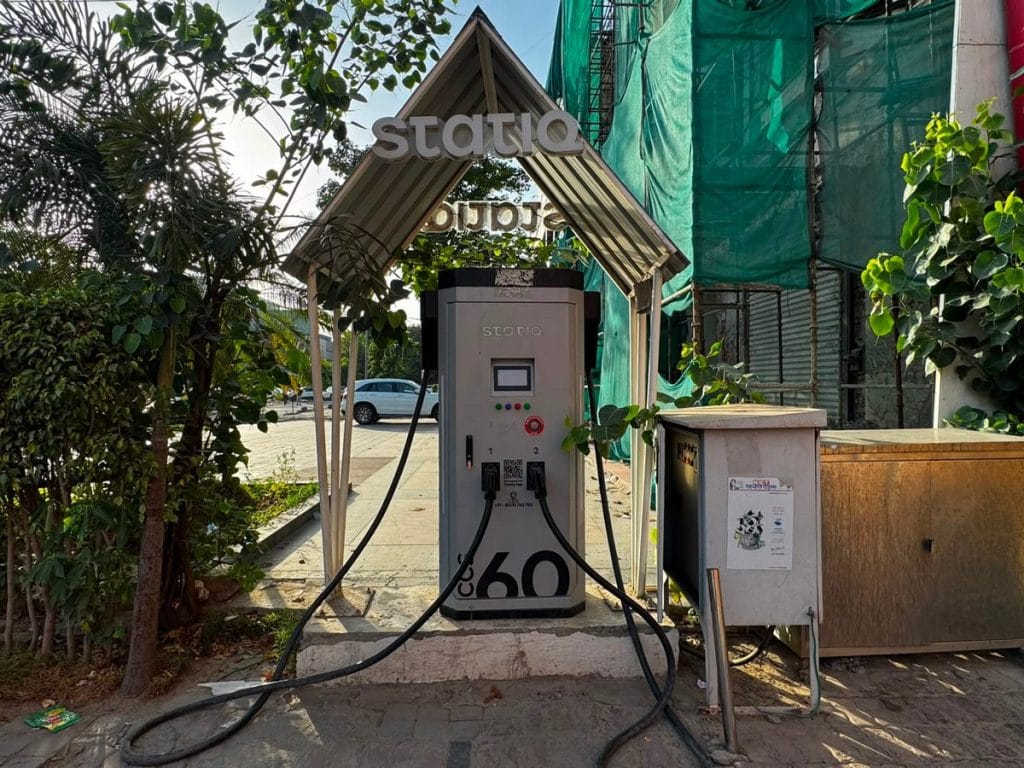
The costs of charging electric vehicles are adding up. Private basement chargers cost between Rs 5 and Rs 7 per unit. Surface chargers range from Rs 11 to Rs 15 per unit. Public charging stations push that cost even higher, to Rs 20-25 per unit.
“I invested in an EV to save on fuel costs and because I believe in sustainable development. But now, these charging prices have dug a hole in my pocket,” Shukla said, flipping through a stack of applications he has sent to authorities.
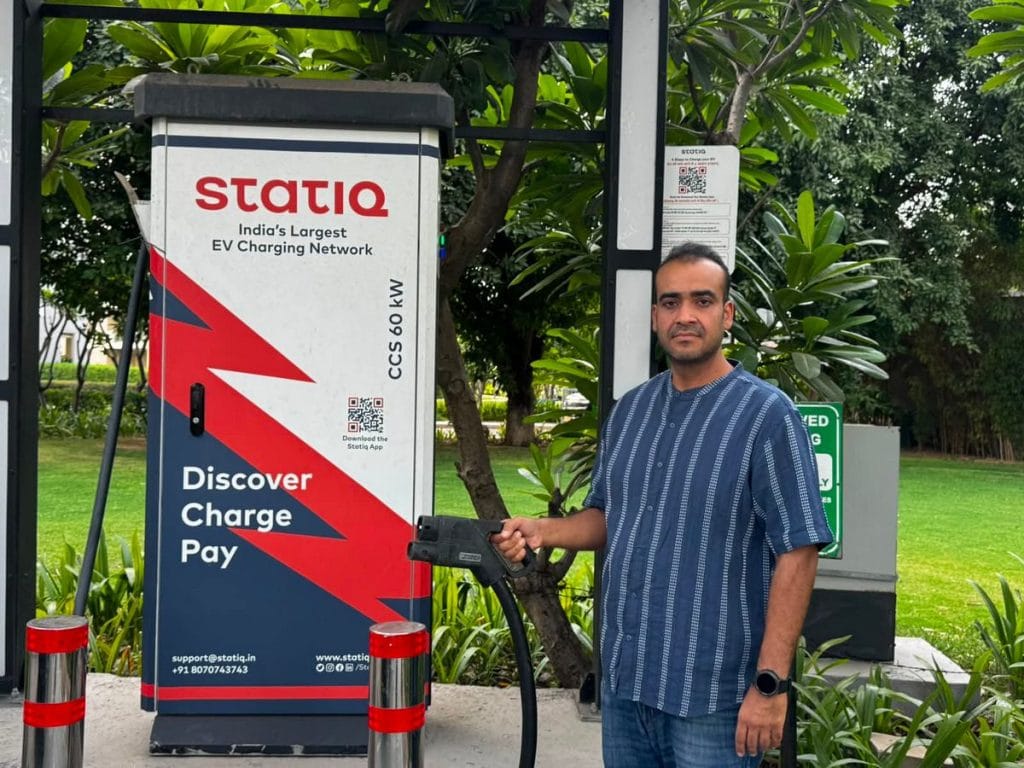
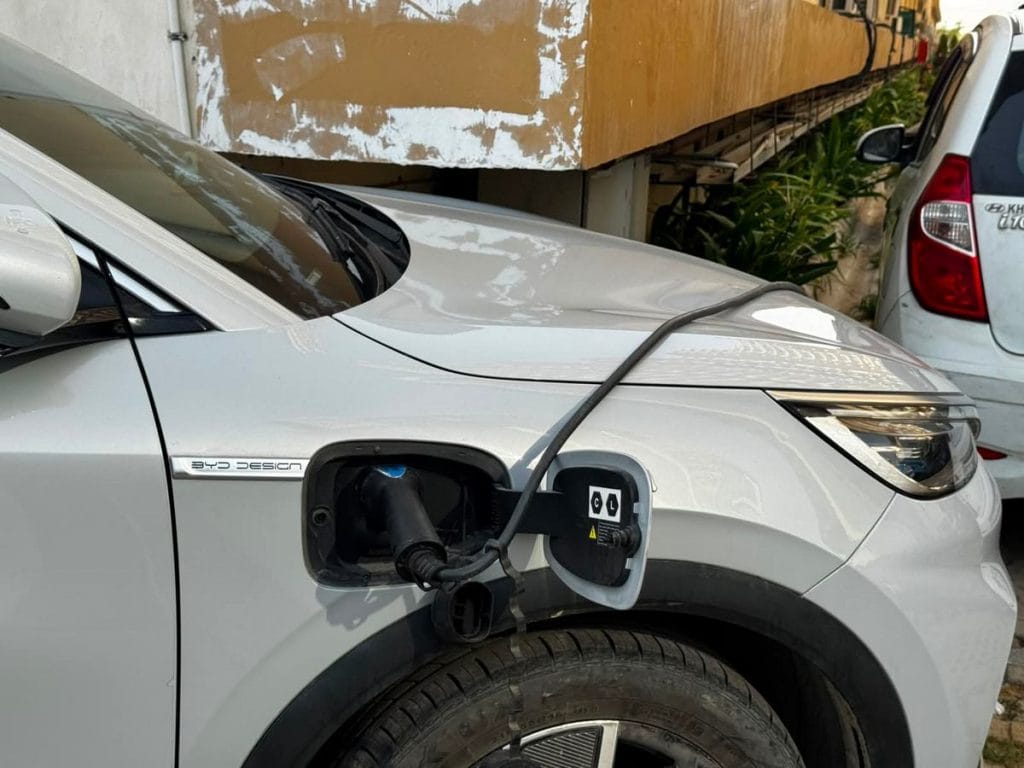
Earlier this year, between January and April, the builder disconnected power to the society’s surface charging station operated by Statiq, citing “internal policy”. When the costs became unsustainable, Shukla began going from one society to another, requesting guards and management to let him charge his vehicle.
“The public charging station is in Sector 85, and another in Sector 83. But you need charge in your vehicle to reach those stations,” he said.
Also Read: Residents in Noida, Gurugram are taking RWAs to courts. A case for every dispute
The road back to diesel
The struggle to charge EVs has blurred the lines between affordable and luxury housing societies.
Ashu Miglani, 41, lives in DLF The Ultima and drives a Kia EV6 that cost him over Rs 50 lakh. For three years, he charged it in the basement of the society he had paid crores to live in. Then the fire NOC was up for renewal, the chargers were gone, and his evenings were consigned to standing in a dreary queue.
“I bought this flat for over Rs 4 crore, thinking that I was buying luxury and now, I am literally taking rounds of the charging station every evening, looking for a spot,” said Miglani.
It takes him 6-7 hours to charge his vehicle. When he is working, his wife takes over and now, their conversation revolves around: “Is the charger free?”
When Miglani bought the Kia EV6, he said he believed he was doing his bit for India’s future — backing sustainable development and a pollution-free tomorrow. But with the daily hassle, he is thinking of alternatives.
“I am planning to sell off this car and switch back to diesel,” he sighed. “EVs might be the future but the present paints a very grim picture.”
(Edited by Asavari Singh)
I do not understand why they are not allowing to install personal chargers at surface/open parking as well