



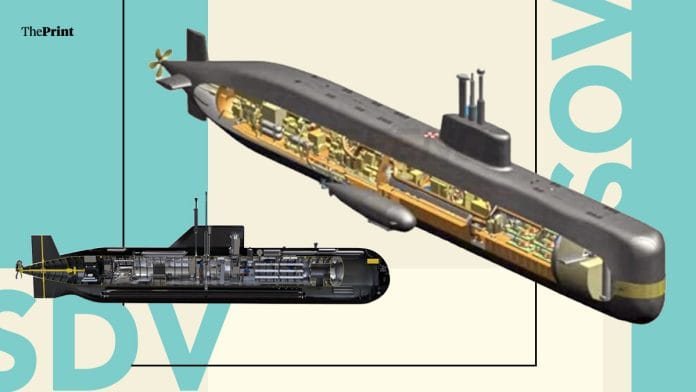
New Delhi: The Indian Navy is pushing to acquire at least two, if not more, Special Operations Vessels (SOVs) along with Swimmer Delivery Vehicles (SDVs), ThePrint has learnt.
The Navy has initiated discussions with at least two Indian shipyards and two foreign manufacturers for procurement of these vessels, often referred to as midget submarines, meant for covert missions by the Navy’s elite Marine Commandos (MARCOS).
Sources said conversations are underway with state-run Mazagon Dock Shipbuilders Limited (MDL) and Larsen & Toubro (L&T), both of which have their own midget submarine concepts.
The Navy is also in talks with a few European firms, which have such midget submarines among their offerings. Interestingly, established conventional submarine designers, like TKMS, Naval Group, Hanwha Ocean or Navantia, do not offer such smaller submarines meant for covert littoral operations as most large blue water navies do not operate such submarines.
Some countries that rely heavily on such midget submarines are Iran, North Korea and Pakistan.
The Indian Navy, given its unique doctrinal requirements for both blue water and littoral operations, has long wanted to acquire these submarines.
Italian companies like Fincantieri and Drass have been active in the small submarine segment, with Drass having supplied midget submarines to Pakistan and West Asia in the past. Sources said that the Indian Navy has also reached out to both firms.
The development comes nearly two decades after India first initiated plans to acquire midget submarines for special forces operations.
The original project was launched in 2006 and a tender issued in 2009. At the time, L&T, already deeply involved in the construction of India’s Arihant-class nuclear submarines, submitted a bid in partnership with Russia’s Rubin Design Bureau.
MDL and state-run Hindustan Shipyard Limited (HSL) had tied up with Italian shipyard Fincantieri and submitted their individual bids. The ABG Shipyard and Pipavav Shipyard also submitted their bids in collaboration with GSE Trieste, Italy, and Babcock, UK, respectively.
However, the programme was eventually scrapped, and in 2016-17, HSL was nominated for the project. The project failed to move forward because HSL could neither develop an indigenous design nor finalise a foreign design partner. South Korea’s Hyundai Heavy Industries had shown interest, but its offering was an all-electric vessel that did not meet operational requirements.
HSL later explored the possibility of offloading the project onto other Indian shipyards, but nothing materialised and the programme once again became dormant.
In late 2022, the Navy issued a fresh Request for Information (RFI) for SOVs. Responses came from MDL, L&T and HSL.
In May 2024, MDL, under the previous administration, unveiled a scaled model of its ‘Arowana’ midget submarine under its previous management. The model drew widespread criticism online for its appearance, though officials maintain the design itself remains under development.
Sources said the Navy is now looking for midget submarines with a displacement of around 500 tonnes, capable of carrying approximately 20 personnel on board.
As mentioned above, the Navy is examining some foreign options like Fincantieri’s S800A or Drass’ DGK class for their ingenious designs. Drass signed a framework agreement with Indonesia in February this year for supplying their DGK class subs along with their SDVs to the Indonesian Navy. Interestingly, Drass’ DGK class design is highly modular and is even transportable on road.
However, these Italian designs are still on paper and no physical submarine of these new designs has been built or supplied to any navy yet.
L&T has been showcasing their in-house design of a mini submarine for the past few years in many forums, including Defexpos. It is understood that L&T has now attained a high degree of maturity in their own design, conceptualised by drawing upon its experience in the Arihant programme. The company is pitching its own solution for Indian Navy’s SOV project as an indigenously designed, developed and manufactured platform under the coveted Buy India (IDDM) category of the DAP.
If the Indian Navy picks a foreign option, the acquisition is likely to be through a direct purchase with little or no indigenous content as localisation through ToT is generally deemed impractical in an acquisition programme of small numbers with limited budget.
Sources said that everything depends on what the government of the day decides upon—the indigenous way or the foreign route.
(Edited by Viny Mishra)
Also read: India commissions its third nuclear-powered ballistic missile submarine—INS Aridhaman