





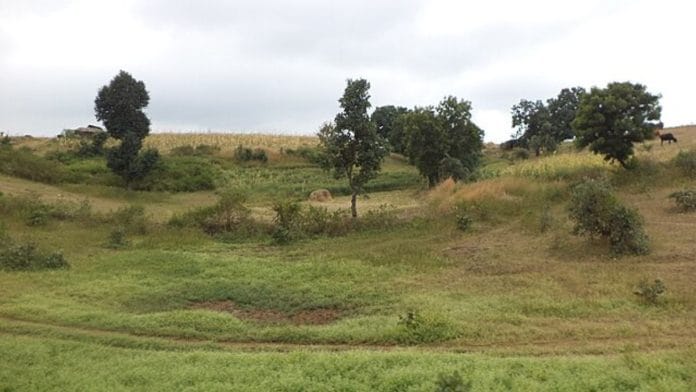


Gurugram: A plot of barren, hilly land on the edge of Gurugram, once considered worthless, now worth a fortune, has finally found an owner, seven decades after the dispute first reached a revenue court.
The Supreme Court has ruled that 436 bighas and 18 biswas (roughly 273 acres) of land in Haiderpur, a bechiraag (uninhabited, literally ‘without light’) village adjoining Wazirabad in Gurgaon tehsil, belongs to the Municipal Corporation Gurugram (MCG), as successor to the Gram Panchayat, Wazirabad.
The judgment, delivered by a bench of Justices Sanjay Kumar and K. Vinod Chandran on 3 August, sets aside a 2007 Punjab and Haryana High Court order that had handed the land back to private claimants describing themselves as biswadars (shareholders by customary right) of three old pattis, or family divisions, of the village.
At the heart of the ruling lies a single date: 26 January 1950, the day the Constitution came into force. The court has held that this is the cut-off by which any claimant must prove his land was partitioned and actually brought under individual cultivation, if he wants to keep it out of the purview of shamilat deh (village common land) laws.
Village with no lights, but plenty of litigation
Haiderpur has no inhabitants and never had a panchayat of its own, a fact its claimants used for decades to argue that its land could not have vested in any village body.
But the top court found documentary proof that Haiderpur was always clubbed with Wazirabad under a single ‘sabha area’ and gram panchayat, going back to a 1983 Haryana government notification and even earlier, to the Punjab Village Panchayat Act of 1939.
The land itself was mutated in favour of the Gram Panchayat of Wazirabad on 13 September 1955, following a Punjab government letter after the state’s shamilat law came into force. That should have settled matters. It did not.
In 1985, four residents of Wazirabad moved a suit before the Assistant Collector, Gurgaon, claiming to represent 524 shareholders under three pattis—Chitru, Ramrattan and Medha; Sadasukh; and Ahmed Ali Khan.
The plaintiffs—Ganpat, son of Umrao; Mehar Chand, son of Jug Ram; Ram Phal (shown as Ram Pat in later orders), an adopted son of Gorthan; and Chattar, son of Sukh Ram—said the land was never shamilat deh at all, but private property under cultivation by their forefathers.
What followed was a legal relay race spanning the Assistant Collector, the Collector, the Commissioner and finally the high court, with orders being passed, reversed, and reversed again, right up to 2007, when the high court sided with the private claimants and companies who had by then purchased large chunks of the land, including Ashvarya Estate Pvt Ltd, Millet Pvt Ltd and others.
The Supreme Court stayed that high court verdict in January 2008. It has now struck it down entirely.
Why 1950 matters more than 1906
The claimants leaned heavily on a 1906-07 jamabandi (periodic revenue record of rights) that recorded the land as ‘shamilat deh hasab rasad biswat’—meaning common land, but with shares assigned patti-wise—and argued this proved private ownership.
The Supreme Court was not persuaded. It noted that even this record continued to show the cultivation column as ‘makbuja malkan‘, a term revenue law consistently interprets as joint possession of the entire proprietary body, not separate holding by individuals.
No ‘khewat’ (individual landholding account) numbers were ever carved out for each ‘patti’ and its ‘lambardar’ (village headman), which the law treats as essential proof of an actual, completed partition.
Under Section 2(g) of the Punjab Village Common Lands (Regulation) Act 1961, replicated in Haryana after the state’s formation in 1966, any land recorded in revenue papers as ‘shamilat deh’ automatically vests in the panchayat. The only way out for a claimant is to show, under the law’s specific exceptions, that the land was “partitioned and brought under cultivation by individual landholders before the 26th day of January, 1950”.
The court found no such proof was ever produced, not before the revenue authorities, not before the high court, and not before the Supreme Court itself.
The ‘Sharat-wajib-ul-arz’ (village administration paper recording customs and rules of land use) of 1939-40 for Haiderpur, the court noted, showed the disputed 436 bighas as ‘gair mumkin pahar, nala’ and ‘johad’ (uncultivable hill, stream and pond land) in the joint possession of makbuja malkan, the clearest indicator, the bench said, that no individual had staked and settled his share before Partition.
“Shamilat deh is non-exclusive property till partitioned,” the judgment observes, and no proprietor can claim a permanent right over a specific portion of it until that partition actually happens.
The 272 sale deeds signed under a stay order
The judgment also flags an uncomfortable fact buried in the case papers. Even after the Commissioner, Gurgaon stayed all proceedings on 2 April 1998, at least 272 sale deeds were registered between 23 March and 6 April 1998, and mutations carried out in favour of six private companies during the very period the stay order was in force. Ashvarya Estate Pvt Ltd told the court it had purchased some of this land in “ignorance” of the stay.
The bench chose not to go further into this, but the pattern—hundreds of registrations completed in a matter of days, right around a litigation, triggering a stay order—is now on record before the country’s highest court. The fact points towards the collusion between private parties and the registering authorities, who, being government officers, must have knowledge of the stay orders.
From Gram Panchayat to Gurugram’s civic body
As Gurugram expanded and grew into a municipal corporation, the case grew with it. In 2010, and in one instance in 2009, the cause titles in the appeals were formally amended to substitute the Municipal Corporation, Gurgaon in place of the Gram Panchayat, Wazirabad, MCG having stepped into the shoes of village bodies under Section 161 of the Haryana Municipal Corporation Act, 1994, which vests ‘shamilat deh’ land within municipal limits in the corporation.
The Supreme Court has now confirmed that the land, once a panchayat asset, stands transferred in law to MCG, bringing a curtain down on litigation that began before most of Gurugram’s glass towers were even conceived.
(Edited by Viny Mishra)
Also read: Gurugram’s ‘OC scam’—how an official certificate leaves buyers stuck in unfinished homes