



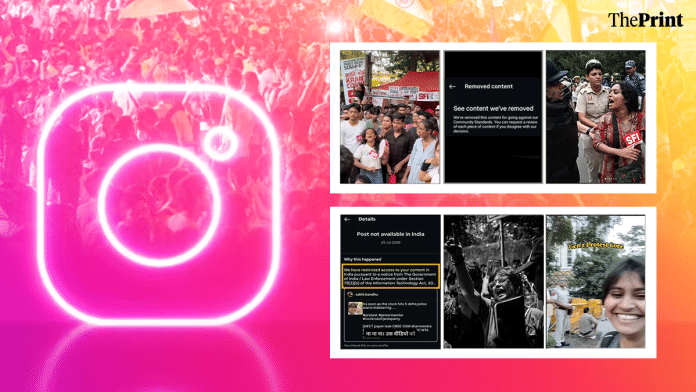

New Delhi: The reel showed student protesters, their clothes torn after Delhi Police “beat” them up. Recorded during the ‘Sansad Chalo’ protest march called by Cockroach Janta Party (CJP) on 20 July, the reel garnered views in millions. But it was taken down this week by Meta-owned Instagram. The reason cited for the removal: violation of “community standard on adult sexual exploitations”.
As the battleground between Gen Z protesters and the government shifts from Jantar Mantar to social media, several students have alleged that Meta has pulled down their reels, filmed in the backdrop of the CJP protest.
Many of these reels were recorded during or in the aftermath of police action against protesters who marched on Parliament to demand the resignation of then Union Education Minister Dharmendra Pradhan over his ministry’s handling of the NEET-UG 2026 paper leak.
Among those now questioning the grounds for the removal of their content by Meta is Sakhi, a Jamia Millia Islamia student affiliated with the Students’ Federation of India (SFI), student wing of the Communist Party of India (Marxist). Social media platforms like Instagram and X (formerly known as Twitter) were afloat with Sakhi’s reels that popularised the Gen Z phrase “vastegune huia” to many, including parliamentarians.
“The reels made during the protest were satirical ways of questioning power,” Sakhi told The Print, emphasising that these reels garnered views in millions.
However, two days ago while scrolling through their Instagram account, Sakhi realised that four of their well-performing reels had been removed.
“The reel where I am sharing how my clothes were torn and how me and my comrades got injured when Delhi Police beat us up on 20 July, was taken down. Instagram showed that it was going against the community standards on ‘adult sexual exploitations’,” said Sakhi.
Instagram’s message for the said reel uploaded by Sakhi on 20 July read: “We can’t show you this post because it may contain sexual content without others’ consent, which could be distressing or unsafe.”
This was not the only post Instagram took down. Four other reels Sakhi uploaded between 20 and 25 July were removed too. For all the four reels Instagram flagged that the post is not available in India. This included Sakhi’s viral reel where they used satire to highlight efforts by Delhi Police personnel to dissuade protesters from gathering at Jantar Mantar.
In the second reel, Sakhi and their comrades had filmed a video where they were singing “mere saamne wale khirki mein ek graduate ladka rehta hai, woh maara maara firta hai”, a parody of a Hindi film song meant to highlight unemployment levels in India.
In the third reel Sakhi had filmed Delhi Police officers unloading food from a truck right after lathi-charge and use of tear gas against protesters on 20 July.
The fourth reel was the one where Sakhi was speaking to Muhammed Junaid, a volunteer distributing food at Jantar Mantar. “In that reel Junaid bhai was talking about how the UP Police hounded his family to stop him from participating in the protests,” said Sakhi.
For each of the four reels removed, Instagram informed the account holder: “We have restricted access to your content in India pursuant to a notice from The Government of India/Law Enforcement under section 79 (3)(b) of the Information Technology Act, 2000.”
Section 79 (3)(b) of the IT act corresponds to removal of legal immunity (‘safe harbour’ protection) for digital media intermediaries if they fail to remove unlawful content after receiving official notice from authorities. This provision applies to social media platforms, search engines, and internet service providers.
Speaking to The Print, a senior Delhi Police official of the Intelligence Fusion and Strategic Operations (IFSO) department said that posts that are found to be “objectionable” are flagged by the department and Delhi’s other police districts on a regular basis.
“This is part of the everyday work of our department, nothing was done specifically for the CJP-related posts,” the official said, denying allegations that posts showing police action during the ‘Sansad Chalo’ protest march were being removed under the scope of the IT Act.
The Print reached the Meta spokesperson for a response via text but had not received a response by the time of publication. This report will be updated if and when a response is received.
Sakhi, however, pointed out that while her reel was removed, the same reel used by a content creator for a reaction video where he allegedly used derogatory terms against the queer community, continues to be on Instagram. “If my video was violating anything, then how come the same video that is part of a longer video including abuses hurled at the queer community continue to be available in India,” asked Sakhi.
Speaking on the matter, Mishi Choudhary, founder of Software Freedom Law Center (SFLC), said they have received several complaints in recent days through their digital rights helpline Rights Line from social media users whose posts relating to the CJP protests have been removed or restricted. SFLC is a non-profit that provides pro bono legal representation in cases centred on technology and policy, among other areas.
“In several cases, users have received no meaningful explanation beyond a generic reference to platform guidelines. That makes it difficult to know whether Meta is applying its own content policies, responding to government or police notices, or simply allowing automated moderation systems to suppress politically sensitive material,” said Choudhary.
Meanwhile, several political leaders have also alleged that their posts have been taken down by Meta—AAP chief Arvind Kejriwal, CJP spokesperson Saurav Das, Indian Youth Congress, to name a few.
‘Secrecy around content moderation’
Similar to Sakhi’s experiences, Gopika, vice president of JNU Students’ Union (JNUSU), also had similar experiences.
“Following my posts on the CJP protests, I received a rape threat over my direct messages on Instagram. Enraged, I took a screenshot of the message and wrote a note on how women continue to face systemic violence for voicing their opinions and then uploaded a carousel post with both the screenshot of the message and my personal note,” Gopika told ThePrint.
The post was removed on the grounds that it was violative of community guidelines for having ‘sexual and nudity content’, said Gopika, who is also a member of the SFI Delhi State Committee.
In another instance, The Print learnt, the Student Federation of India’s Instagram post where several students were interacting with Mohammed Junaid was also removed.
“Instagram flagged the video and notified that this post was unavailable in India,” said Sooraj, state president of SFI’s Delhi unit. “In the video, Mohammed Junaid was visiting our office and speaking to our comrades about how the UP Police had illegally detained his parents and sister and were hounding them to ask him to come back,” Sooraj added.
He told The Print that they had attempted to upload that video five times and it got uploaded only on their sixth attempt. “A couple of days back when I was going through the account, I realised that Junaid’s video had been taken down,” he said.
Instagram’s message on the video read: “We restricted access to this content through an automated system implemented pursuant to legal requirements under India’s Information Technology (Intermediary guidelines and Digital Media Ethics Code) Rules.”
“This video was taken down by Meta the first two times it was posted. Let’s see what happens now. You know who gave the “maafi” to the youngsters and has now directed his friends in the Meta to take down videos of the people who speak against them?” read the caption of the video uploaded by SFI.
Mishi Choudhary said that any form of expression concerning a protest, police conduct and the actions of the government is core political speech and while a platform may remove material that genuinely incites violence or violates a clearly specified rule, it must inform the user what was removed, which rule was applied, whether a government request was involved, and how the decision can be challenged. “This secrecy around content moderation is an issue which SFLC.IN has challenged in the Supreme Court as well,” she added.
She also said that there was an “obvious conflict where Delhi Police, the agency accused of using excessive force, is able to identify and seek removal of the material documented”.
(Edited by Amrtansh Arora)
Also Read: Delhi, Mumbai, Kolkata—women are facing ugly pushback after CJP protests
Another sensationalist spin. Instead of addressing agitators clashing with police and attempting to breach Parliament security, the author just copy-pastes PR quotes from SFI activists pretending to be innocent victims. You don’t get to manufacture chaos for cheap social media clout and then cry fascism when inflammatory content gets taken down.