






New Delhi: There is a photograph that, for a few days in late July, seemed to be everywhere. A young woman in a rain-soaked hoodie, standing alone in front of a moving police bus, refusing to move. Inside the bus were detained students. Outside, the world was about to decide what her body, her clothes and her tone of voice said about the women who had joined the movement she had just become the face of.
Her name is Rhiya Ahir — also known as Rhiya Yadav — a 27-year-old model and actor in Mumbai. In the days after her photograph went viral, she became one of the most recognisable faces of the student-led protests, mobilised by the Cockroach Janta Party, that swept Indian cities following the NEET paper-leak controversy, and of the July 20 police crackdown at Jantar Mantar that has been described as brutal.
She is only one of many women — students, lawyers, homemakers, professionals — who walked into those crowds. Teenage girls had run away from their homes to protest against the paper leaks at Jantar Mantar and they were sleeping on the roads. Their stories trace the same arc: courage in the moment, and something far uglier in its aftermath.
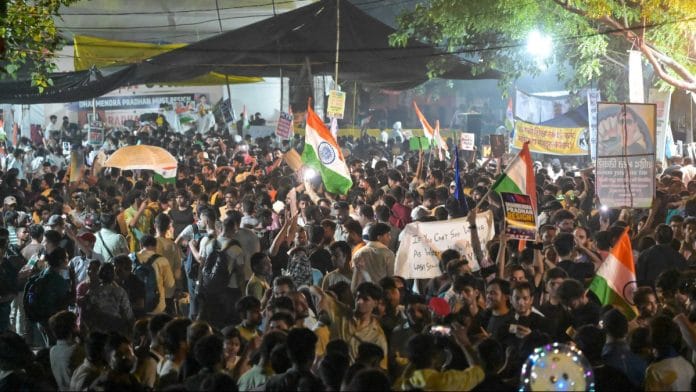
Three days after the protests were called off, these women became targets. Accounts across social media began circulating cropped and, in some cases, AI-manipulated images of young women who had attended the CJP protests, several captioned with calls to identify and report them — one post urged followers to help police “teach her a lesson.”
A moment of bravery
Rhiya Ahir was not supposed to be near the bus at all. She had gone to Shivaji Park on 22 July to join the protest. At first, she was watching the crackdown on students from a distance. Before joining the protest, she had sent emails to the Supreme Court, the High Court, the United Nations office, anything she could think of to do from afar. The day before she reached Shivaji Park, she said, she had confronted police officers guarding a parked van holding detained students. Some of them were minors, and Ahir had stood her ground until people inside were released.
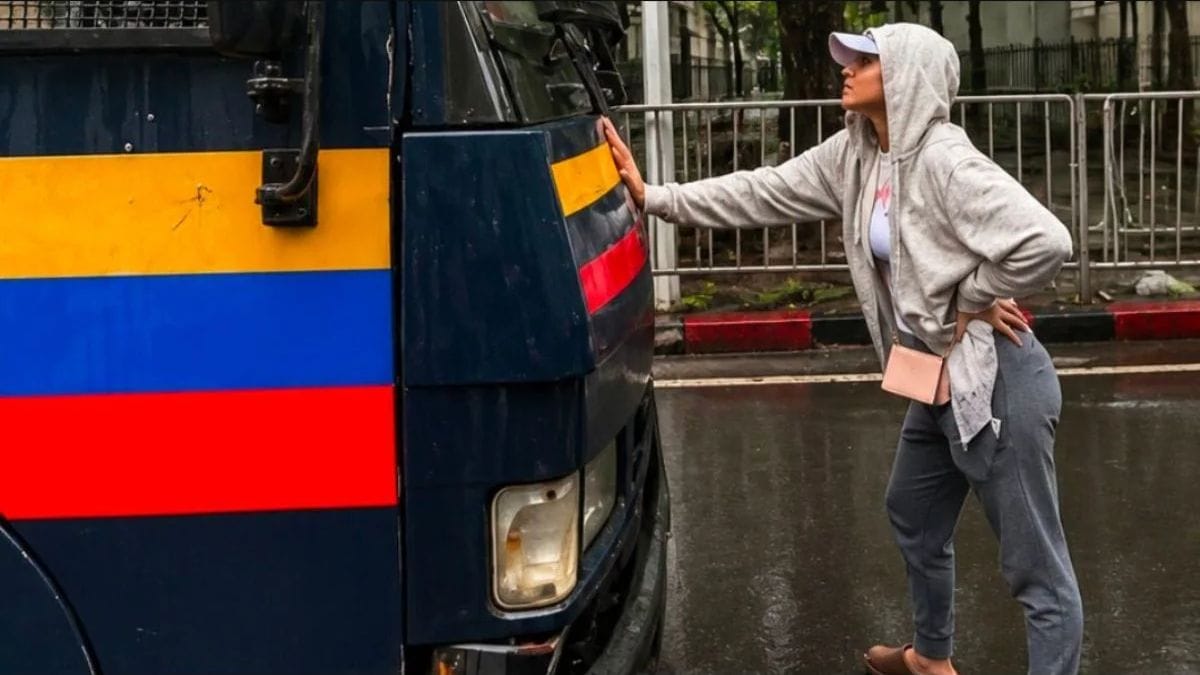
On 22 July, she walked into a crowd of people chanting “Inquilab Zindabad” and “Bharat Mata ki Jai”. A police bus packed with detained students stood right there. Ahir asked two officers whether they had a formal order to hold the students. Neither, she said, would meet her eyes.
“I had to make a split-second decision,” she said. “Am I supposed to just ignore this…The bus started moving, so I was like, I have to do something about it; otherwise the bus will pass by, and I will fail myself as a citizen, and I will live with the regret for the rest of my life that I let it happen.”
She stepped in front of the bus.
“It doesn’t matter what happens next,” she said in the moment. “If they run me over, that’s fine by me. That means that was my purpose in life.”
Character assassinations
What followed the image’s viral spread, Ahir said, was not simply criticism — it was, in her account, a coordinated campaign. She said fabricated and morphed images of her were circulated online, along with false claims that she sold explicit content. Her mother was also attacked in the comments.
Ahir has filed a police complaint alleging harassment and defamation. She said she is pursuing the matter with the Maharashtra Cyber Police as well. Mumbai’s Deputy Commissioner of Police, Datta Nalawade, has confirmed her complaint was received and forwarded to the MIDC police station in Andheri East for verification.
She alleged that a ruling-party functionary from Hyderabad made a Facebook post unfavourably comparing her to an Olympic silver medallist. It used derogatory terms for her and also included her Instagram profile details. Ahir is considering taking legal action as well.
“I do not understand how these women are speaking such things about other women,” she said, “you can talk about other women like this — you’re putting them down just because you have a party card in hand.”
She was unsparing about what she sees as the broader pattern: attention that once celebrated the protest’s images had, within days, curdled into scrutiny of the women themselves — their profession, their clothing, their past.
“You’re telling me I am not fit to stand in a protest because I wear a bikini at a beach,” she said. “It’s horrible.”
She pointed to public remarks by other prominent women — including one by actor-turned-politician Kangana Ranaut’s comments. On Instagram stories and videos, Ranaut shamed Gen Z women as “gutter chaap” and questioned their ability to become homemakers. It was clear that the backlash against women protesters was not confined to anonymous trolls.
“It’s so sad to see these are our representatives,” she said.
Why did women become the focal point of attacks once the protests themselves wound down? Ahir has a blunt answer.
“When they don’t have anything to say, when they can’t fight your argument, they will attack your character…this is what they’re trying to deflect us from.”
Patriarchy is a perfect tool
More than a thousand kilometres away, in Kolkata, a final-year law student named Sutithi watched a parallel version of the same story unfold. After Sonam Wangchuk was ‘forcibely’ removed from the Jantar Mantar protest site, more people wanted to show up. This was followed by a smaller, “rather disorganised” demonstration by Jadavpur University students after the 20 July Jantar Mantar crackdown, and finally a mass rally on 24 July that ran from Sealdah to Dharmatala.
Sutithi, who helped run a student initiative interviewing fellow demonstrators, said women turned out in large numbers and across generations. There were women “well above the age of 60” who walked the length of the rally route. Kolkata’s tradition of women’s political participation is long-standing, but Sutithi noted that this generation brought something additional: young women from law, sociology and political science backgrounds, shaping the protest’s arguments as much as its numbers.
Her explanation for the pivot toward women in the protest’s aftermath echoes Ahir’s.
“Patriarchy becomes a rather perfect tool when it comes to attacking women,” she said, “because if you cannot attack the cause, you attack the character. You harass and assassinate their character. You question what they wear, you question the kind of language they use.”
When a movement’s underlying grievance is difficult to argue against, she said, “you then go into the nitty-gritty… because that becomes your greatest defence to hide behind the lack of accountability.”
Women are loud and clear
Karishma Kodaji, who attended protests in Mumbai on three separate days beginning 18 July, went alone. She said she never felt her safety was in question because of her gender. It was police brutality that was the real danger, not being a woman in a packed crowd.
The way women were doxxed and attacked online for their participation in peaceful protests didn’t shock Kodaji.
“That’s just life in India,” she said.
What surprised her instead was the response from many of the women protesters themselves: they responded with humour, and refused to be rattled.
“It’s really not affecting the women as much,” she said, “because they’re speaking about it in the lightest of ways…but they still want to convey the message, and they want it loud and clear.”
Kodaji offered one detail that cut against the grain of the wider narrative of confrontation: several women police officers, she said, quietly thanked her and her friends for protesting because they couldn’t do it.
Being watched
Women at the protests across the country were already thinking about who is watching them and why.
Reporting from Jantar Mantar by Feminism in India mentioned a JNU student, Amisha, who spent her first hours at the 20 July protest trying to avoid phone cameras. She was worried her politically conservative family might spot her online. An IIT Delhi graduate also said the constant presence of cameras made it harder to stay focused on the protest itself. In the same report, one IIT Madras student worried the footage could someday be used against her. She could see that some police officers were wearing camera-equipped smart glasses with facial-recognition capability.
Former Jawaharlal Nehru University Students’ Union president Aishe Ghosh has petitioned the Delhi High Court alleging that police erected a permanent surveillance tower at the Jantar Mantar protest site and filmed demonstrators continuously. The petition claimed that footage was being taken of women in wet clothing during rain. It violated their bodily privacy. The plea also claims police threatened to send protesters’ photographs to their parents and colleges to discourage participation.
Outlook India reported on 23 July that Delhi Police deployed AI-enabled surveillance vehicles, including a facial-recognition-capable van. The officials claimed that it was intended to identify individuals already flagged in criminal databases. The Solicitor General Tushar Mehta told the High Court that the filming was for maintaining law and order, not surveillance.
For the women, the legality of the whole thing didn’t matter. Their immediate concern was where the footage might end up, and who might eventually see it.
Also read: The pressure cooker life of a 16-year-old Indian student
The doxxers and their toolkit
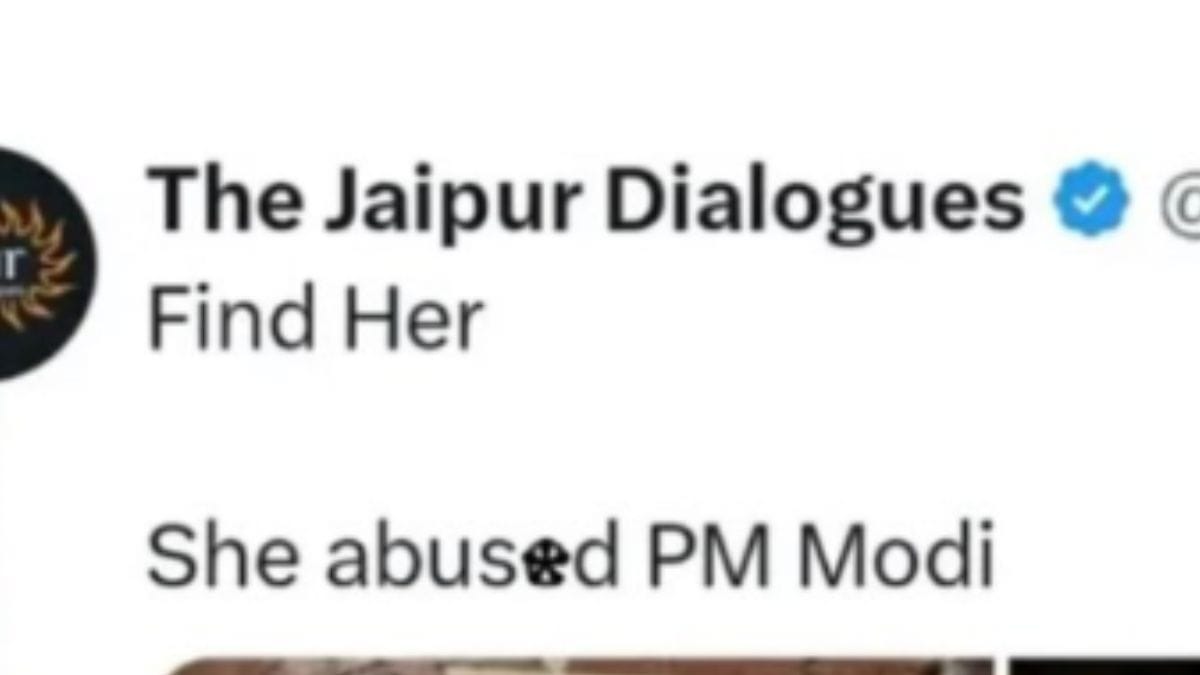
A prominent Right-leaning account, The Jaipur Dialogues, with roughly 7,000 followers, criticised women protesters for using foul language against PM Modi. The framing of all anti-women posts is done in a way to portray these women as not respecting Indian sanskaari values. Another large account, with several hundred thousand followers, @Being_Humor singled out women demonstrators as uniquely responsible for the crudest language used during the protests. From Delhi to Mumbai, people of all genders and age groups had shouted the same slogans.
Alt News co-founder Mohammed Zubair told ThePrint that this was a familiar story. The same tactics, he said, were applied after the Shaheen Bagh and the farmers’ protests. Morphed images, misleading videos and personal attacks aimed at discrediting demonstrators. The character of women was questioned.
Delhi Police has separately issued notices to take down social media posts abusing senior political leaders. The targeting of women protesters continues largely unchecked.
(Edited by Ratan Priya)
Being a woman is no excuse for the filthy language that got used. Pushback is against the language, whether used by women or men, not women per se.
Basic understanding is lacking from the author. Or should we say, doesn’t fit with the propaganda?
They should have thought twice before uttering such vile and filthy abuses – that too in full public view and in front of cameras.
The only possible response to a ‘gaali’ is a ‘gaali’. Why? Because it’s kind of impossible to take legal action against anyone for using cuss words – as it is, it’s not a criminal offence.
What is entitlement?
It’s the expectation that you have the freedom to abuse others but others can’t give it back to you.
If you are so brave and bold to dish it out, you must be strong enough to take it. Take a look at Kangana Ranaut. She speaks her mind – though never uses such filthy language. But she knows that people will come for her and they do. She takes it like a champ.
Moral of the story – if you can’t take it, please don’t give it.
I have forwarded this article to both ‘The Jaipur Dialogues’ as well as ‘BeingHumor’ and asked them to look at the feasibility of a defamation law suit against both thePrint as well as Saman Husain.
I hope they pursue the case legally and make ThePrint cough up a hefty amount for defaming and vilifying them and their social media handles.
A propaganda piece by ThePrint.
A totally one-sided account of things which paints filthy mouthed scumbags as NEET aspirants – nothing could be more untrue.
If you abuse, you should be ready for the consequences.
In a crowd of people, it’s really easy to be brave. In a mob, everyone’s bold. Now that the chickens have come home to roost, these gutter-mouthed idiots are playing the victim card. Even better, the gender card.
Silly trite blog exaggerating influencers, youtubers and non-entities. The subtext is law should work differently for some people just because the blogger thought so.
I genuinely wish that ‘The Jaipur Dialogues’ and ‘Being_Humor’ file for defamation against ThePrint and Mr/Ms. Saman Husain. That would deter such propaganda peddling journalists and news media from ‘doxxing’ right wing social media handles.
As for targeting, nobody is going after any specific gender. People are pointing out anyone and everyone who indulged in such crude, foul and abusive language during the ‘protests’.
Mr/Ms Saman Husain lies blatantly when she claims “From Delhi to Mumbai, people of all genders and age groups had shouted the same slogans. ”
Hardly any student or NEET aspirant used such language against any leader or minister or bureaucrat. The ones who used such language during the protests were the ones who had nothing to do with NEET – like Ruchika Singh of Noida who is learning nail art at a salon there. In each of these foul mouthed filth uttering case – the person in question has been found to be neither a student nor a NEET aspirant.
one sided story telling seems to be the journalists requirement at the print except sneshesh alex p , he is the best