



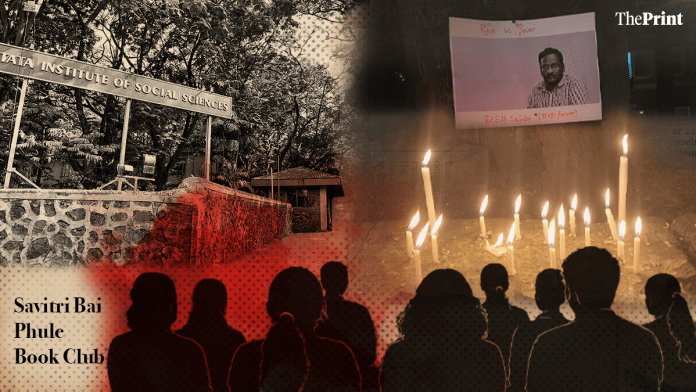
New Delhi: When a former student of Mumbai’s Tata Institute of Social Sciences first heard about a remembrance meet for Professor G.N. Saibaba in October 2025, little did she know that mere participation would cost her her dream—research and academic practice of her field of specialisation.
She was among the nine students against whom the TISS administration had filed a complaint after the 12 October event to commemorate the life and works of the academic-activist, who was accused of having Maoist links, convicted under UAPA, and later acquitted. It was alleged that the students had raised objectionable slogans.
“I had joined the institute with the singular vision of learning more about the field I was studying, and hopefully finding a job linked to that, but after the whole debacle of the FIR, all hopes and dreams about securing a job in the field fell apart,” she says.
“I had to accept a job in a different sector far away from my research interest and specialisation, only because I would not get a clearance certificate from the police owing to the FIR against me.” It’s common practice for firms and organisations to run a background check, including police verification, on candidates for jobs.
The FIR registered by Mumbai Police’s Crime Branch, days after the event last year, named Nikita Monica D’Souza, Utkarsh Khuntia, Yash Kaundilya, Avantika, Ishpreet Kaur, Hardika Bhagat, Satyam Yadav, Abhirup Paul and Kamakhya Prasad Das. While seven of the former and current students were granted anticipatory bail earlier this month after multiple rounds of interrogation and hearings, Paul and Das were denied.
It has been alleged that slogans were raised at the event in support of jailed student leaders Sharjeel Imam and Umar Khalid. The Mumbai Sessions Court noted that instead of the customary phrase ‘Rest in Peace’, the students used ‘Rest in Power (1967–Forever)’, and this alone is not a criminal offence. But, it said, when combined with recovery of objectionable material from Paul and Das’s devices—including downloaded Maoist books, deleted files and WhatsApp chats suggesting ‘field work’—it raised doubts about their conduct and suggested ideological influence towards banned organisations.
Days later, on 7 August, Paul was arrested, and has since been in judicial custody. Das was given interim relief by Bombay High Court, with his next hearing scheduled for 31 August.
Saibaba, a former professor of Literature at Delhi University was arrested on 9 May, 2014 under Unlawful Activities (Prevention) Act for his alleged links to Communist Party of India (Maoist), and was accused of engaging in activities and conspiracies to wage a war against the State. He was acquitted by the Nagpur Bench of Bombay High Court on 5 March, 2024 after being served a life sentence and spending 10 years in jail.
Also Read: Blown out of proportion’: After FIR, TISS students deny sloganeering at GN Saibaba tribute event
Life since the FIR
Of the nine named in the FIR, many were just months away from submitting their final Master’s theses and appearing for job placements.
“First the police informed us that they were seizing our devices for three days, then they continued to keep them. I lost all my dissertation notes and research materials,” says one of those booked, adding that since her email account required a two-step verification process, she would not even receive an OTP if she wanted to access her email ID from a different device.
Another one tells ThePrint, “We were supposed to be present for interrogations and hearings multiple times in the month, when the placement process was just about to begin. So all of us missed job opportunities crucial for us and our families.”
For many, the search and seizure process even impacted how they wrote their theses, the authors they cited in their references, and the nuances they had intended on exploring. “The way the police were hounding us with our readings, the books we had downloaded on our phones and laptops, we were afraid of quoting or referencing even Marxist thinkers in our papers and dissertations… despite the fact that our college syllabus and libraries have books on the same,” recounts one of the accused who have secured pre-arrest bail.
Another former student recalls that due to fear, she removed parts from her dissertation. “Circumstances were such that it was difficult to write the final dissertation with nuances.”
Meanwhile, the ones, who did manage to get through the initial rounds of job interviews, struggled to make it through the verification rounds by Human Resources. “At one job, where I was almost finalised, I was told by HR that there was a criminal case against me which was flagged by their system,” says one of those named in the FIR.
Another ex-student says that he has had to jump from one internship to the next to ensure a steady stream of work and meagre pay, just enough to support himself.
Some of the students were so deeply impacted by the criminal proceedings that they decided to take a gap year, while those who had just joined the institution struggled to get a grasp of the rigour and academic demands of the courses.
We were afraid of quoting or referencing even Marxist thinkers in our papers and dissertations… despite the fact that our college syllabus and libraries have books on the same
A book club & two poems
Back in 2024, when a 30-year-old woman first arrived at the TISS campus in Mumbai for her Master’s degree, she was hopeful of finding a space that allows debate, dissent and critical thinking. However, in the absence of student elections and an alleged monitoring of all cultural activities of students, many, like her, turned towards a book club. “We were told that there would be no elections for the student bodies that year, and a strict curb on dissent over the same or any other issue,” she tells ThePrint.
That’s how a WhatsApp group, named “Savitri Bai Phule book club”, came into being. Participants would meet to discuss research papers, books and news articles once a week.
“Most of us wanted a third space where we could have discussions. So every week, we would select a text, research paper or news article, share it in the group and meet during the week,” the woman recalls.
Days before the 12 October event, the book club members had shared two poems by the late professor Saibaba—“Mother, weep not for me”, and “My love, my freedom”. “These two poems were shared and students decided to light candles in his remembrance.”
On 12 October, around 6:30-7 pm, some students gathered outside a tea stall adjacent to the campus. “We did not have any permission, but this was not a large-scale event or a march, and there were very few students who were coming together,” recounts another former student who was present at the event. She notes that in 2024, another students’ forum had organised a much larger gathering after Saibaba’s death. “At least 60 students had gathered in the same place, the area in front of Hostel no. 4, to talk about the same issue—wrongful incarceration and disability rights.”
For the commemoration event, after taking print-outs of Saibaba’s photographs, students entered the college’s old campus from the gate and walked up to the area near Hostel 4, where they read the two poems by Saibaba, lit candles and then left. “We did not remove the photographs, since we thought more people might want to light candles as per their convenience,” says the former student.
A few hours later, after most of them scattered, a Development Studies student called Rajshekhar Singh, along with several others, came to the venue, tore up the pictures and began shouting, says a student later named in the FIR.
“They called all the organising students Naxals and even hurled queerphobic statements towards one of the queer students present in the event. When we were reading the poems, several TISS security guards were already present who took photographs of us. Then, as soon as Rajshekhar and the others began shouting, several police officers reached the campus.”
However, Rajshekhar, now a former student himself, tells ThePrint that he was only passing through the old campus area when he noticed a gathering. “All I saw was some people arguing with the guards. Neither did I shout any slogans, nor did I hurl any abusive statements,” he says. “It is different that I did not agree with what they were doing, but I had no role to play. The activities they were doing were only to malign the name of the university, that too before placement season.”
Also Read: ‘Only looked at closed walls for yrs, couldn’t see my dying mother’: GN Saibaba on decade in prison
What came after 12 October
The police and university authorities began interrogating the students present at the event soon after, following which the Mumbai Police detained two students—Abhirup Paul and Utkarsh Khuntia on 14 October.
“I was asked how I knew Kamakhya and Abhirup? Was I close friends with them?” recalls one of those named in the FIR, who was also asked about the source of funding for the event and that of the legal fees. “They asked me if I was being paid to participate in the event and who gave us money for organising the event. I informed them that we bought the candles and print-outs with our own money.”
Another person tells ThePrint that the police kept asking about the “Maoist and Marxist literature” she had been reading. “The police picked up a copy of Arundhati Roy’s book The Shape of the Beast and Michele Foccault’s Madness and Civilisation, and asked why I was reading those books.”
The professor present told the police that students of the discipline were expected to read several types of literary works.
“They did the same while doing the panchnama for Abhirup. He had a copy of War and Peace and another book on Godhra riots,” says a third former TISS student. He alleges that the police kept questioning him about the books until they were shown the reading list of the department. “The book related to the Godhra incident was a recommendation by the department as a study of how Disaster Management aspirants should react to such incidents.”
“They asked me if I was being paid to participate in the event and who gave us money for organising the event
According to another one named in the FIR, they were also asked if they knew Saibaba and had personal connections with him.
The FIR lodged by the police stated, “On 12.10.2025 between 7.30 pm and 8.30 pm, around 10 to 12 students including the accused persons have without prior permission of the administration, paid homage to Gokarakonda Naga Saibaba (G. N. Saibaba), who was an active member of the International Human Rights Organisation and supporter of Naxalite and Moist Organisations, in the premises i.e. in front of Hostel No.4. They have allegedly raised slogans “Umar Khalid ko riha Karo” and “Sharjeel Imam ko riha Karo”.
Sloganeering claims
According to one of the accused students, while the police had photographs of them carrying Saibaba’s photographs and entering college premises, there was no evidence of them sloganeering about Khalid or Imam. “The gathering was strictly about disability rights, and no one sloganeered but there is no photographic evidence as the university authorities have informed that the CCTV camera monitoring that area was not functional that day.”
Meanwhile, three students from the institution, including Rajshekhar—who, according to the accused students, called them “naxals”—have recorded a statement with the police, submitting Das and Paul had raised slogans in support of Imam and Khalid.
Both Khalid and Imam have been booked under UAPA for their alleged role in the 2020 Delhi riots, and are in jail awaiting trial.
Taking cognisance of the lack of “permission of the administration”, “sloganeering” in support of Khalid and Imam, and “downloading” objectionable material, and visiting “several places as field work”, the Mumbai Sessions court denied Paul bail.
“Having knowledge that, the Law of Land has denied bail to Umar Khalid and Sharjeel Imam, raised slogans to release them. It was not any public gathering or agitation raising any dissent in a public place. On the cost of repetition objectionable material was found in the laptop and mobile of the applicant accused Abhirup, suggesting division of Country. Therefore, he cannot take benefit of the ratio laid down by the Hon’ble Bombay High Court,” reads the court order.
Advocate Vijay Hiremath, who is representing the nine accused, tells ThePrint that the allegations against the students do not stand.
“How is it a criminal offence to light candles for an academician whom the courts have acquitted? Are you then questioning a higher court’s order?” he remarks. He also questions the criminality of the readings and field work prescribed by TISS itself. “The university website has it written that certain courses have mandatory field work. How can that be a criminal offence?”
A senior Mumbai Police Crime Branch officer refused to comment. “The matter is sub judice and the police also already submitted witness testimonies and incriminating material.”
ThePrint has also attempted to reach the TISS Vice-Chancellor’s and the Registrar’s office via email. This report will be updated if and when a response is received.
(Edited by Mannat Chugh)
Also Read: Lack of valid sanction, discrepancies in police documents — why HC acquitted GN Saibaba, 5 others
As you sow, so shall you reap.
There’s no point in crying and apologising now. TISS is a place for studying and conducting research – it is the premier social sciences institution of the nation. It’s not for engaging in stupid acts like shouting sloagns in support of Sharjeel Imam.
By the way, Ms. Alisha Dutta, Sharjeel Imam is not just any student leader. Please watch his videos and listen to his speeches and if you are not cognitively impaired you would realise how much of a threat he is to the safety and security of this nation.