





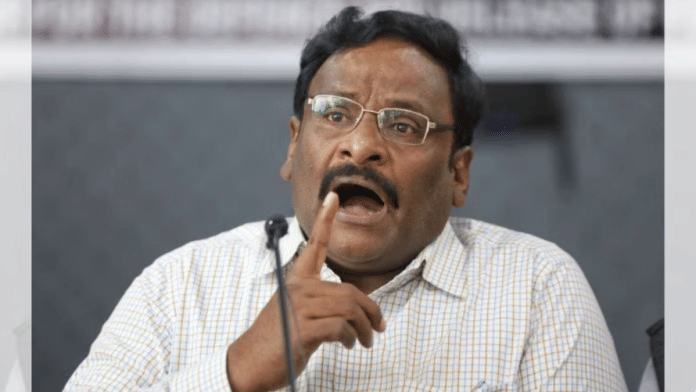


New Delhi: Denying anticipatory bail to two students of Tata Institute of Social Sciences (TISS) charged with unlawful assembly and related offences, a Mumbai Sessions Court has noted that instead of the customary phrase ‘Rest in Peace’, the students used ‘Rest in Power (1967–Forever)’ in homage to G.N. Saibaba, a former professor and supporter of Naxalite and Maoist organisations.
This act alone was not considered a criminal offence, Additional Sessions Judge V.B. Bohra observed on Friday, but added that when combined with the recovery of objectionable material from the students’ devices—including downloaded Maoist books, deleted files and WhatsApp chats suggesting ‘field work’—it raised doubts about the accused’s conduct and suggested ideological influence towards banned organisations.
The First Information Report (FIR) was lodged by the TISS administration in October 2025 alleging that a group of students organised an illegal gathering to pay homage to Saibaba, a former Delhi University (DU) professor acquitted by the Bombay High Court.
The accused were booked under provisions of the Bharatiya Nyaya Sanhita (BNS) relating to unlawful assembly and obstruction of authority, along with charges under the Maharashtra Police Act for violating prohibitory orders and police directions.
The protesting TISS students had displayed Saibaba’s photograph, lit candles, read his poems and wrote the phrase “Rest in Power (1967–Forever)”. The prosecution emphasised that such slogans, coupled with materials recovered from the students’ devices, suggested ideological sympathy with banned organisations and warranted custodial interrogation.
Saibaba was accused of having ties with outlawed Maoist organisations and sentenced to life imprisonment by a sessions court in 2017. He was later acquitted of the charges under the Unlawful Activities (Prevention) Act, or the UAPA, by the Nagpur bench of the Bombay High Court on 14 October 2022. The former DU professor died at a Hyderabad hospital on 12 October, 2024.
The controversy, meanwhile, deepened as slogans were allegedly raised demanding the release of student activists Umar Khalid and Sharjeel Imam, both facing trial under the UAPA and whose bail pleas have already been rejected by the Supreme Court.
The court stressed that such slogans, voiced in an institutional setting rather than a public protest, were inappropriate. “Being students, it was expected from accused persons to respect the law of the land.”
The court, however, granted anticipatory bail to other students named in the same FIR, noting that no incriminating material was recovered from their possession, and that their role was limited to participation in the gathering.
Also Read: ‘Blown out of proportion’: After FIR, TISS students deny sloganeering at GN Saibaba tribute event
‘Field work’ under lens
The court acknowledged that paying homage to Saibaba was not unlawful in itself. However, the charges he once faced as an alleged member of the banned Communist Party of India (Maoist) remain on the record.
During the investigation, authorities seized laptops and mobile phones from the accused. In these devices, investigators found downloaded books authored by members of the CPI (Maoist).
The court clarified that simply downloading books published by a Maoist organisation would not, by itself, constitute an offence. In this case, however, the investigation revealed more: the applicant had not only downloaded such books but also undertaken “field work” at different locations. Although the books are not officially banned, they were described as instigating or encouraging division within the country.
These materials were interpreted as signs of ideological alignment with banned organisations and an effort to persuade other students. The court noted that such evidence appeared to support or encourage illegal activities, including division of the country.
In their submissions, the accused students highlighted Saibaba’s disability and long incarceration, but the court observed that such arguments appeared “to question or criticise the procedure followed by the criminal court”.
The order emphasised that delays in trials are often caused by systemic issues such as judge‑population ratio and heavy case pendency, and that Saibaba’s imprisonment was a consequence of the ongoing trial until his eventual acquittal on appeal.
The court acknowledged that, under Supreme Court guidelines, pre‑arrest bail applications are expected to be decided within six weeks. Yet, in this case, the plea remained pending for nine months, a delay attributed as inevitable in serious offences, and one that must be understood within the broader context of judicial workload.
Against this background, the court held that custodial interrogation was necessary to understand the applicant’s motives—both in downloading the books and in raising slogans for the release of individuals facing trial under the UAPA, whose bail had already been rejected by the Supreme Court.
“Considering the overall facts and circumstances on record, for extracting truth, custodial interrogation of the applicant accused is necessary,” the court said.
It added that the interrogation was also considered essential to probe any potential links with banned organisations acting against national interests. Accordingly, the court rejected the application, ruling that the request for anticipatory bail did not merit consideration.
Alfreza Ahmed is an alum of ThePrint School of Journalism, currently interning with ThePrint.
(Edited by Nardeep Singh Dahiya)
Also Read: ‘Only looked at closed walls for yrs, couldn’t see my dying mother’: GN Saibaba on decade in prison