



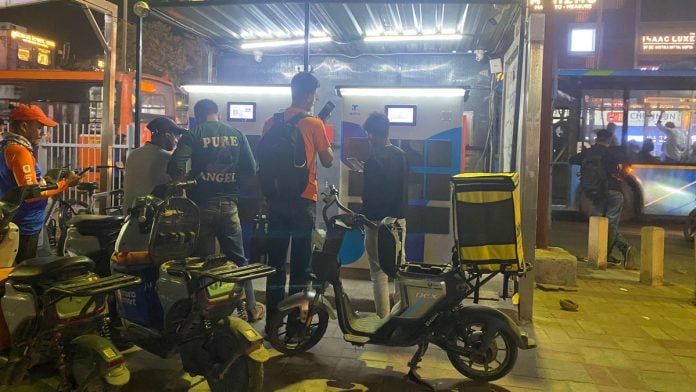
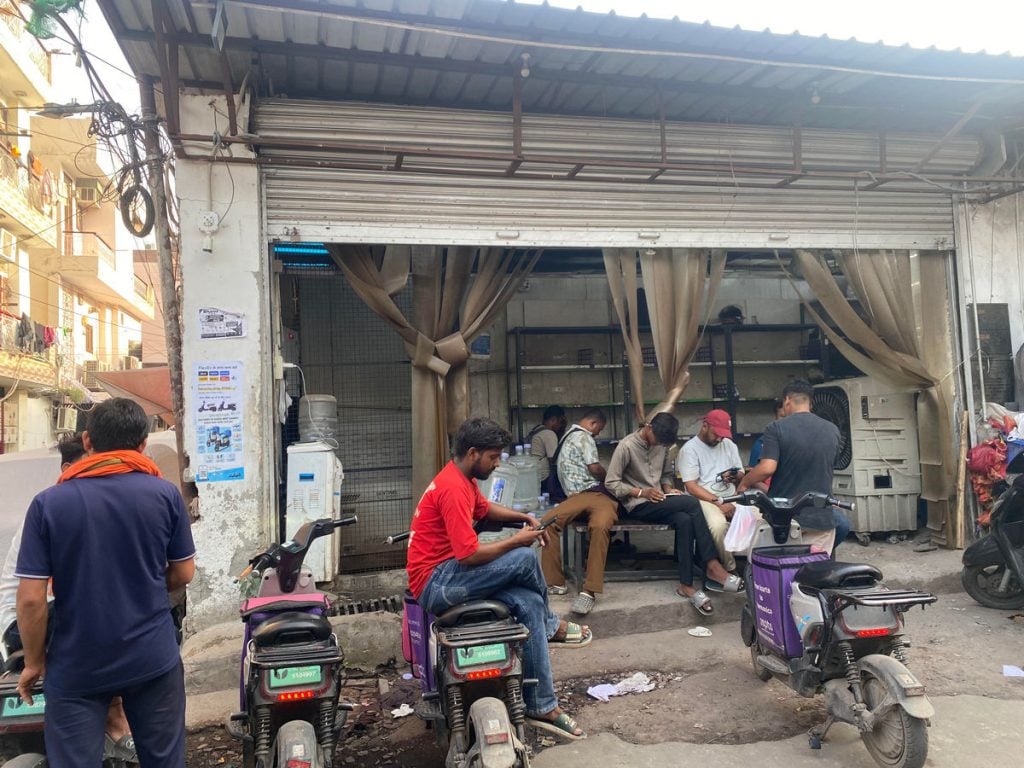
New Delhi: Electric scooter rental stations outside Delhi Metro stations were meant to make last-mile connectivity easier for commuters. Instead, they have become a lifeline for the city’s gig economy. All the customers waiting at an EV battery-swapping station near South Extension Metro station on a recent Tuesday evening were on rented e-scooters and wearing Blinkit, Swiggy, Zomato T-shirts.
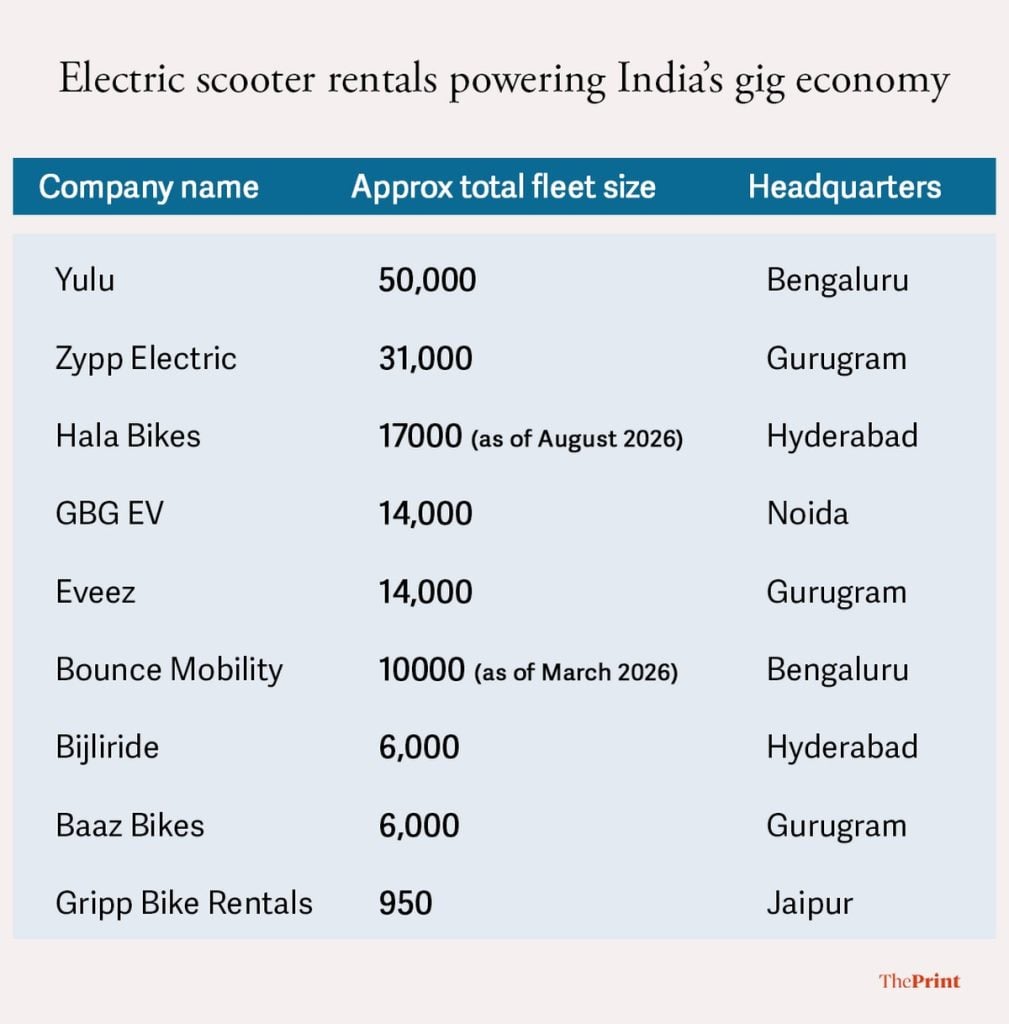
India’s hankering for speedy, last-minute deliveries has created a whole new business model for rental electric two-wheelers. Companies such as Yulu, Bijliride and Eveez have found a much more lucrative market in delivery agents than the office-goers they started out targeting.
And it’s not just Delhi-NCR. In cities such as Bengaluru, Hyderabad and Mumbai, and even smaller ones like Indore, Coimbatore and Guwahati, rental electric two-wheeler companies are catering to delivery workers with weekly plans, battery-swapping stations and scooters custom-built for the job.
Six out of the seven rental electric two-wheeler (E2W) companies that ThePrint spoke to had their roots in alternate electric commuter solutions, targeted largely at urban white-collar workers. In 2019, Bengaluru-based Yulu—which now also operates in Mumbai, Hyderabad and Delhi-NCR, among others—tied up with the Delhi Metro Rail Corporation to offer rental electric scooters at Metro stations. But a better market was hidden in plain sight.
The epiphany for Yulu came in the thick of the Covid-19 pandemic.
“Before, Yulu’s EV rental service mainly catered to commuters looking to cover short distances between their homes, offices and transport hubs,” a company spokesperson said.
“The pandemic lockdowns changed the situation. As home-delivery orders of food, groceries and medicines surged, we noticed that many delivery partners were using our EVs. This business segment contributes over 90 per cent of Yulu’s revenue today and will remain our primary focus for the foreseeable future.”
And the market is only getting bigger. India has nearly 12 million gig workers, according to the Economic Survey 2025-26, and NITI Aayog projects that the number will reach 23.5 million by 2030. For India’s growing army of delivery workers, many of them migrants with little money to spare, renting an electric scooter offers a cheap way to start earning without buying a vehicle. It also saves them hefty petrol bills on long shifts. But that doesn’t mean there aren’t new problems. EV infrastructure is still shaky.
We figured out that our primary target audience, due to the emergence of quick commerce, was in the delivery space… gig workers, who were using mobility for their earnings
– Vishal Vikram, co-founder and director, Bijliride
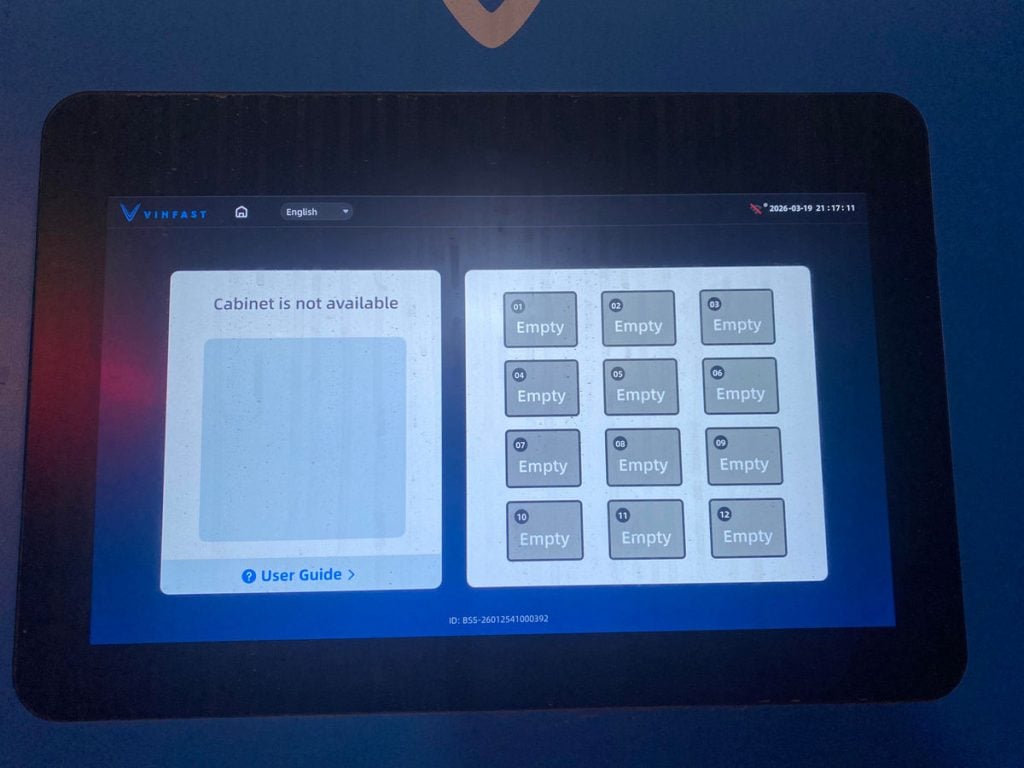
At the South Ex battery-swapping station, five delivery agents were frustrated that the machine that dispenses charged batteries wasn’t working. After about 10 minutes, one of them finally reached a Yulu assistant over the phone, who unlocked the system. He swapped his discharged battery for a charged one and zoomed away on his rental Yulu DeX scooter. His phone had just pinged with another order. Soon, other riders were able to access charged batteries as well.
“Delays such as this eat away from the time that could have been spent making a delivery,” said Mohit Kumar, a rider who says he has to swap his battery around three times during his 12-hour shift.
Also Read: Security guards vs delivery agents. It’s a new source of tension across Delhi-NCR societies
The unexpected customer
When Hyderabad-based Bijliride started renting out electric scooters in 2021, it did not have a clear picture of who its customer was.
“We were trying to reach out to anyone and everyone,” said Vishal Vikram, co-founder and director of the company, which also operates in Bengaluru, Mumbai, Delhi-NCR and Pune. But the customers it had in mind were largely office-goers, whether corporate employees or migrants who needed a two-wheeler to get to work. This urban commuter did not take to the rental EV model as widely as Vikram had hoped.
“Daily white-collar commuters and corporate employees often have the capacity to purchase their own petrol vehicle, or get an Ather or Ola electric vehicle,” Vikram added.
By 2022, gig workers made up 90-92 per cent of Bijliride’s customers. Its fleet has since grown from 1,000-1,500 to 6,000 electric two-wheelers, with just 2-3 per cent now used by daily commuters.
“We figured out that our primary target audience, due to the emergence of quick commerce, was in the delivery space… gig workers, who were using mobility for their earnings,” Vikram said.
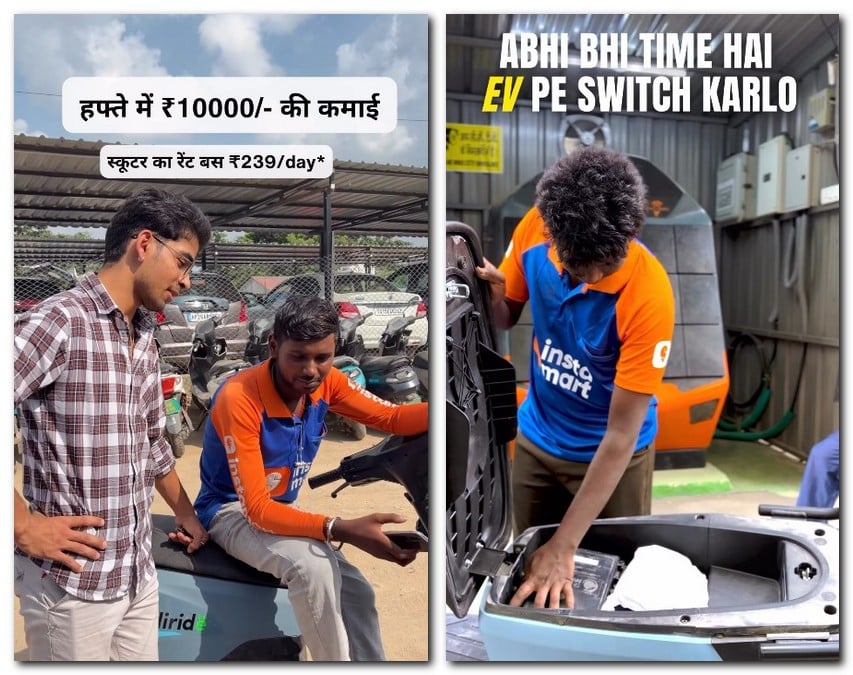
Bijliride now makes a direct pitch to delivery workers on its website and social media. Its offerings include battery swapping, doorstep battery delivery, 24-hour roadside assistance and even help to “identify high-demand pockets”. Its Instagram page also has reels aimed squarely at delivery riders, with captions promising better kamai (earnings).
Delivery workers also put their vehicles to much greater use than ordinary commuters.
“If you and I utilise the bike, we would probably ride it for 30-50 km (daily). However, delivery partners ride for around 150 km a day,” Vikram said. “For them, a lot of calculations come into the picture, in terms of maintenance costs, fuel expenses, etc. This ultimately becomes a viable option.”
Thanks to surging demand from e-commerce, quick commerce and quick services, the DeX has become the mainstay of our fleet and our biggest revenue driver
– Yulu spokesperson
Yulu followed a similar trajectory. It started with bicycle rentals in 2018 before introducing the Miracle electric scooter a year later. Customers could unlock a vehicle through the Yulu app, ride it to their destination and leave it at another designated Yulu zone. The bicycles never really took off, hampered by poor cycling infrastructure and maintenance challenges. But the scooters found their sweet spot in the delivery segment.
In 2021-22, Yulu launched its first “purpose-built” delivery EV, the DeX, with a top speed of 25 kmph and a rear carrier that can take a load of up to 10 kg.
“Thanks to surging demand from e-commerce, quick commerce and quick services, the DeX has become the mainstay of our fleet and our biggest revenue driver,” the Yulu spokesperson said.
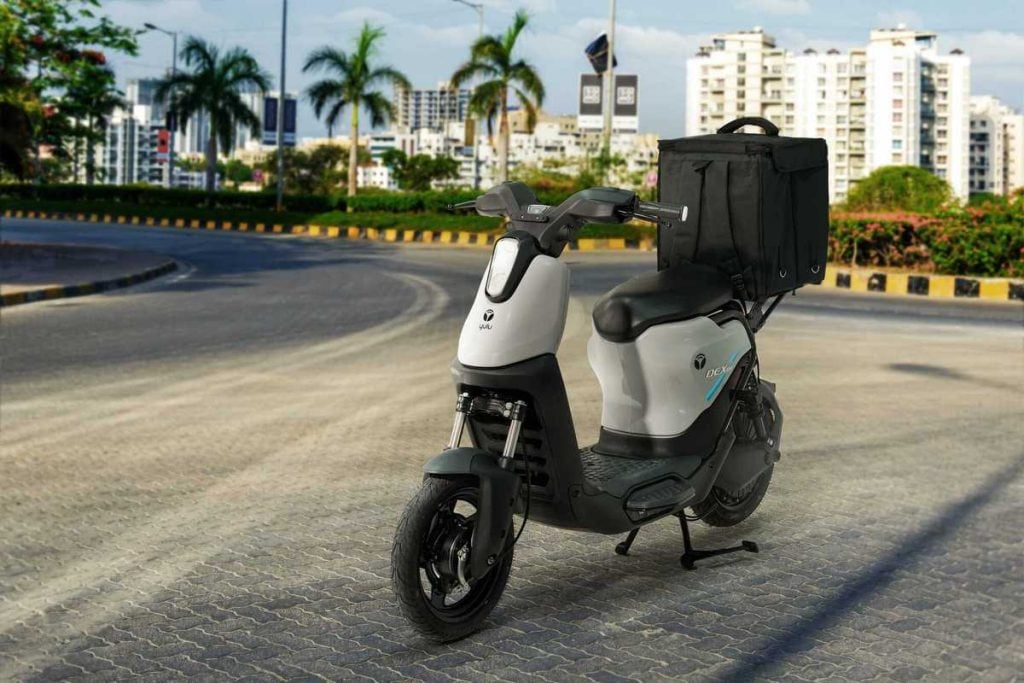
Yulu’s revenue grew sevenfold between FY2023 and FY2026, the company said in August, when it announced a $93 million funding round led by GEF Capital Partners. In an Instagram post, it said the funding would drive its growth in “delivery and urban logistics.”
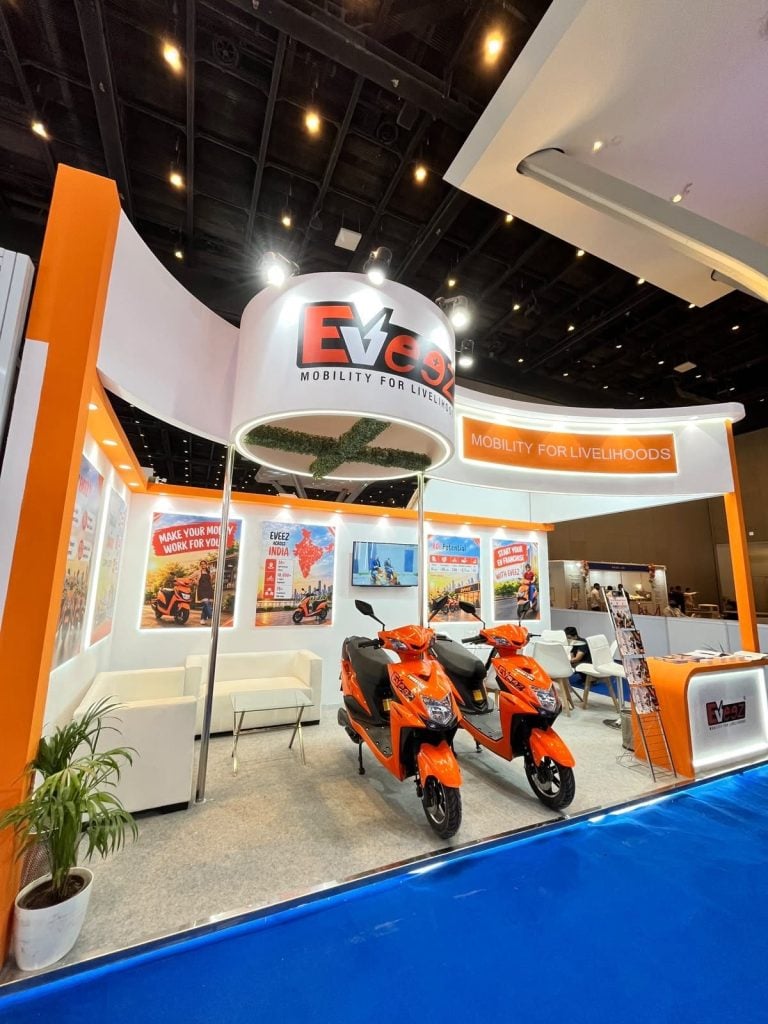
The only company ThePrint spoke to that didn’t stumble upon its ideal customer was Gurugram-based Eveez, which launched in the second half of 2020. It targeted delivery riders right from the get-go.
“We were very clear from the beginning that the urban commuting model would not work in India,” said Gaurav Rathore, co-founder of the company. “Gig work as a market always made more sense to us.”
Now, smaller companies are entering the rental E2W market in Tier 2 and Tier 3 cities too. Just as apps helped kickstart the gig economy, AI is now making it cheaper for rental companies to enter the business.
Jaipur-based Gripp Bike Rentals has a fleet of around 950 scooters across 39 cities, including Siliguri, Agartala and Gorakhpur. It sees these cities as emerging markets for gig work.
“Earlier companies would need large investments to run the tech infrastructure [such as] unmanned battery-swapping stations, automated QR-based vehicle locking and unlocking, and easy tracking of vehicles,” said Navneet Chaudhary, co-founder of Gripp Bike Rentals. “But AI has lowered the upfront engineering costs for small companies, making it much cheaper to build a company’s tech infrastructure.”
Maths that makes sense
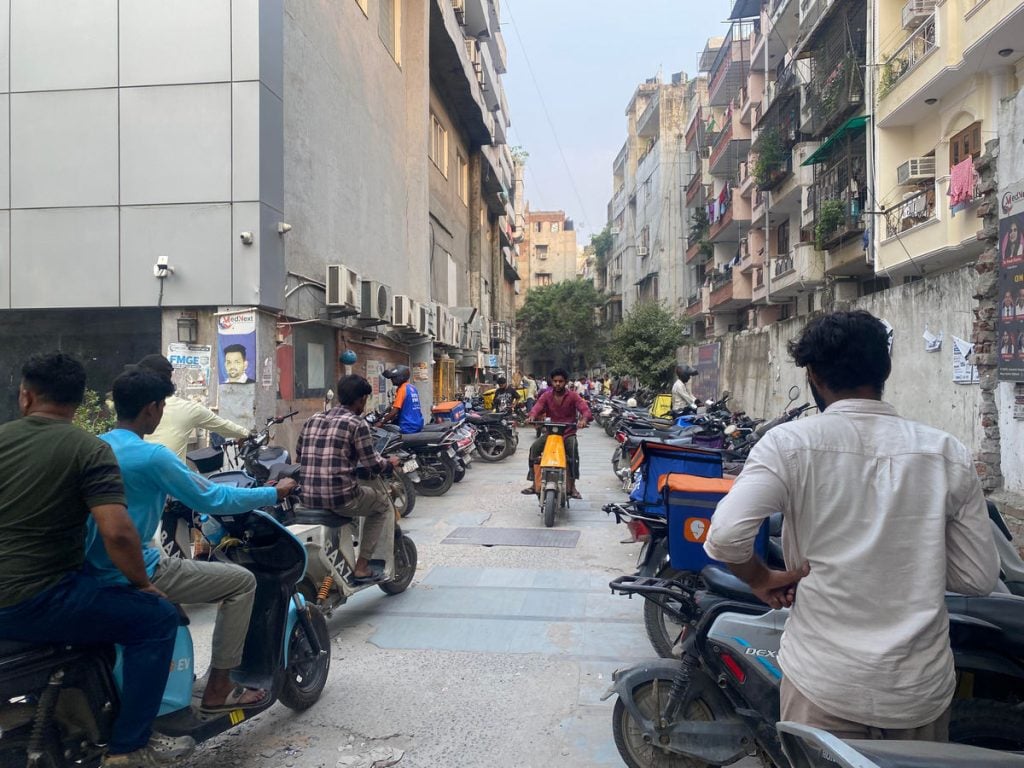
Outside a Zepto dark store in Delhi’s Jangpura, most of the delivery bikes were Yulu DeX rentals.
For a delivery rider, the maths of rented electric scooters is hard to argue with. A weekly subscription plan costs Rs 1,500 to Rs 2,100, with some throwing in unlimited battery swaps. Repairs are usually free or come at a minimal cost.
A petrol bike bites much harder into earnings. Karan, a Zepto delivery rider from Delhi’s Nehru Nagar who drives a Hero Splendor, told ThePrint that he spends Rs 200 to Rs 300 a day on fuel and another Rs 1,000 every 7 to 10 days on servicing.
Gaurav Rathore, co-founder of Eveez, said riders were keen to get off petrol even when the company started in 2020. But going electric came with too many unknowns: which vehicle to pick, who would service it, how the battery would be recharged and how to pay for the lot.
The subscription plans of rental companies took those worries off the rider’s hands. Eveez’s weekly plan is designed to match a rider’s pay cycle.
“Typically, these guys’ payouts are weekly. Zomato, for example, will pay them weekly, so they pay us weekly,” Rathore said.
I can stop the subscription whenever I go to my village, and don’t have to worry about lugging my bike home
– Sumit Yadav, Swiggy delivery agent
Rentals also bring down the entry barrier to taking up a rider gig. Buying a bike means a down payment of Rs 10,000 to Rs 20,000, depending on the make. A rental subscription requires a small upfront deposit of just Rs 500 to Rs 2,500.
And the bills keep coming once the bike is bought. If the bike is still under EMI, the owner pays around Rs 3,000 to Rs 4,000 every month. Other expenses include a one-time road tax (4-8 per cent of the cost of the vehicle), along with vehicle insurance which typically ranges between Rs 4,500 and Rs 5,000 per year. Additionally, they have to bear the cost of repairs and pay for minor damages in case of accidents.
A rental also comes with the freedom to walk away at will.
“If he takes a vehicle on subscription, he can upgrade, change plans, stop, start, and shift the subscription plans, based on his requirements. He is not married to one line of work. This flexibility is the basic essence of gig work,” Rathore said.
An EMI has to be paid every month, however bad the month, which is why so many default, he added. A subscription can simply be cancelled “if he’s not earning well, or wants to go back home for some time”.
Several gig workers ThePrint spoke to said they valued this flexibility.
Charan, a 20-year-old Swiggy delivery agent from Uttar Pradesh’s Badaun district, recently appeared for the Agniveer exam. He plans to work as a delivery agent only until his results come out, so buying a vehicle made little sense. He currently rides a Yulu DeX.
Another Swiggy delivery agent, 31-year-old Sumit Yadav from Kannauj, rents a Yulu scooter despite owning a bike in his village.
“I can stop the subscription whenever I go to my village, and don’t have to worry about lugging my bike home,” he said.
But for Karan, owning a vehicle is about future upward mobility. He doesn’t see himself working as a delivery rider forever.
“Hum doosri naukri karenge toh vahan thodi na Yulu leke jayenge (We are not going to take a Yulu to another job),” he said.
Also Read: Over 50,000 Swiggy gig workers file ITRs. Refund claims totalled Rs 6.5 crore
New crop of problems
Even as gig workers have opted for rental electric two-wheelers in large numbers, complaints about inadequate battery-swapping infrastructure, slow repairs and poor-quality vehicles have come along for the ride.
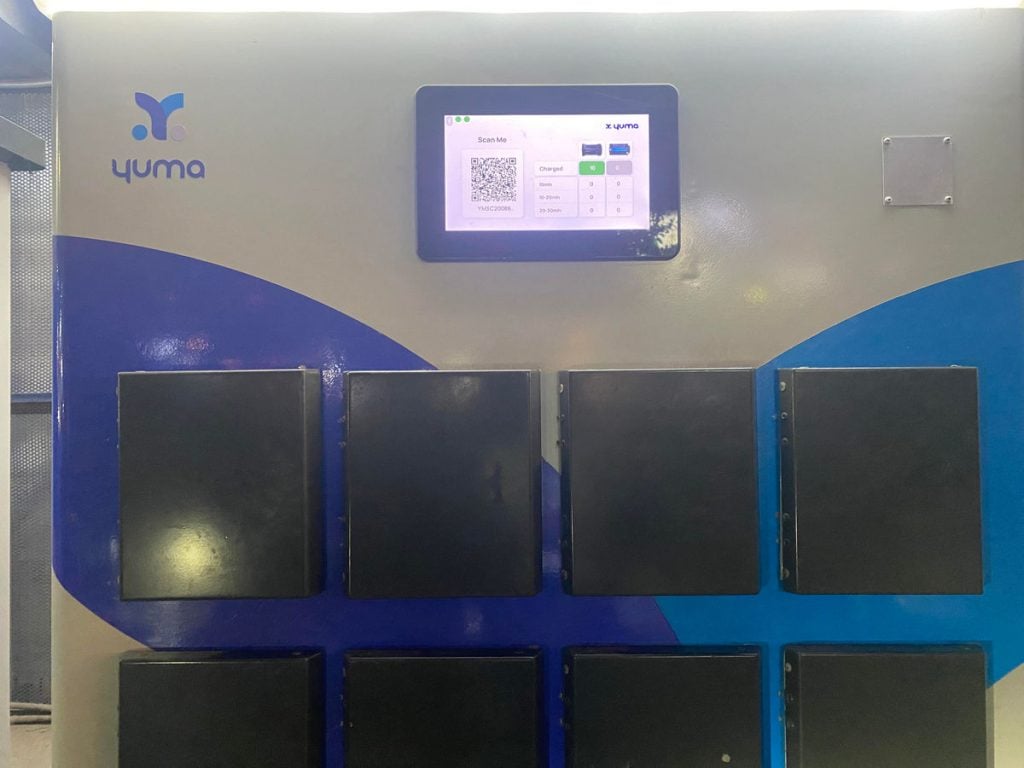
Riders of low-speed vehicles working 10-12 hour shifts typically swap their batteries three times a day. A fully charged battery lasts approximately 50 km. While delays at swapping stations are not the norm and vary across companies, they happen often enough to frustrate riders.
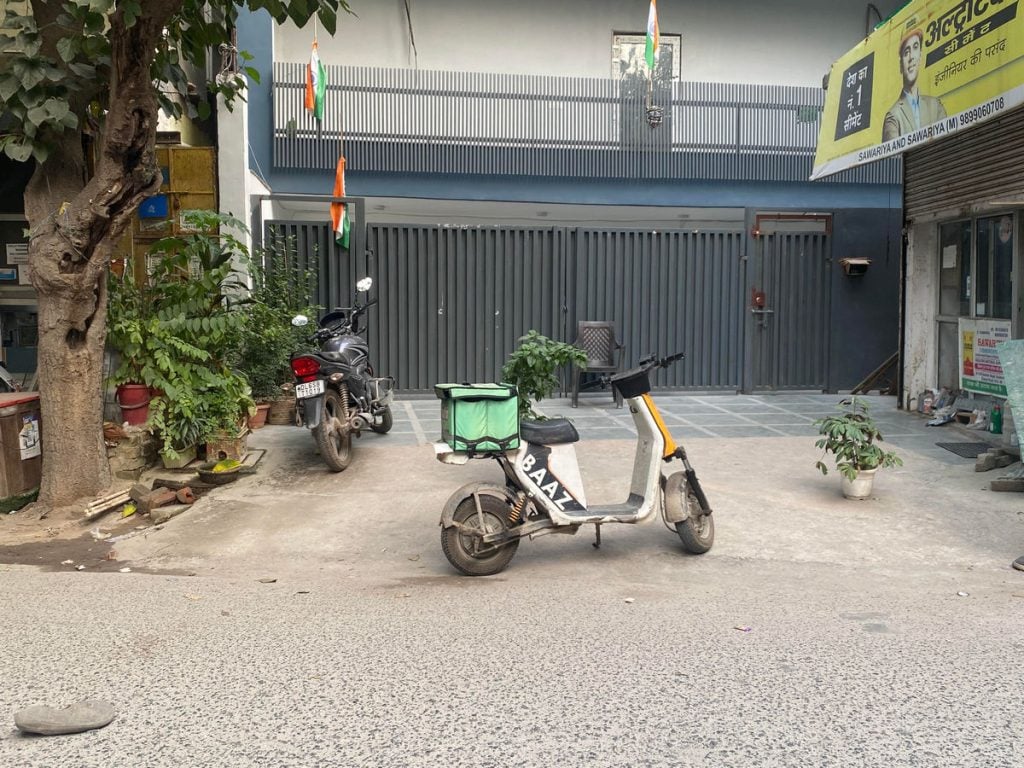
A Swiggy delivery agent who has been working with the company for a little over four years switched to a rental electric Baaz scooter after his personal vehicle crossed the 15-year mark, making it ineligible to be driven in Delhi-NCR. He has a litany of complaints.
“Half their swap stations don’t work. They have released so many cycles that the batteries at these stations are only 10-12 per cent charged when we get there. If I have an order that is 10 km away, how do I complete that? I have to keep going around in search of a fully charged battery, sometimes even as I’m carrying the order with me,” he said.
Getting home to Aya Nagar, on the outskirts of Delhi, after a late shift can also be a tedious affair.
“Sometimes at night, after I finish my shift, I have to wait for up to an hour for a battery that is at least 40 per cent charged, so that I can make it home,” he added.
Anubhav Sharma, co-founder and CEO of Gurugram-based Baaz Bikes, acknowledged this challenge. While Baaz’s first-generation bikes run for only up to 45 km on a full charge, he said the team is working on a newer model with a battery range of 75 km.
“It is a continuously evolving process for us. We are also working on increasing the number of swap stations by building partnerships with dark stores, and having swap stations at these stores,” he added.
Getting their rental scooter repaired can be frustrating for delivery agents too.
Sunil Kumar, a rider waiting to get his scooter repaired at a Yulu hub in South Delhi, complained about the long waits.
“Every time I come to one of these hubs, I waste at least 2-3 hours. Sometimes there are 8-10 people waiting in line before me,” he said.
Many of them are low-speed scooters, which don’t even require a licence. Pretty much anyone can become a gig worker. And now companies know that if one person leaves the job, another one will join
– Bharat, Zepto delivery agent
A senior technician at the hub told ThePrint that the centre receives at least 40-50 scooters for repairs every day, with 14 mechanics working across day and night shifts. Despite this, a shortage of parts can lead to delays.
“Most of our parts come from Bangalore, and we send some of our parts, like the tyres, to Chhatarpur in Delhi for fixing,” he said.
Of the 100-150 vehicles parked at the hub, only about 10 were ready to ride. The rest were awaiting repairs.
Technicians allow riders to exchange their scooters for others parked at the hub, but that isn’t always a solution.
“You never know the condition of the scooter you will get,” Kumar said. “Once I had to swap 3-4 different scooters in one week, because each one had some problem or the other.”
Bharat, a 38-year-old Zepto delivery agent from Delhi’s Lajpat Nagar, has been working in the gig economy for more than five years and rides a self-owned bike. He acknowledges that rental electric two-wheeler companies have lowered the barriers to employment. It worries him sometimes.
“Many of them are low-speed scooters, which don’t even require a licence. Pretty much anyone can become a gig worker. And now companies know that if one person leaves the job, another one will join,” he said.
(Edited by Asavari Singh)