



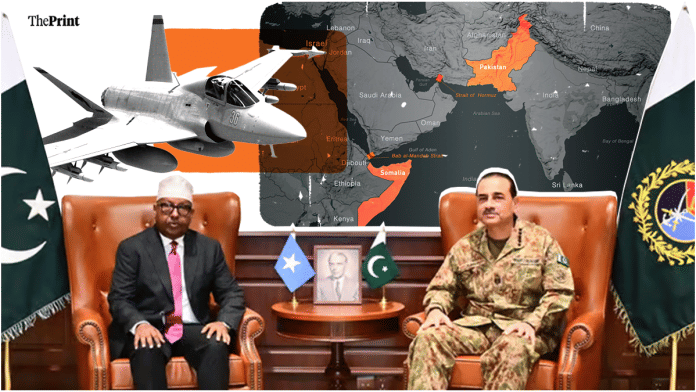
New Delhi: Last week, Somalia reached an agreement with Pakistan to acquire JF-17 Thunder multirole fighter aircraft as part of efforts to rebuild and modernise its air force, according to Turkish news outlet TRHaber.
The report did not specify the number of aircraft Somalia intends to purchase, the value of the deal, or when deliveries are expected to begin. If concluded, this acquisition would mark Mogadishu’s largest defence procurement since the collapse of the central government in 1991.
The development comes weeks after a senior Pakistan Air Force (PAF) delegation visited Mogadishu for talks on rebuilding Somalia’s air force and expanding defence and air-defence cooperation between the two countries.
The delegation was led by Air Marshal Muhammad Sarfraz, Pakistan’s Air Defence Commander and Deputy Chief of the Air Staff. During the visit, he held meetings with senior Somali officials, including President Hassan Sheikh Mohamud, Prime Minister Hamza Abdi Barre and Defence Minister Ahmed Moallim Fiqi.
Air Marshal Sarfraz also met Brigadier General Abdirisaaq Mahmoud Haji, the commander of the Somali Air Force, at the force’s headquarters. Their discussions focused on pilot and personnel training, institutional development, specialised skills and the capabilities required to rebuild and strengthen Somalia’s air force.
According to reports and images from the meetings, Air Marshal Sarfraz presented the Somali Air Force commander with a model of the JF-17 Thunder. At the time, however, neither side announced an agreement for Somalia to purchase the aircraft.
Somalia was previously reported in February to be in discussions with Pakistan over the possible acquisition of JF-17 fighter aircraft, jointly produced by Pakistan and China.
The September visit followed a trip to Pakistan the previous month by a Somali delegation led by Defence Minister Fiqi, during which they met Field Marshal Asim Munir. Islamabad and Mogadishu agreed to deepen bilateral defence and security cooperation.
In August, they signed an MoU in Islamabad for cooperation in counterterrorism, military training, the exchange of expertise and broader military capacity building.
Neither side then said whether the agreement included the purchase of fighter aircraft or other major weapons systems.
Seen in the context of Pakistan’s increasing engagement in West Asia—it signed the Makkah Joint Defence Agreement with Saudi Arabia and Turkiye in August, and Pakistan–Saudi Arabia defence agreement last year—the reported deal with the African country becomes significant.
It also came amid an increasingly fluid geopolitical environment—from the Gulf and the Red Sea to the Horn of Africa—and at a time when Somalia seeks new partners to rebuild its security institutions after more than three decades of domestic conflict.
Domestically, Somalia is fighting Al-Shabaab, the Al-Qaeda-linked militant group that continues to operate across parts of southern and central Somalia and carry out attacks against government and civilian targets. The country has also been attempting to rebuild its armed forces and establish greater control over its territory and airspace.
Against that backdrop, the Pakistan-Somalia agreement offers Islamabad an opportunity to extend its military partnerships into the Horn of Africa, and gives Mogadishu access to a country willing to offer military expertise, and potentially weapons.
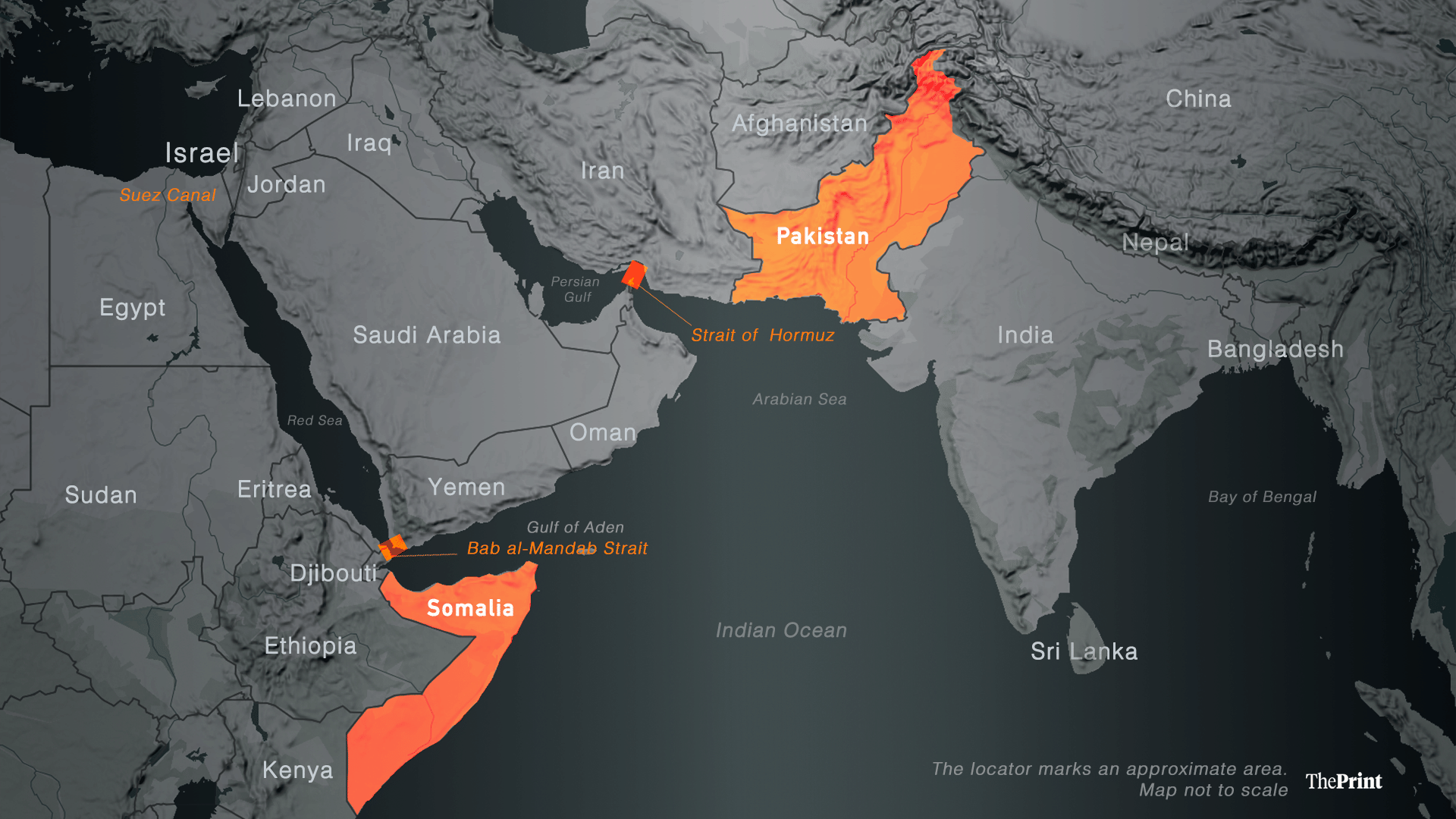
The Pakistan-Somali defence cooperation is also being watched closely by analysts from New Delhi, given it may allow Islamabad logistics leverage in a region becoming increasingly significant for maritime trade.
Former Indian ambassador Gurjit Singh sees the agreement as part of a wider Pakistani strategy. “Pakistan is attempting to convert its long-standing military relationships with Muslim countries into a wider network of strategic partnerships, while simultaneously turning its defence industry into an instrument of foreign policy”, he told ThePrint.
“Somalia is especially important because it extends that network from the Gulf into the Horn of Africa and the Red Sea,” he added.
Also read: The curious case of Pakistan’s JF-17 ‘orders’
Why Horn of Africa significant & where Pakistan fits
Somalia occupies an important geographic position. Its coastline stretches along the Gulf of Aden and the western Indian Ocean, giving it a strategic location near the Bab al-Mandab Strait, which has emerged as one of the world’s most important maritime chokepoints, especially as Strait of Hormuz remains disrupted since the US/Israel-Iran war broke out in February.
The Bab al-Mandab Strait connects the Red Sea with the Gulf of Aden and the wider Indian Ocean and is vital to energy supplies and global commercial shipping.
That geography gives Somalia importance much beyond its military capabilities. For Pakistan, establishing a closer defence relationship with Mogadishu can, therefore, extend its diplomatic and security reach from the Gulf into East Africa, while following the footsteps of Saudi and Turkey.
Pakistan is attempting to convert its long-standing military relationships with Muslim countries into a wider network of strategic partnerships, while simultaneously turning its defence industry into an instrument of foreign policy—Former ambassador Gurjit Singh.
Moreover, Pakistan seems to follow the lead of its closest allies in spreading its influence in African Muslim countries, invoking history, religion and strategic ties. Pakistan currently is the largest market for Turkey’s arms, accounting for roughly 16 percent of total Turkish defense exports. Pakistan also maintains close relations with Saudi Arabia and the UAE.
However, it is no secret that Pakistan’s relations with the United Arab Emirates are in decline, partly due to the UAE’s growing ties with India and Islamabad’s growing alignment with the Saudis.
The Islamabad-Abu Dhabi ties have also been negatively impacted by Pakistan signing the Makkah Joint Defence Agreement, and Pakistan–Saudi Arabia defence agreement, both involving Saudis.
Pakistan & Somalia—as seen from Saudi Arabia
For Saudi Arabia, Somalia is the road to reshape the security order around the Red Sea and counter the UAE influence and Iran-aligned threats.
According to an April 2026 report by Dr John Calabrese, a former director of East-Asia Project (MAP) of Washington-based think tank Middle East Institute, Somalia is no longer a peripheral concern for Riyadh. “It has become a key arena where Gulf rivalry, maritime insecurity, and Saudi ambitions converge.”
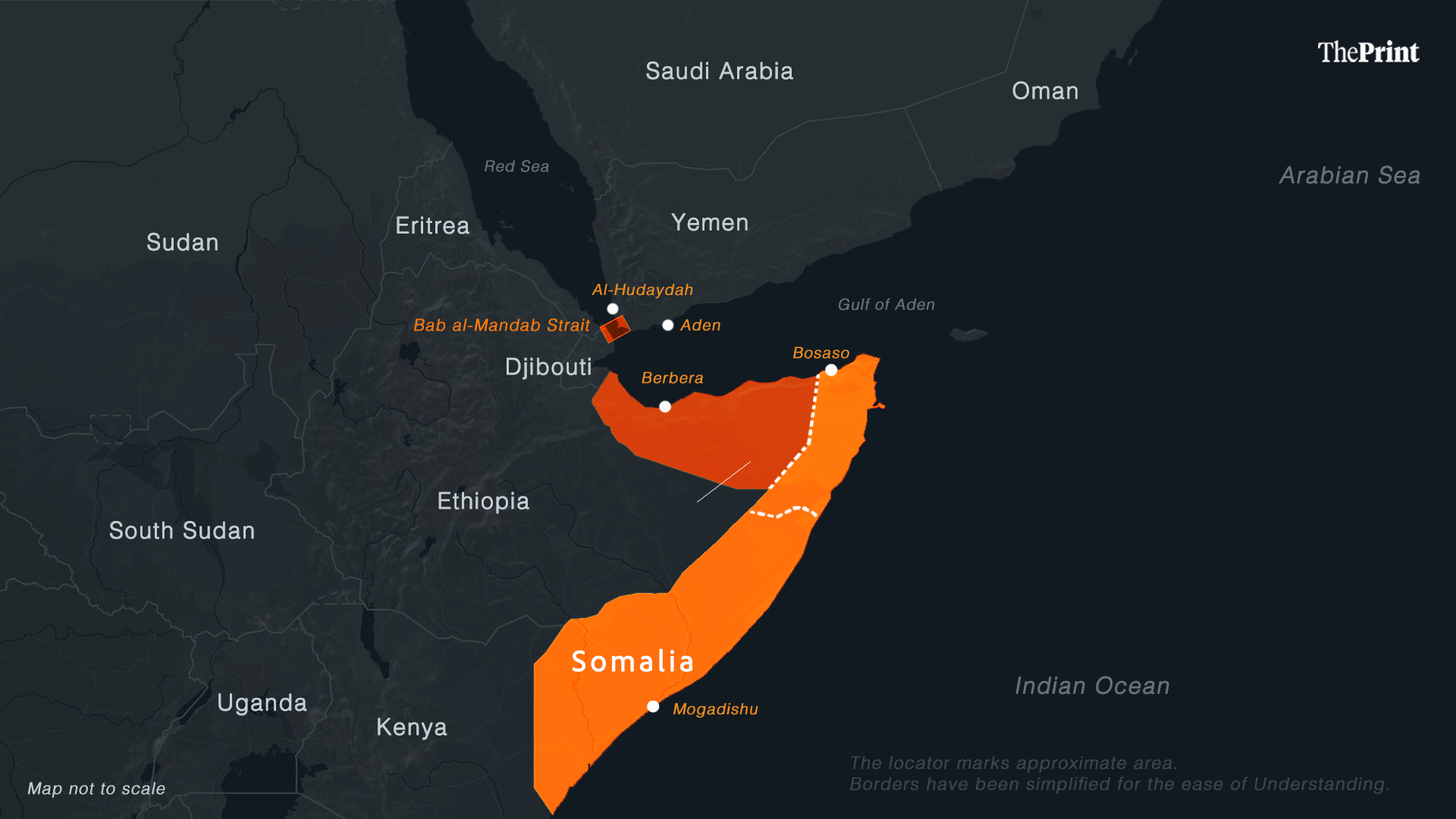
It is driven mainly by Saudi’s growing rift with the UAE. Abu Dhabi already has a footprint in Somalia since 2010 having trained security forces, securing long-term port management and development concessions in areas like Berbera and Bosaso and having cultivated political ties with Somaliland and Puntland.
Riyadh is more concerned about Abu Dhabi’s bypassing of Somalia’s Saudi-backed federal government and empowering sub-State actors.
To counter it, Saudi is now positioning itself as the champion of Somalian sovereignty and territorial integrity and has hence aligned more with the capital. This has another aim— it establishes Saudi as the defining Gulf player in the Horn of Africa committed more to state authority than just a transactional partnership like the UAE.
Somalia has a coastline along the Gulf of Aden, a critical maritime corridor linking the Indian Ocean to the Red Sea (through Bab-al Mandab) and the Suez Canal. This is the site of one quarter of the global container trade transit route, significant to all external players including Pakistan—and India.
If you look at maritime positioning, I don’t think Pakistan is major naval power, and it is unlikely to become one. It is also not going to play a major role in policing the waters. The main significance, then, is logistics—strategic affairs expert Ilya Roubanis.
Amid the West Asia war, Iran-backed Houthis have wreaked havoc on shipping lines and there are reports of the Houthis now cooperating with the al-Shabaab. For Saudi, the Somalian coastline risks becoming the link to enable coordination on both sides of Bab al-Mandab.
Al-Shabaab networks in East Africa have helped funnel arms from Iran and regional routes through maritime channels earlier. Despite deep ideological differences (al-Shabaab is Sunni Islamist while Houthis belong to the Zaydi branch of Shia Islam), both groups cooperate due to mutual hostility toward Western nations, Israel, and regional governments.
With the Strait of Hormuz effectively closed due to the ongoing war, Saudi re-routes its exports through the Red Sea and hence Somalia has become strategically important for multiple reasons, linking the coastline with Riyadh’s economic standpoint.
Pakistan and Saudi Arabia’s Strategic Mutual Defence Agreement of September 2025—committed to mutual defence, and expanding military cooperation——could give both countries greater leverage in Somalia.
However, the defence cooperation is not likely to suddenly make Pakistan a major naval actor in the strategically significant region.
“A lot of the Pakistani Navy’s hardware is co-produced with Turkey, which already has a military base in Somalia, and it is also developing another base in Sudan. So, I think one element here is complementarity. The other thing to watch is the broader regional picture,” strategic affairs expert Ilya Roubanis told ThePrint.
Expanding further he added that Somalia is a weak state, and there is already a significant presence of outside powers in the region. Israel has recognised Somaliland, while the UAE has logistical capabilities that allow it to participate in the war in Sudan, whereas Saudi Arabia supports the opposite side — the Sudanese government.
Pakistan has historically tried to balance between the UAE and Saudi Arabia.
“If you look at the maritime positioning, I don’t think Pakistan is a major naval power, and it is unlikely to become one. It is also not going to play a major role in policing the waters. The main significance, then, is logistics: the ability to deliver troops on the ground if they are needed, as well as providing logistical support. That appears to shadow Saudi interests and provide a potential deployment capability if and when Saudi Arabia needs it,” he added.
Turkey and Saudi play the strategic game together. But Ankara’s interests in Somalia are not the same as Saudi’s. For Ankara, it is the abundance of oil deposits which drives President Recep Tayyip Erdoğan’s interest.
In a May 2026 article, UK based security think tank RUSI argued Erdogan enjoys widespread popularity in the region owing to his humanitarian aid and soft diplomacy. In 2011, he was the first non-African head of state to visit Somalia in 20 years.
According to RUSI, Ankara is now Mogadishu’s “foremost foreign ally”, with Turkish companies also assuming control of the management of the Mogadishu port and airport, and Somalia hosting Ankara’s largest overseas military base– Camp Turksom—since 2017.
Though a NATO member, Turkey has often taken an assertive independent position across West Asia, North Africa and the Horn of Africa. The promise of oil and gas is what is enticing to Ankara, which signed a deal with Somalia in 2024. Recent studies cited by RUSI say the region has around 30 billion barrels of oil, a quarter of the UAE’s current crude oil reserves.
There is also a hydrocarbon deal, under which Turkey’s latest deepwater drillship, the Çağrı Bey, came to Mogadishu Port, its first trip beyond Turkey’s own waters, in April.
With the current West Asia crisis disrupting global supply, Somalia, thus, becomes crucial for Turkey.
Turkey’s homegrown military technology—Jets, drones, helicopters, warships and more—have appeared in Mogadishu and played a role in operations against al-Shabaab.
According to a RUSI analysis, Somalia is emerging as a broader platform for Türkiye to project its influence. This was underscored by Somali President Hassan Sheikh Mohamud’s visit to Türkiye on 30 December 2025, his first foreign trip after Israel unilaterally recognised Somaliland in late December.
During that trip, the two sides agreed on plans for a Turkish military base at Laas Qoray, in a disputed part of Somalia along the Gulf of Aden. A Turkish base at Laas Qoray would amount to a direct counterweight to the expanding Israeli and Emirati presence in Somaliland farther along the coast.
In this backdrop, ambassador Singh said the Pakistan–Somalia agreement should not be viewed as an isolated bilateral arrangement after the Mecca Joint Defence Agreement.
In his view, there is therefore a potentially important security chain emerging.
“The Pakistani-Somali relationship can therefore become an extension of this wider security ecosystem rather than a conventional arms relationship. I would describe this not yet as a formal alliance system, but as an emerging web of overlapping security partnerships,” he added.
Roubanis argues that Saudi Arabia may be the most important lens to understand Pakistan’s interest in Somalia.
Saudi Arabia does not have a major expeditionary force. Turkey does, but it would be reluctant to deploy its own troops and expose Turkish forces to the risks involved, he said.
Pakistan, on the other hand, has deployed forces on behalf of Saudi Arabia in several places and has played a role, particularly through its special forces. Pakistan does not have a major expeditionary force, and it does not have major maritime interests in the region, Somalia is an important source of sailors for the international merchant fleet, but Pakistan itself is not a naval power, he said.
Somalia is, therefore, an auxiliary. “Pakistan has, therefore, always been viewed as a force that is available and ready to deploy in support of Saudi interests. My interpretation is that Pakistan is there because Saudi Arabia asked it to be there,” he added.
(Edited by Ajeet Tiwari)
Also read: Is the China-Pakistan arms nexus exporting authoritarianism? The case of the JF-17