





When the Pakistan Air Force released a mostly AI-generated video on September 7 depicting its implausible ‘victory’ over India during Operation Sindoor, it grabbed eyeballs and got mocked.
But beneath the fabricated claims lay a genuine defence upgrade.
For the first time, Pakistan showcased its Chinese-origin HQ-17AE short-range surface-to-air missile (SAM) system, and Turkish-made Şahin counter-unmanned aerial vehicle (C-UAV) weapon and Korkut self-propelled anti-aircraft gun (SPAAG).
This display reinforced the obvious — Islamabad’s deepening defence partnerships with Beijing and Ankara. But it also pointed to something subtler and larger: a pattern of growing defence cooperation between autocratic governments and the role the military-industrial complex plays in entrenching such illiberalism. Nowhere is this trend clearer than in the export story of the JF-17 Thunder fighter jet, which also featured in the PAF video.
Also Read: Asim Munir wants to redraw Pakistan. The first field marshal’s One Unit debacle offers a warning
The ‘thunder’ around JF-17
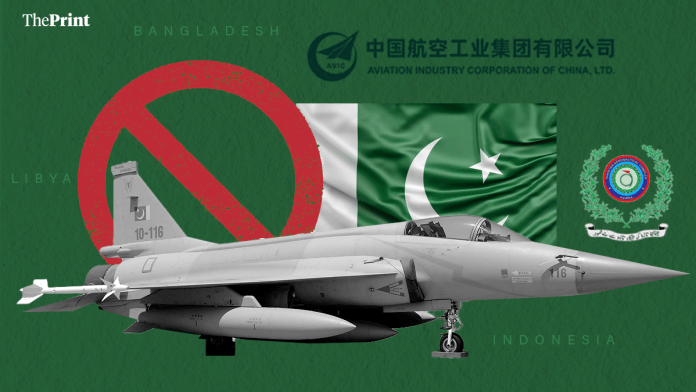
From December 2025 onwards, Reuters began publishing a string of reports, almost like clockwork, about Pakistan signing or negotiating defence deals with several countries. At the heart of these deals was the JF-17 fighter jet. Libya was the first to be reported on. Bangladesh, Saudi Arabia, Sudan, Indonesia and Somalia have since reportedly expressed interest in acquiring the aircraft.
The noise around the JF-17 ‘Thunder’ petered out a few months into 2026. But such prospective deals hold pieces of a larger puzzle that could aid understanding of the broader alignment between China, Pakistan and the states operating, or interested in, the aircraft.
Jointly produced by the Pakistan Aeronautical Complex and Chengdu Aircraft Corporation, the JF-17 is powered by Russian-made Klimov engines: RD-93 (used in Block I and Block II variants) and RD-93MA (Block III). With its first prototype taking its maiden flight in 2003 and later being inducted into the Pakistan Air Force in the late 2000s, the JF-17 has been elevated to what can be regarded as a tour de force of the China-Pakistan friendship — dubbed “higher than the mountains…stronger than steel”.
While the sudden surge in interest from late 2025 did raise eyebrows about the substance of Reuters’ reports, the JF-17 does appear to be having its moment under the sun. Materialisation of deals notwithstanding, the reports alone amounted to a huge publicity boost. Coupled with the fact that the JF-17 now has the tag of ‘combat-tested’ after Pakistan reportedly used the aircraft, alongside the Chinese J-10Cs, during its four-day conflict with India in May 2025. That it was deployed against an air force operating a mix of Western and Russian fighter planes lent further credibility to the aircraft’s prowess.
A tool of influence
What is underexplored about this 4.5-generation, single-engine, all-weather, multi-role aircraft is the profile of its current and speculated export destinations. Beijing appears to be leveraging the JF-17 as a tool to export its influence, specifically among nations that are at odds, to varying degrees, with the largely liberal West.
Libya is a case in point. Pakistan’s deal was signed with the Libyan National Army, whose authority over eastern Libya is not recognised by the United Nations, which only accords legitimacy to the government in charge of the western territory. Add to that, Libya has been subject to an arms embargo since 2011, with arms transfers allowed solely to the internationally recognised government in Tripoli. Similarly, Sudan, a country rendered asunder by the civil war that erupted in 2023, is subject to arms embargoes by the West.
The political trajectories of the three countries that officially operate the JF-17 tell a similar story. Myanmar, Nigeria and Azerbaijan have displayed weakened democratic principles to differing degrees and have increasingly taken an authoritarian turn. Myanmar, the first importer of the JF-17, is sanctioned by the US and some of its allies to boot, while the country itself has been ravaged by a civil war since 2021.
This suggests the Sino-Pakistani nexus is consolidating influence among nations with governance and freedom profiles similar to theirs through inter alia defence partnerships. China’s export of its authoritarianism in digital and political forms is fairly well-documented. Less examined is the role of defence exports. Arms sales to non-democratic, authoritarian or military-dominated states by like-minded regimes account for a subtler yet consequential tool of extending sway. The JF-17’s export pattern fits this description closely.
While Pakistan’s former army chief Qamar Javed Bajwa pivoted from geopolitics to geoeconomics, his successor, Field Marshal Asim Munir, seems to be advancing what can be called a mix of economics and defence.
Pakistan is projecting JF-17 deals as a means of generating revenue for its economy, which has a long-standing history of external bailouts. Defence Minister Khawaja Asif remarked that the country is “receiving so many orders that Pakistan may not need the International Monetary Fund in six months”. Further highlighting this defence-economics nexus is the potential conversion of a Saudi loan into an arms agreement. That the military, not the civilian leadership, is steering such efforts is evident; for example, Field Marshals Asim Munir of Pakistan and Khalifa Haftar of Libya are negotiating the JF-17 deal.
China: The ultimate winner?
A Foreign Affairs essay, ‘The Illiberal International’, spotlighted the burgeoning coordination among illiberal governments through military and financial tools, resulting in the entrenchment of illiberal governance.
To illustrate this, the piece cites Turkey’s supply of Bayraktar TB2 drones to Azerbaijan and Libya — both of which have also cut JF-17 deals with Pakistan. One can also reference the Turkey-Pakistan defence partnership in a similar vein. Turkey plans to establish a drone assembly facility in Pakistan. Here, it is worth mentioning that just as Pakistan is maximising the JF-17’s battlefield credentials to buoy up the aircraft’s marketability, Turkey has similarly capitalised on its drone’s performance in the Russia-Ukraine and Armenia-Azerbaijan conflicts to boost its exportability.
A separate Lowy Institute study identifies four ways through which military and security cooperation occurs among illiberal powers: transfer of weapons and war-fighting equipment; provision of non-lethal resources like intelligence and satellite information; structured military exercises; and, more prominently, through formal pacts. China and Pakistan tick all four of these boxes and may extend the same channels of cooperation to countries they want as customers.
The Mecca Joint Defense Agreement between Saudi Arabia, Turkey and Pakistan, all three of which have illiberal governments, also checks the same four boxes. China stands to gain from this indirectly. As Pakistan becomes more embedded in Gulf security arrangements, Chinese-built systems, training and maintenance networks could gain a foothold in the region by extension, given China’s overwhelming influence over Pakistan. There can also be an overlap of defence supply chains and the military-industrial complex of the Mecca Pact countries and China. If collaboration between them deepens, the role of a ‘liberal’ US as a traditional security guarantor in the region will further diminish, paving the way for a Chinese-led ‘illiberal’ architecture.
China, despite co-producing the JF-17, does not itself operate the aircraft. But Beijing is unmistakably the face of such deals and any sale is likely to be regarded as a win for Chinese influence, which China may well be encouraging.
There is reason to believe this. The states operating or planning to negotiate a JF-17 deal are participants in China’s Belt and Road Initiative (BRI), already tied to Beijing economically, infrastructurally, and to some extent, through a political slant. It is not implausible that Beijing sees defence cooperation as a way of deepening the extant relationship. Correlation is not causation. But a history of economic cooperation often facilitates future collaboration in other sectors.
Many of these countries are also mired in conflicts, domestic and international, which drives their increased need for arms procurement. In an unstable geopolitical environment, the Sino-Pakistani military-industrial complex stands to benefit from conflict-prone regions, where their platforms can acquire the combat-proven tag, boosting future sales. The more battlefields their platforms are tested in, the better.
And where there is war, there is money to be made, as the saying goes. Africa, convulsed by conflicts that get little attention due to the high-profile wars in Ukraine and the Middle East, is one region worth watching closely on this front. China and Pakistan, and even Turkey, may seek to make Africa their next big market for weapons.
Also read: Saudi firm bets $200 mn on Afghanistan’s energy sector. Can it succeed where Chinese failed?
Arms and ideology
The intertwining of ideology and defence exports is not new, but it is often overlooked.
As China throws its weight globally, its growing role in the weapons market, especially among countries classified as illiberal, deserves closer scrutiny from observers and policymakers. Such deals are not purely confined to the defence sphere. They also signal deeper strategic alignment, something defenders of liberal democracies would do well to examine if they want to halt the expansion of illiberal networks.
Part of the appeal is that Beijing, unlike Washington, does not impose political, value-based constraints on defence partnerships. A sense of ease appears to exist between China and countries that have either not reaped the benefits from a democratic system or are seeking to diversify partnerships beyond the West, both of which pave the way for greater trust. Such relations not only entrench China’s influence within these states, but in a way also sustain those illiberal regimes.
For Pakistan, if these deals materialise, its cherished goal of becoming a net security provider in the Arab region and beyond could inch closer to reality, with the already existing Strategic Mutual Defense Agreement (SMDA) with Saudi Arabia and the Mecca Agreement acting as two anchors.
Bantirani Patro is a staff writer at ThePrint. She tweets @bantirani_patro. Views are personal.
(Edited by Asavari Singh)