


Bengaluru: In late 1998, members of the Dr Rajkumar Fans’ Association protested outside the Karnataka Accountant General’s (AG’s) office against the Union government’s hiring policy. The Central Staff Selection Commission had appointed 19 Tamilians with no knowledge of Kannada to the AG’s office, sparking protests from locals.
Then Karnataka chief minister J.H. Patel wrote to the Centre, expressing his reservations about the appointments, and fueling the protests.
“This was the first time there was such a protest. The incident was the flashpoint of a realisation that we needed a dedicated organisation to safeguard the interests of Kannadigas,” Arun Javagal, General Secretary of the Karnataka Rakshana Vedike (KRV), told ThePrint.
T.A. Narayana Gowda was among the few who embraced this realisation which eventually led to the formation of the Kannada Rakshana Vedike–later changed to Karnataka Rakshana Vedike to expand its scope beyond just the language struggle.
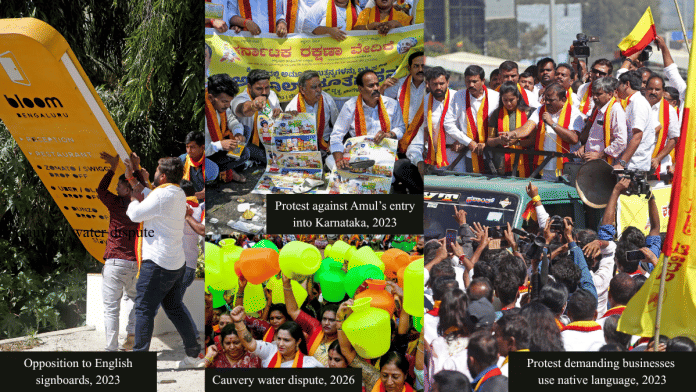
The Gowda-led KRV now boasts nearly 68 lakh active members across the state, country and beyond, making it one of the biggest such apolitical associations in Karnataka. Its consistent and non-compromising stand on ‘Nela, Jala, Bashe’ (land, water and language) makes it a formidable force that political parties can ill-afford to ignore.
This possibly explains the silence from the D.K. Shivakumar-led Congress government and the BJP who have looked the other way even as KRV approaches multinational corporations, demanding details on their hiring practices.
In just the last two days, KRV claims it has approached nearly 300 MNCs—including Google, Infosys, Oracle, Reliance and several others who have a large presence in India’s infotech capital.
The objective is to gather data on the number of locals hired by these companies, many of which, KRV claims, have benefited from subsidised land and other perks to set up operations in Karnataka.
“We are approaching companies just to get data. We are neither pressurising them (sic) nor are they taking offence to our approach,” Javagal said. The sight of teams of pro-Kannada activists, however, wearing their signature red and yellow stoles in lobbies of tech parks is being perceived and projected very differently online.
‘We are a pressure group’
On 25 October, Shivakumar warned infotech companies of action if they were found indulging in discriminatory practices and sidelining locals. The statement followed a viral–unverified–video–in which an unnamed woman alleged bias against resumes mentioning ‘Kannada’ in favour of candidates from states like Andhra Pradesh and Tamil Nadu.
Shivakumar’s predecessor Siddaramaiah had indicated plans for a job reservation Bill, but has remained silent on recent developments. “Siddaramaiah said they will bring a job reservation Bill. If we don’t do it, the government won’t do anything,” Javagal said.
On Wednesday, the KRV held a Zoom meeting with its unit heads in other parts of Karnataka. The objective is to expand its exercise to other districts of the state that have large companies in manufacturing and other sectors. “Our leadership has made it very clear: everyone approaching companies should do so politely, keep a soft tone while speaking and not engage in any form of aggression or altercation,” Javagal said, sharing details of the meeting.
Although the group claims it is collecting data by requesting information from companies, statements by its leadership and online comments paint a contrasting picture. “We feel like organising a massive protest against Mohandas Pai. It appears he is playing the part of ‘Shakuni’ in Karnataka. It is getting difficult with this ‘Shakuni’ because he claims he is from Karnataka and is a Kannadiga. I am asking my workers to go sit in front of his house,” Gowda said.
The reactions came after Pai, the Chairman of Aarin Capital and former chief financial officer of Infosys, asked if it was the chief minister ruling Karnataka or “these vigilantes,” instantly facing a backlash.
Despite Pai being a native Kannadiga, his opposition to language- or region-based reservations continues to come under fire from pro-Kannada groups.
This is largely because they disagree with his views, or, as they decide sometimes, anything or anyone being against the interest of Kannadigas. They have even gone after native Tulu speakers for demanding priority for their language in coastal districts of Karnataka.
Bollywood singer Sonu Nigam had to make a call to Narayana Gowda in mid-October before performing in Bengaluru after the former’s comments last year triggered a row.
Organisations such as KRV have unlimited manpower they can mobilise to disrupt any event, often forcing several organisers onto the backfoot. The KRV, however, remains a relatively docile organisation when compared to its counterparts like the Maharashtra Navanirman Sena (MNS) or Shiv Sena in Maharashtra or pro-Tamil organisations in Tamil Nadu.
‘Language-lined identity’
On 1 November, Karnataka celebrated ‘Rajyotsava’ or its statehood day, a prime occasion for KRV and other pro-Kannada organisations to mobilise.
There have been multiple reports of organisation members pressuring non-Kannadiga operated businesses for large donations to fund local events with threats of disruptions for non-compliance. A retired senior bureaucrat characterises some of these groups as “extortionists” who require the strictest legal action and calls for regulation of their activities.
Authorities and political parties remain reluctant to act against these groups, largely because language is a deeply emotional issue even though it has scarce political capital.
The KRV backed the Congress party’s calls to safeguard the identity of local dairy brand, Nandini, over Union Home Minister Amit Shah’s suggestions for it to be merged with Amul.
The fear of being projected as ‘anti-Kannada’ looms large over anyone who dares take on these groups, risking the loss of an entire constituency whose sole identity is linked with language.
Beyond their events, the KRV maintains strong support through its high-profile and high-decibel campaigns, including opposing Hindi imposition, protesting Tamil Nadu over the Cauvery water dispute and demanding that migrants respect and learn Kannada rather than trying to impose their own respective tongues on the locals.
The group has also evolved since its inception, reaching out to its arch rivals in Maharashtra like the MNS and Shiv Sena as well as the Dravida Munnetra Kazhagam in Tamil Nadu to come out with a game plan to counter the Centre’s imposition of Hindi.
Their advocating regional language options in central government employment exams and confronting bank staff who fail to serve rural customers in Kannada have added to their popularity among various sections of the population.
(Edited by Nardeep Singh Dahiya)
Also Read: Kannada classes are taking off in Bengaluru. Migrants are lining up now