



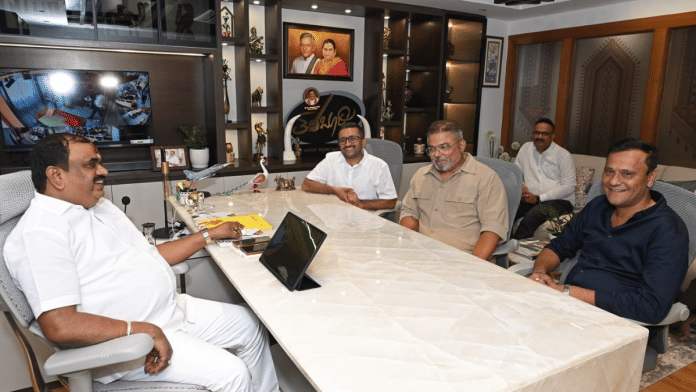
Bengaluru: The Karnataka Rakshana Vedike (KRV), a pro-Kannada organisation, and Raj Thackeray-led Maharashtra Navnirman Sena are teaming up to address federal issues and unplanned migration, which they argue is leading to the imposition of Hindi and erosion of local culture.
Despite a history of conflict over similar issues, the two organisations are now seeking and building common ground with groups in other states on the perceived threat to regional languages and culture.
“This is going to be a pressure group on various federal issues. More than Hindi imposition, it is a joint effort to ensure the eradication of language inequality,” Arun Javagal, the general secretary of the KRV told ThePrint.
The KRV has over 68 lakh active members and is often seen protesting any decision it perceives to be against ‘Nela, Jala, Bashe’ (land, water and language). However, they have remained largely apolitical, unlike the MNS, which regularly contests elections in neighbouring Maharashtra.
The two have regularly fought each other over issues including Belagavi, the Krishna River water dispute, and Mahadayi (Mandovi).
Coming together now, they say that unregulated migration of people to cities like Mumbai and Bengaluru among others, is affecting local culture with more people insisting on making Hindi the common language.
Sandeep Deshpande, the Mumbai city president of the MNS, said that the Narendra Modi-led Bharatiya Janata Party (BJP) government has no intention of resolving any long-standing disputes.
“These are problems that the Centre does not want to resolve. They want states to keep fighting each other. So, we have decided to discuss these issues among ourselves and resolve them,” Deshpande told ThePrint.
He attributed the BJP and other national political parties with relentlessly diluting state issues as ‘regional,’ trying to break language-rights groups, and dismissing them under the garb of ‘national interest’.
Both KRV and MNS are now looking to establish contact with like-minded outfits in Tamil Nadu, Andhra Pradesh, Kerala, Telangana and West Bengal to mobilise support and find common ground.
‘Common minimum programme’
In a meeting Monday in Bengaluru, MNS and KRV decided to come up with a common minimum programme which they will use to raise awareness in other states as well.
The common regional issues include language rights and identity, forcing the Centre to look beyond Uttar Pradesh and Bihar, proposed delimitation and estimated loss of representation, and NEET among others.
“This platform will be against the imposition of Hindi, jobs for locals, issue of uncontrolled migration, high tax collection but poor returns… we want to create some sort of pressure group for the Union government to take our issues seriously,” Deshpande said.
The Raj Thackeray-led MNS has resorted to violence in the past, physically assaulting anyone or anything it considers a threat to ‘Marathi pride’.
In Karnataka, the KRV has also resorted to similar methods, taking the law into its hands under the garb of safeguarding the local language and culture.
The two groups confront each other almost annually around December when the Winter Session of the Karnataka legislature is held in Belagavi, which a section in Maharashtra considers an integral part of itself.
“We are neighbours and have several issues with each other. But we are trying to find common ground as well which would help dilute the other concerns over time,” Javagal said.
With Greater Bengaluru Authority (GBA) elections round the corner, KRV and other pro-Kannada organisations are wary of non-Kannadigas being in the majority in at least three of the five newly carved out corporations.
The two groups believe this is part of a larger plan by the BJP that would further dilute regional identity.
However, this is not the first time that the two groups have come together.
In the run-up to the 2018 assembly elections in Karnataka, MNS, KRV and other language-rights groups came together to resist the imposition of Hindi in the southern part of the country.
At the time, even the Karnataka unit of the Dravida Munnetra Kazhagam (DMK) extended support to these causes.
Deshpande said that KRV will next visit Mumbai later this month or the next, have Zoom calls, and create a 10-point common minimum programme, then convey it to like-minded organisations in other states.
On whether all this will be achieved before the 2029 Lok Sabha elections, Deshpande said, “There is a lot of time but we have to create some sort of pressure group because now there is a one-party dictatorship (at the Centre) that does not consider anything good for the individual state. We have to find common ground and do it ourselves,” he said.
(Edited by Viny Mishra)
Also read: Why Maharashtra govt has put on hold a Hindi proficiency test for its employees