



New Delhi: From broken furniture and damaged windows to a shortage of classrooms and hostel accommodation, India’s central universities are struggling to keep pace with student needs, even as campuses remain unfinished and infrastructure projects languish.
As student numbers grow, the gaps are visible not just in deteriorating infrastructure, but also in the inability to complete projects meant to expand capacity.
At Delhi University (DU), the need for more student accommodation has acquired urgency following the September collapse of a five-storey building housing a private boys’ hostel in Delhi’s Satya Niketan, which killed seven people, including five students.
On 13 October, DU’s Executive Council—its highest decision making body—cleared a Rs 5,889-crore proposal to build new hostels and reconstruct two existing ones, with a combined capacity of 21,895 students. Given the scale of the expenditure, the university has decided to seek additional grants from the Union Ministry of Education as it says it “cannot afford” to take loans.
At the Central University of Himachal Pradesh (CUHP), the Central Public Works Department (CPWD) halted construction at the Dehra campus in September, citing the “non-release of funds” by the Centre due to “administrative reasons”.
Despite more than 90 percent of the work being complete, the campus missed its July 2026 deadline to begin operations, with the target now shifted to January 2027.
The DU and CUHP cases highlight different aspects of the infrastructure pressures facing central universities: One needs additional funds to expand hostel capacity, while the other remains unable to complete a largely finished campus amid delays in fund release.
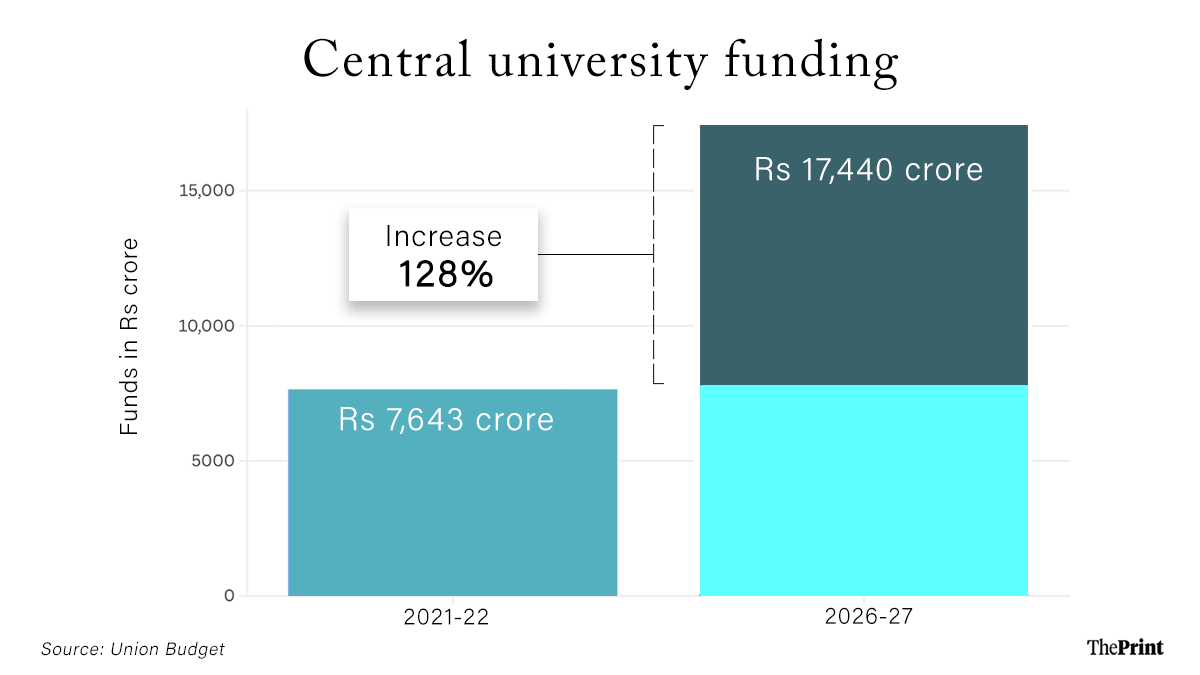
The irony is that government allocations to central universities have more than doubled in five years, rising from Rs 7,643 crore in the 2021-22 Budget Estimate to Rs 17,440 crore in 2026-27. Yet, higher allocations have not eliminated infrastructure bottlenecks, raising questions about whether funding is keeping pace with their growing needs.
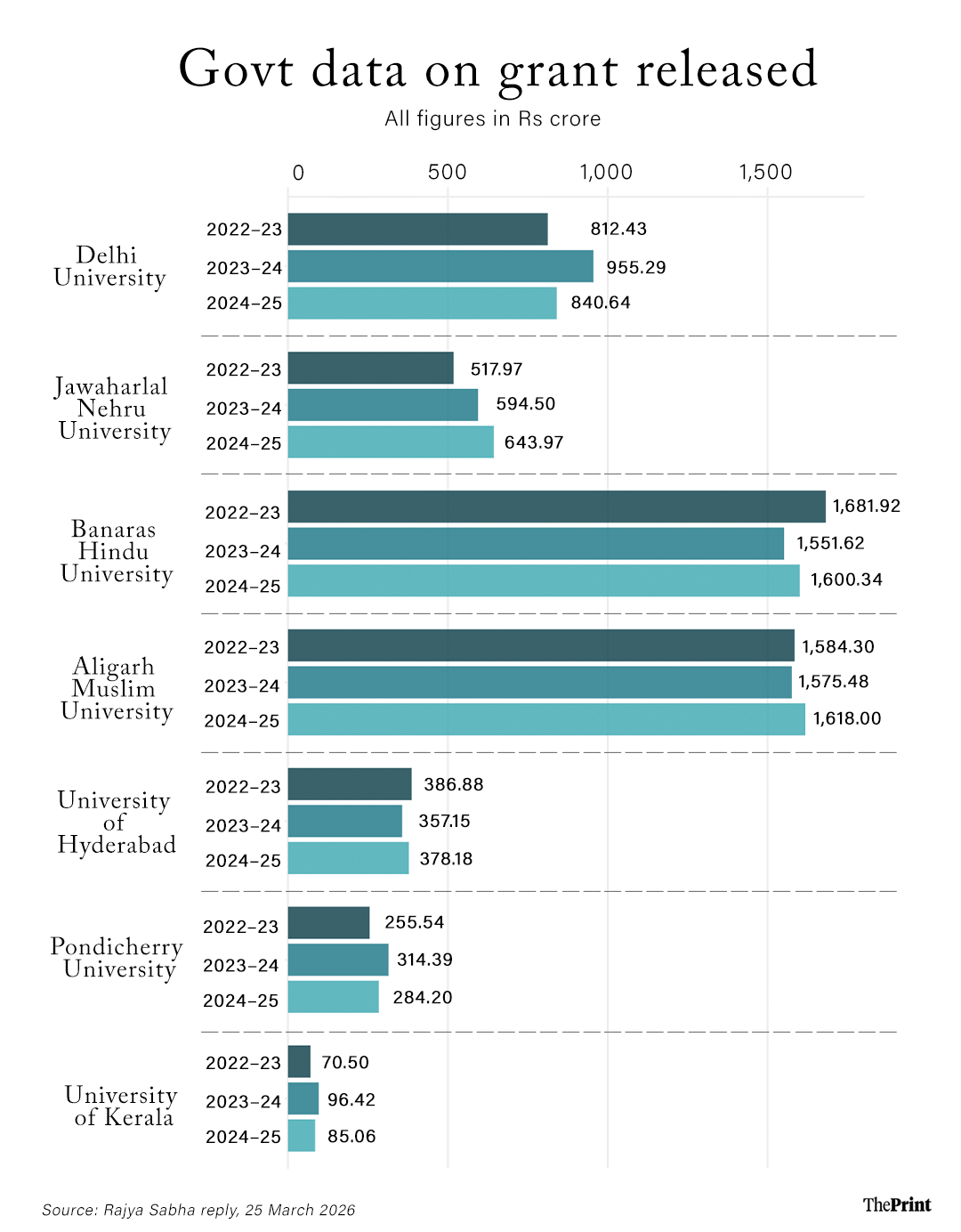
According to data provided by the Ministry of Education in a Rajya Sabha reply on 25 March 2026, grants to individual universities have also risen, though not uniformly. Delhi University’s grants increased from Rs 812.43 crore in 2022-23 to Rs 955.29 crore in 2023-24, while Jawaharlal Nehru University’s grants rose from Rs 517.97 crore to Rs 594.50 crore. Jamia Millia Islamia’s grants, meanwhile, fell from Rs 577.20 crore to Rs 564.16 crore before rising to Rs 613.26 crore in 2024-25, the data shows.
From grants to project-based funding
What has changed over the years is not just the amount of funding available to central universities, but also how infrastructure is financed.
The Union Ministry of Education introduced the Higher Education Financing Agency (HEFA) in 2017 to finance infrastructure projects in centrally funded higher education institutions through loans rather than relying solely on government grants. Set up as a joint venture between the government and Canara Bank, HEFA provides funding for projects such as academic buildings, hostels and laboratories.
The Education Ministry said in a Lok Sabha reply on 3 August 2026 that the government supports university infrastructure, including hostels, through both Grant-in-Aid and HEFA. Since its inception in 2017, HEFA had disbursed Rs 24,977.62 crore in loans to centrally funded institutions, the reply said.
The shift towards project-based financing gathered pace in 2018 under the Revitalising Infrastructure and Systems in Education (RISE) initiative, which sought to move infrastructure funding from the block-grant model to a project-based system.
In August 2018, the Union Education Ministry told the Rajya Sabha that financing for educational infrastructure in centrally funded institutions would henceforth be through HEFA loans.
However, project approval also does not necessarily mean that the entire sanctioned amount has been disbursed or that construction can proceed uninterrupted. Delays in fund release can leave projects incomplete even after work has begun.
Also, unlike regular grants-in-aid, HEFA loans must be repaid, placing an additional financial obligation on universities.
The financial pressure is visible in university accounts. Jawaharlal Nehru University’s (JNU) annual accounts for 2024-25 show an outstanding HEFA loan liability of Rs 38.72 crore, up from Rs 90.59 lakh in 2023-24. This liability represents the amount JNU is obligated to repay against its HEFA borrowings for infrastructure projects.
The University of Allahabad’s 2024-25 financial statements show a negative Corpus/Capital Fund of Rs 213.33 crore, while the Aligarh Muslim University recorded excess expenditure over income of Rs 48.24 crore in the same year.
A former vice-chancellor of a central university in Delhi, who did not wish to be named, said funding had not kept pace with inflation and the growing demand for infrastructure.
“…especially when higher education institutions have to expand their capacity after the introduction of NEP 2020 and four-year programmes. It’s not that universities don’t have money. There are savings from admission fees, student development funds and other sources. But that money should not be used for repayment. It should instead be used for students and the development of universities,” the former vice-chancellor said.
“In the present situation, there is hardly anything left from the capital expenditure and that’s where the mismatch exists,” the former vice-chancellor added.
ThePrint has sent a detailed questionnaire to the Union Ministry of Education but they are yet to respond. This report will be updated as and when the ministry responds.
Grants leave little room for capital spending
A large share of the government grants received by central universities goes towards salaries and other regular expenses, leaving less money within these grants for building classrooms, laboratories and hostels.
For instance, Delhi University’s 102nd Annual Report for 2024-25 shows that it received Rs 828.88 crore in government grants. Of this, Rs 473 crore (57.1 percent) went towards salaries and Rs 313 crore (37.8 percent) towards recurring expenses. Just Rs 42.88 crore (5.2 percent) was allocated for capital assets.
JNU’s 2024-25 annual accounts show a similar pattern. Of the Rs 605.42 crore it received in grants-in-aid, Rs 577.96 crore (95.5 percent) went towards recurring expenditure, while Rs 26.18 crore (4.3 percent) was classified as non-recurring expenditure, which typically includes spending on capital assets.
The figures show how little of these grants was allocated to capital assets compared with regular expenses. However, they do not represent the universities’ total infrastructure budgets, as institutions may also receive funds from other sources and through project-specific financing.
A principal of a Delhi University college said most of the grants received went towards salaries, leaving limited funds for infrastructure development.
“Substantial grants from the UGC go towards salaries, leaving limited funds for developing facilities. We need to keep improving infrastructure for students and teachers, but that has become a challenge,” said the principal, who wished not to be named.
The problem is compounded at newer universities, where delays in fund releases can hold up campus construction.
At the CUHP, Registrar Narendra Kumar acknowledged a delay in the final instalment from the Centre for the Dehra campus project. “There was a slight delay in the issuance of the last installment due to administrative issues. But we have heard it will be released soon,” he told ThePrint.
Rising student numbers deepen the infrastructure strain
The pressure on university infrastructure has also grown as institutions have had to accommodate more students without necessarily receiving a proportionate increase in the classrooms, laboratories, hostels and faculty strength needed to support them.
At Delhi University, the expansion of reservations illustrates the scale of the challenge. The introduction of OBC reservations in 2008 required a 54 percent increase in seats. The subsequent expansion for Economically Weaker Sections (EWS) in 2019-20 and 2020-21 led to a further 25 percent increase in total intake. DU’s notification provided for the EWS-related expansion in two phases: 10 percent in 2019-20 and 15 percent in 2020-21.
A DU college principal, who spoke on condition of anonymity, said successive expansions had required colleges to accommodate substantially more students within existing infrastructure.
“That kind of increase of strength cannot be absorbed into the existing infrastructure. That is obvious. The initial OBC expansion came with additional posts and some funding, but for EWS expansion no posts, no money, nothing has come. Just a 25 percent increase and that’s it. Absorb it as it is,” the principal said.
The principal’s account points to the gap between increasing enrolment and the resources required to accommodate it. More students need additional teaching space, facilities and staff; where funding and posts do not increase in tandem, colleges are left trying to absorb the additional intake within existing capacity.
The introduction of new courses and practical components under the National Education Policy (NEP) 2020 has added to these requirements. A principal of another DU college said institutions needed laboratories and equipment for the new courses but often lacked the money to establish them.
“For example, computers are very costly. One lab can cost around Rs 1 crore, and a computer science programme may need three or four such labs. So colleges have to keep fees relatively high to provide students with the facilities they need,” the principal said.
At JNU, teachers have also raised concerns about the condition of existing infrastructure. The JNU Teachers Association (JNUTA) flagged shortages of essential academic resources, including updated computers, reliable Wi-Fi and funding for seminars. “Classrooms suffer from broken furniture, damaged windows, unusable blackboards, cracked walls, and peeling plaster. Faculty offices lack essential infrastructure and are sometimes structurally unsafe,” JNUTA told ThePrint in a statement, adding that these conditions affected the university’s academic environment.
Concerns extend to JNU’s hostels. In September 2026, after a ceiling fan collapsed inside a room at Tapti Hostel, the JNU Students’ Union (JNUSU) demanded a structural audit of all hostels and university buildings. JNUSU said the administration had previously indicated that Tapti and Mahi-Mandavi hostels had been declared unfit for accommodation, yet students were still being allotted rooms there.
JNU had approved plans in 2021 to establish a School of Medical Sciences and an attached hospital, including an MBBS programme. However, the proposed medical school and hospital have yet to materialise. Sources said the project had effectively been shelved because of a lack of funds.
In August 2024, JNU Vice-Chancellor Santishree D. Pandit told The New Indian Express that the university was considering leasing or redeveloping its properties to generate revenue amid a financial crunch.
Infrastructure development under HEFA has also been slow at Jamia Millia Islamia (JMI). In May 2025, Vice-Chancellor Prof. Mazhar Asif and Registrar Prof. Md. Mahtab Alam Rizvi flagged the “unsatisfactory pace of progress” of HEFA-funded projects to former Education Minister Dharmendra Pradhan, according to a university statement.
A Jamia professor told ThePrint that several projects, including classrooms, remained pending. “It has been more than two months since the academic session began, but I still do not have a classroom assigned for master’s students in my department. The NEP 2020 has increased the demand, but we do not have the infrastructure to meet it,” the professor said.
Sanctioned funds often fall short of actual disbursals
The gap between HEFA funding sanctioned and money actually released is visible in university records. At Delhi University (DU), the Ministry of Finance approved Rs 938.33 crore for seven projects, according to the university’s 93rd University Court meeting in November 2025. Of this, HEFA had sanctioned Rs 576.33 crore for five projects. HEFA had released Rs 60 crore to the Central Public Works Department (CPWD) for three ongoing construction projects and around Rs 36.5 crore for the university-wide Wi-Fi expansion.
At its 13 October meeting, DU decided to seek grants-in-aid from the Ministry of Education to build new hostels and maintain existing ones. Registrar Vikas Gupta told ThePrint that the projects would cost around Rs 6,000 crore, an amount the university could not afford to raise through HEFA loans.
“Ten percent of Rs 6,000 crore would amount to Rs 600 crore, which would be a substantial sum for the university. It is not possible for us to take such a large loan. That is why the university has decided to request grants from the Ministry of Education,” he said.
At the Hemvati Nandan Bahuguna Garhwal University (HNBGU) in Uttarakhand, the 2024-25 annual report shows three HEFA-funded projects with a combined estimated cost of Rs 44.60 crore, but only Rs 11.46 crore had been released by March 2025.
The projects included a science block, an examination, laboratory and faculty block at Srinagar, and a boys’ hostel. University finance officer A. K. Mohanty told ThePrint that some additional funds had been released since then, but a new project proposal worth Rs 440 crore, submitted in January, was still pending.
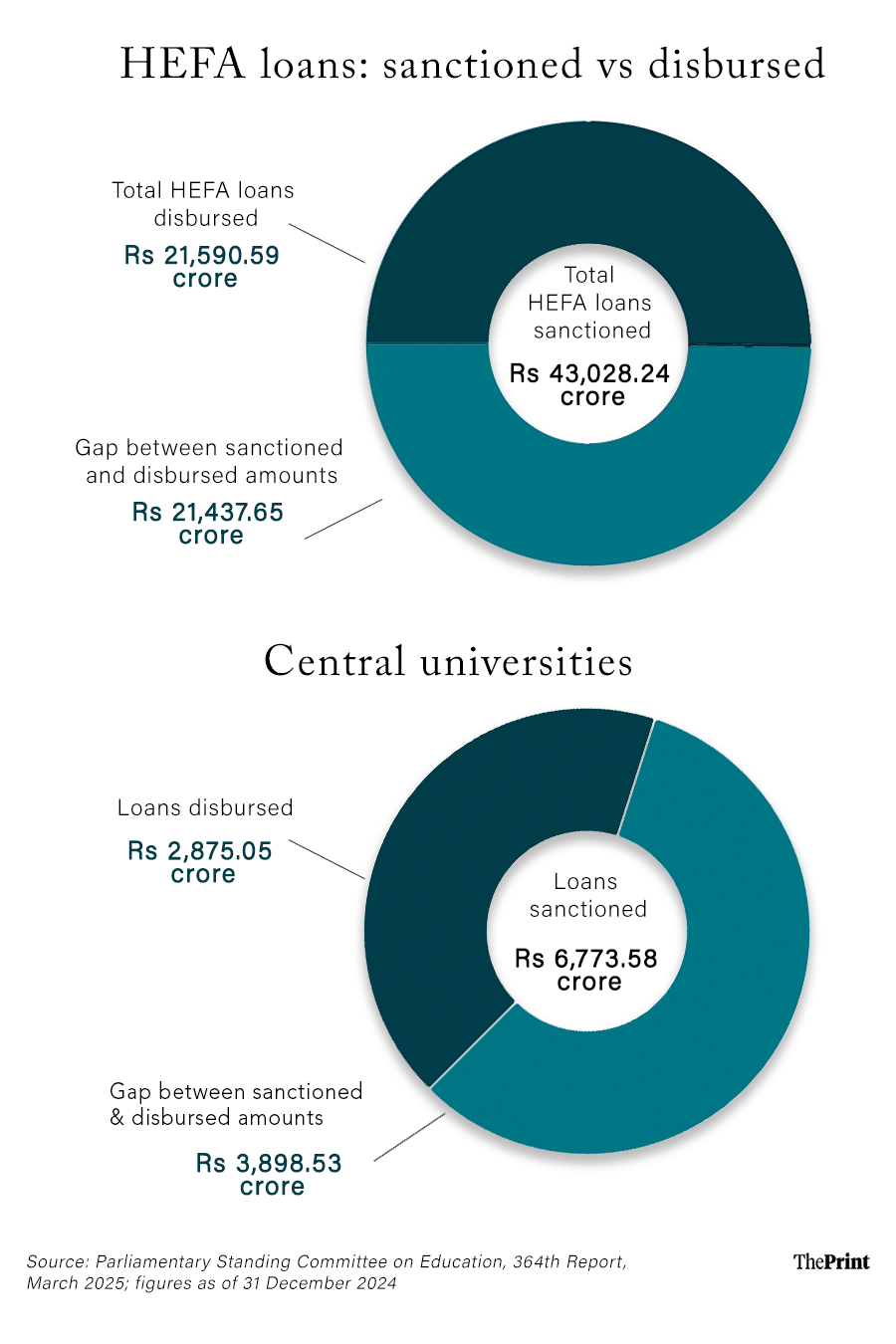
The gap is also visible at the national level. As of December 2024, HEFA had sanctioned Rs 43,028.24 crore but disbursed Rs 21,590.59 crore, according to a parliamentary committee. The committee recommended that HEFA be used as a supplement, not a substitute, for government grants, and said the Centre should continue financing capital expansion through grants while allowing institutions the option to borrow through HEFA. By March 2026, total disbursements had risen to Rs 24,977.62 crore.
A senior government official told ThePrint that sanctioning a HEFA project did not mean the funds would be released immediately. Institutions first had to begin work and raise a demand, after which funds were released according to project progress.
“Interest on a HEFA loan starts accruing from the day of disbursement. That is why, until universities show progress on the project, the money is not disbursed. In most of these cases, that could be a possible reason for the delays,” the official said.
HEFA loans leave universities with repayment obligations
HEFA financing also creates a long-term financial commitment for universities. Under the financing structure described here, central universities and other non-technical institutions established before 2014 have a 10-year repayment window, while those established after 2014 have a 15-year window. Institutions are required to repay 10 percent of the principal over time, while the government bears the remaining 90 percent and the full interest component.
Although this arrangement reduces the immediate cost of infrastructure projects for universities, institutions must still meet their share of the principal repayment from their own resources, adding to their existing financial commitments.
Abha Dev Habib, associate professor at Delhi University’s Miranda House, said even the 10 percent contribution could be a significant burden for universities because it had to be met through their own revenues.
“They want you to pay 10 percent. But 10 percent is also huge. Why should universities have to pay? When you are talking about public-funded universities, whatever university infrastructure exists today, 95-96 percent has been there because of grants. Now, when we talk about infrastructure development, everything has been replaced by HEFA loans,” she said.
When public universities have to find their own money
While HEFA shifts part of the cost of infrastructure projects to loans, it also puts pressure on universities to generate their own revenue to meet repayment obligations and fund development.
The 364th report of the Department-related Parliamentary Standing Committee on Education, Women, Children, Youth and Sports, presented in March 2025, cited a review by the National Institute of Public Finance and Policy (NIPFP), which found that, on average, 78 percent of the internal revenue of institutions that had taken HEFA loans came from student fees. In some institutions, fees accounted for 100 percent of internal revenue.
But accessing HEFA funding can itself be a challenge for colleges that lack the staff and technical expertise to prepare project proposals. A Delhi University college principal said the process required detailed plans, architects and approvals from multiple authorities, resources the college did not have in-house.
“We have to hire people to prepare the layout, make a master plan and then get approval from different authorities. We don’t have a dedicated estate officer or engineer to make the plan. Hiring such people is a challenge. I have to hire an architect,” the principal said.
The college had earlier upgraded its building with funds provided during the expansion of infrastructure following the introduction of OBC reservations. It is now considering HEFA financing to renovate a hostel with around 200 seats, which the principal said had been in poor condition for nearly a decade.
Meanwhile, colleges are also grappling with rising costs and pressure to increase their own revenue. The principal said the college’s annual fee, which was around Rs 10,000 in 2014, had risen to roughly Rs 29,000-36,000, depending on the course.
Increase in fee has become a major bone of contention at other central universities too. At Allahabad University, students protested in 2022 after annual undergraduate fees rose from Rs 975 to Rs 4,151, an increase of more than 300 percent. The university said the revision, its first major increase in 110 years, was needed to introduce multidisciplinary courses under the National Education Policy (NEP) 2020 and hire teachers.
These examples do not establish that HEFA directly caused the fee increases, but they illustrate the wider financial pressures on public universities as they expand courses and infrastructure while meeting rising costs.
The pressure to generate internal revenue is also reflected in the expansion of self-financed professional programmes with higher fees at central universities.
At Delhi University, the listed BTech fee for the 2026–27 academic session was Rs 2.35 lakh, significantly higher than the fees charged for many conventional undergraduate courses.
The Central University of Jammu charges a one-time self-financing fee of Rs 90,000 for programmes including Computer Science and Technology, M.Tech ECE, MA Mass Communication and New Media, and Rs 75,000 for MA English and Social Work, over and above the regular programme fee.
Prof. Sukhadeo Thorat, former chairperson of the University Grants Commission (UGC), told ThePrint that pressure to generate internal revenue was pushing central universities towards self-financed courses.
“I have done an analysis of Karnataka, where 44 percent of students are enrolled in private institutions and 30 percent are enrolled in self-financed courses, whose fees are almost similar to those of private institutions. It is a very disturbing trend, and it reduces access to quality education for the poor,” he said.
The funding challenge comes as demand for university infrastructure continues to grow. In a Lok Sabha reply in August 2026, the Education Ministry described affordable hostel capacity as “core academic access infrastructure”.
For central universities, the challenge is to expand infrastructure and meet growing student needs without placing an excessive burden on students through higher fees or taking on loan commitments they cannot afford.
As they weigh government grants against HEFA loans and revenue from fee-paying programmes, the question remains whether they can bridge infrastructure gaps while keeping public higher education affordable. DU’s request for grants-in-aid is one test of how that balance will be struck. Whether the ministry agrees to DU’s request for grants-in-aid remains to be seen.
(Edited by Viny Mishra)
Also read: University townships—India’s chance to build its own version of what America got right