


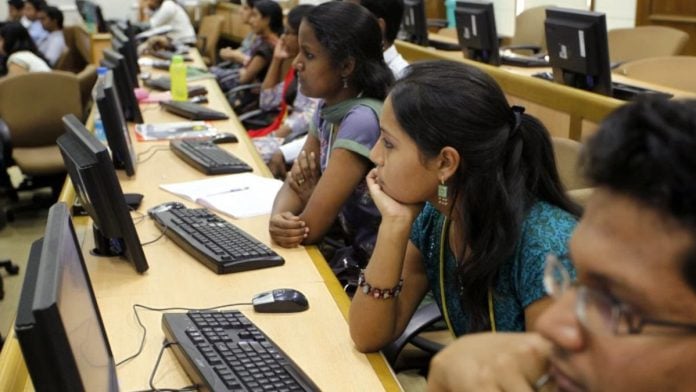
New Delhi: More than half of India’s employed young graduates work in occupations classified as low-skill, according to a new working paper by the Economic Advisory Council to the Prime Minister (EAC-PM), which flags the uneven returns from higher education even as enrolment in colleges and universities continues to rise.
The paper, titled ‘How India is Transforming Educational Capacity under the New Education Policy 2020: School Networks, Higher Education and Pathways to Work’, was published this month. It was authored by Soumya Kanti Ghosh, a member of the EAC-PM and Group Chief Economic Adviser at the State Bank of India (SBI), and Shashidharan Sharma, an economist at SBI.
Citing the India Employment Report 2024, published by the International Labour Organization (ILO) and the Institute for Human Development (IHD), the paper highlights two aspects of graduate employment. It notes that 52.8 percent of employed young graduates were working in low-skill occupations in 2022.
Among employed youth with a graduate degree or higher, 57.8 percent were in regular salaried employment, while only 36.1 percent were in formal employment, the paper states.
The authors, however, caution that these figures do not establish individual skill deficits or prove that degrees have lost their value. Instead, they point to “uneven returns”, increasingly dependent on the quality and reputation of the institution and programme.
“The general degree did not become worthless, but it became less informative on its own. Employers facing uncertainty about applicants increasingly differentiated among degree holders by institution, field, examination performance, internships, experience and networks,” the paper says.
The authors describe this as “qualification congestion”—a situation in which families continue to see degrees as the safest route to social and economic mobility, while employers increasingly distinguish between candidates on the basis of institution, field of study, experience and other signals.
The paper also points to the limited reach of alternative pathways. Formal vocational or technical training covered only 5% of people aged 15-29, according to the Periodic Labour Force Survey 2025.
“Qualification congestion is therefore an institutional equilibrium rather than an error of aspiration,” the authors write, arguing that vocational routes need to offer recognised qualifications, decent earnings and clear progression into further education and skilled work.
The paper states that its findings and arguments are the authors’ views and do not necessarily reflect the official position of the EAC-PM or the government.
Also Read: More educated than ever, but struggling to get jobs—global media analyses India’s youth ‘paradox’
As fertility falls, EAC-PM paper flags school network rethink
India’s school network is changing, with fewer reported schools but more institutions offering education up to higher classes. The authors link this partly to a shrinking population of primary-school-age children and the operational constraints faced by very small schools.
India’s total fertility rate fell from 2.1 in 2019 to 1.9 in 2024. The population in the five-to-nine age group, which stood at 12.53 crore in 2011, is projected to fall to 11.27 crore in 2026 and 10.02 crore by 2036, according to official projections cited in the paper.
The number of reported schools fell from 15.51 lakh in 2018-19 to 14.67 lakh in 2025-26 — a decline of 84,000, or 5.4 percent. Primary-only schools, offering Classes I to V, fell from 8.27 lakh to 7.22 lakh, a reduction of 1.05 lakh, or 12.6 percent. In contrast, schools offering education up to Class XII increased from 1.30 lakh to 1.69 lakh, a rise of 29.7 percent.
The authors say very small schools may struggle to provide adequate teachers, facilities and a wider range of learning opportunities. The NEP 2020 proposes school complexes or clusters, through which nearby institutions can share teachers, infrastructure, leadership and professional development without necessarily shutting down individual teaching sites.
However, the fall in reported school numbers should not be treated as a count of closures, the paper states, adding that a primary school upgraded to offer Classes VI to VIII, for instance, would no longer be counted as a primary-only school even if it continued functioning on the same campus.
Therefore, it says that the decline could also reflect mergers, management changes, openings, deactivations of school codes or corrections in the administrative register.
The authors caution against using falling child populations as an automatic reason to close schools. “The evidence therefore supports demographic planning without demographic determinism,” they write, adding that projections “do not identify a closure” or prescribe a uniform number of schools for a district.
Change in enrolment patterns
They also point to changing enrolment patterns. Between 2012-13 and 2021-22, enrolment in rural-located schools fell by about 78 lakh, while that in urban-located schools rose by around 93 lakh.
This suggests some areas may need additional capacity while others see fewer pupils. “A school network must provide access as well as capacity,” the authors write. They say decisions must account for local conditions, including terrain, road access, travel safety and the capacity of nearby schools.
Education expands, but faculty vacancies remain a constraint
India’s higher education enrolment increased by 31.5 percent, from 3.42 crore in 2014-15 to 4.50 crore in 2023-24. However, the paper flags faculty availability as a constraint on the expansion of institutional capacity.
“Expansion is constrained by people as well as buildings,” the authors write.
The number of teachers reported by the All India Survey on Higher Education (AISHE) rose from 14.73 lakh in 2014-15 to 17.32 lakh for responding institutions in 2023-24 — an arithmetic increase of 17.6 percent, lower than the rise in estimated enrolment. The authors caution that differences in estimation, response coverage and classification mean the figures cannot be treated as a precise like-for-like national comparison.
Faculty vacancies were also significant in prominent public institutions. In March 2023, vacancies accounted for 39 percent of sanctioned faculty posts at the IITs, 31 percent at the IIMs and 29 percent at the NITs, according to figures cited from a parliamentary standing committee report.
The paper notes that these figures are dated and do not measure the quality of serving faculty. However, “they demonstrate that staffing constraints extend even to prominent public institutions,” the authors said.
The authors argue that institutional capacity cannot be measured only through the number of campuses, seats or buildings. It also depends on whether institutions have the personnel and support systems needed to deliver teaching, research and practical training.
(Edited by Anupama Yadav)
Also Read: Only 42.6% Indian graduates are employable; non-technical skills, creativity low—Mercer report