


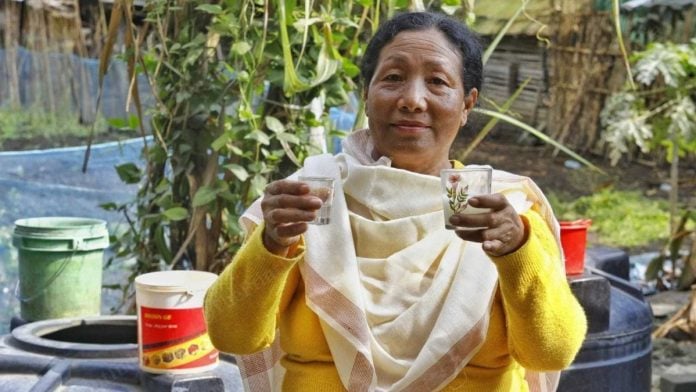
Imphal/Kakching/Chandel: An alcoholic sweet-and-sour aroma wafts around a quiet courtyard in Andro, a foothill village about 25 km east of Imphal in Manipur. It comes from a makeshift mud stove, a mix of woodsmoke and fermenting rice.
Yu is being prepared, as it has been for generations in almost every household of this Meitei village. The fermentation and distillation of rice produces the traditional alcoholic beverage. Andro is one of the villages known for the locally made brew.
For 55-year-old Chingakham Memcha, this has been her everyday routine for more than two decades. Beginning at 8 am and working until the sun sets, Memcha, wearing the traditional wraparound called ‘phanek’, washes rice, sets it to ferment, and quickly manages the boiling pots.
Yu is no quick-fix intoxicant or merely a side-gig. Rice wine and beer are an essential part of religious rituals and community life in Andro.
That quiet routine came to a sudden halt this past week, when 17 people died after consuming spurious liquor in the neighbouring districts of Chandel and Kakching.
According to Manipur Police sources, the victims in Chandel had purchased the liquor from Sugnu, a batch allegedly traced back to Andro. In the aftermath, police and excise officials arrested nine people from the village, registered 159 cases under the Excise Act, and launched a sweeping statewide crackdown, even as a Special Investigation Team (SIT) probes the supply chain and health officials screen hundreds of residents.
Yu is at the centre of this crackdown. How is it made? Has this age-old craft been touched by modernity? Who are the people behind it? What happened after Manipur lifted its three-decade-long prohibition in December 2023? ThePrint travelled to Andro, Sugnu and Chandel to find out.
The ‘secret’ craft of making rice wine
Located in Manipur’s Imphal East district, Andro is inhabited by the Chakpa, a Scheduled Caste sub-community of the Meiteis, and has long been preserved as a centre of indigenous Manipuri heritage and pottery.
Andro’s standout feature is a tin shed tucked into every courtyard, the ubiquitous housing for a small makeshift brewing set-up. Earthen pots, bags of rice and water stored in large buckets complete the picture.
Both brewing and pottery are strictly the domain of married women. Dressed in a baby-pink phanek and sweater, Memcha explains that she only learnt the craft after her wedding. Like most women in Andro, she does not sell her brew in the open market. “Middlemen come to our doorstep, collect the liquid, and bottle it themselves,” she tells ThePrint.
“Yu cannot be rushed. We have to wash the grains and ferment them; a single batch takes roughly two weeks,” she says.
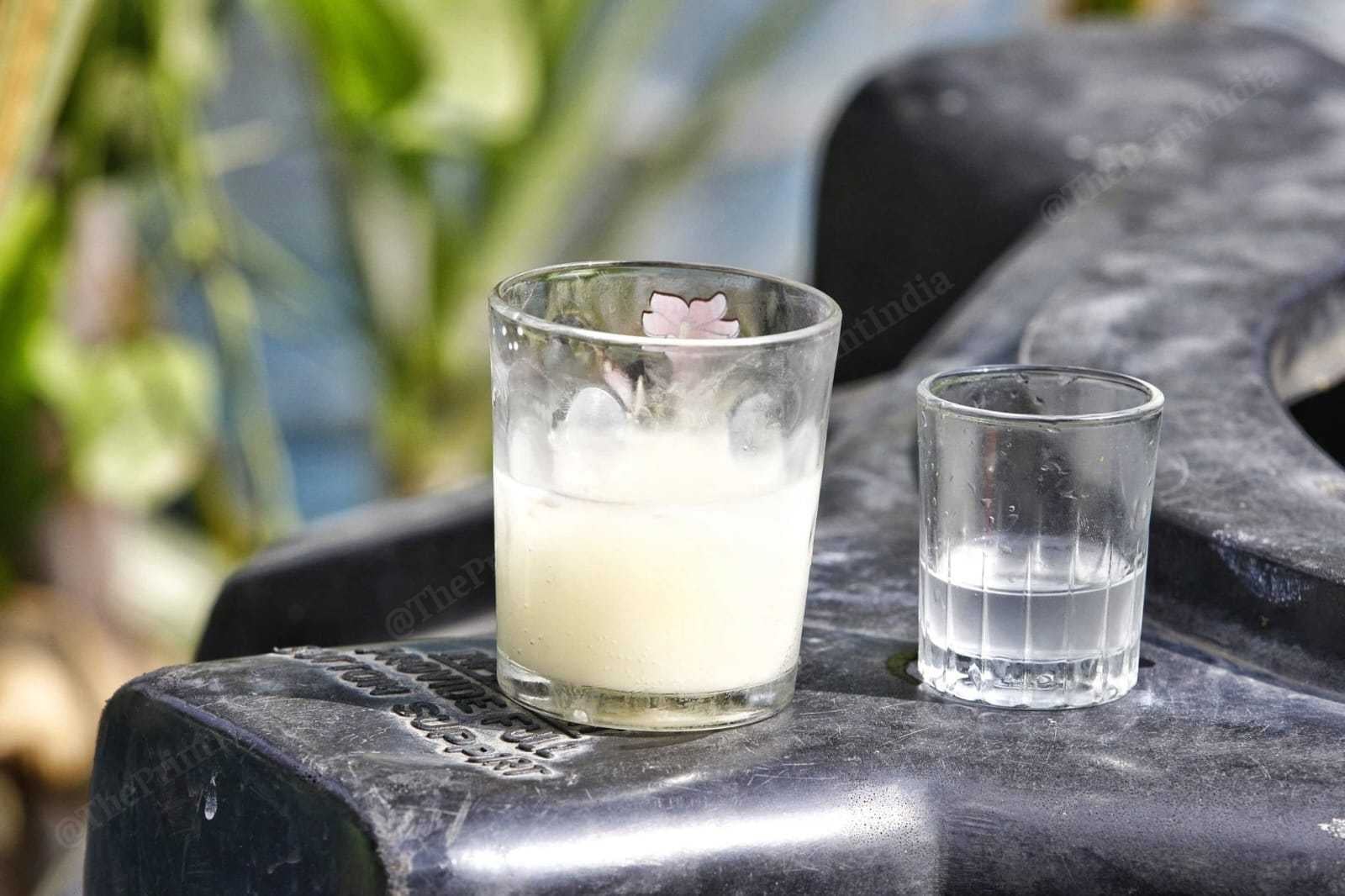
To make eight litres of distilled rice wine, or popularly known as ‘atingba’, Memcha starts with 10 kilogrammes of local Manipuri rice, soaking it in water overnight. The next day, she separates out all the ‘yangli’, the fine husk bits that float to the surface, and kneads it with rice flour into flat, bread-like cakes called ‘humai’, the local yeast.
“The soaked rice is then steamed for three to four hours before being mixed with the humai. Covered with a cloth, the mixture is left to ferment for four days. It is topped up with cool water, and left undisturbed for another six to seven days,” she says, proudly holding two humais in her hand.
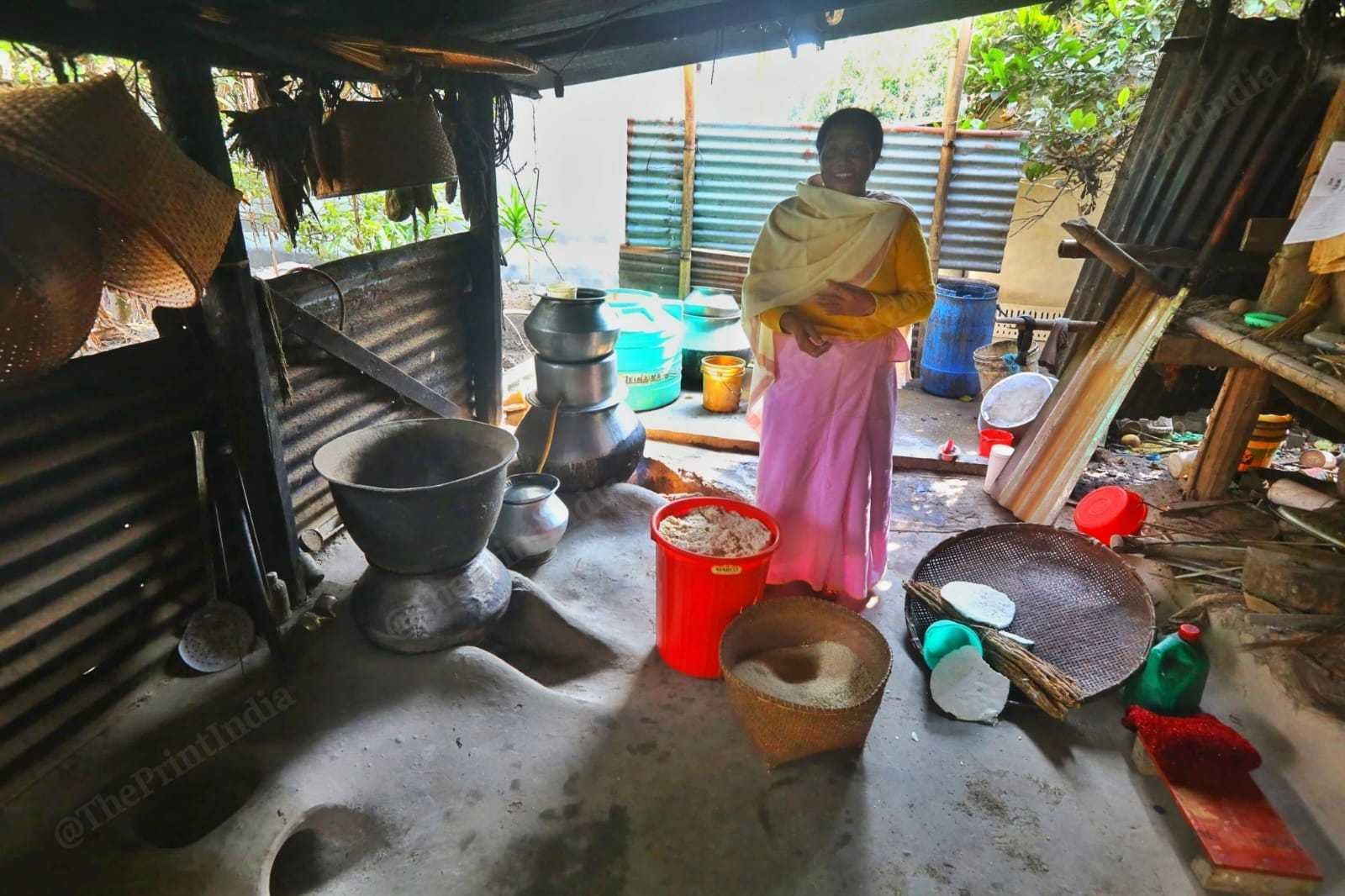
Finally, the fermented mash is transferred to a vessel for distillation, heated for four hours with a cooling pot of water balanced on top until clear drops of liquor collect inside.
For all that labour, the margins are pretty thin. Memcha spends about a thousand rupees on a single 10-kilogramme batch—half of it on rice, and the remainder on firewood and water.
Distilled yu is sold for about Rs 200 a litre, while rice beer sells for half that. A fortnight of work with fires and pots yields roughly Rs 300 in profit per batch.
“Wine is a ritual in our town, yet people outside look down on us because we make it,” Memcha says, adding that most families brew quietly behind closed doors. “Some people have used it the wrong way.”
Historically, every stage of that distillation relied on earth, not metal. Now, people have started using steel, even aluminium.
A few lanes away, sits 70-year-old Phanjoupa Khema. Her phanek is purple a striking contrast with the dark clay vessels in her shop.
Married into the village 50 years ago, Khema has spent half a century shaping clay using only a flat stone and a wooden bat to beat the mud into usable structures. A 2013 National Merit Award winner, she now trains younger women to shape pots.
Khema points out the three distinct earthen pots traditionally stacked for distillation. “There’s ‘uphu’ at the base, ‘ngangkok’ in the middle, and ‘uyasaphu’, the small vessel where the distilled wine finally collects, alongside esingzaphu to hold water,” she explains in Manipuri.
“Earlier, everything was made in earthen pots,” Khema says. “Now, aluminium and plastic have replaced them.”
Also Read: Fear & panic fuel hospital rush in Manipur amid hooch tragedy. Anxious villagers queue up for tests
Anatomy of a tragedy
The yu of Andro may well be bound by ritual, but what unfolded eight kilometres away from Sugnu in Chandel’s Chakpikarong sub-division exposes a very different reality.
The breakdown of older local supply chains after the 2023 ethnic violence, and the absence of regulation in a state shaped by prohibition birthed a shadowy network moving country-made liquor across district boundaries. “There are no licensed liquor shops in Sugnu. Instead, alcohol moves underground, sourced from valley hubs like Andro and sold discreetly out of homes and basements in Sugnu town,” a senior police officer says.
For men in Chakpikarong, where local sale is prohibited, procuring a drink meant taking a shared private jeep to Sugnu for Rs 30 to Rs 50, buying two or three plastic bottles, and carrying them back home.
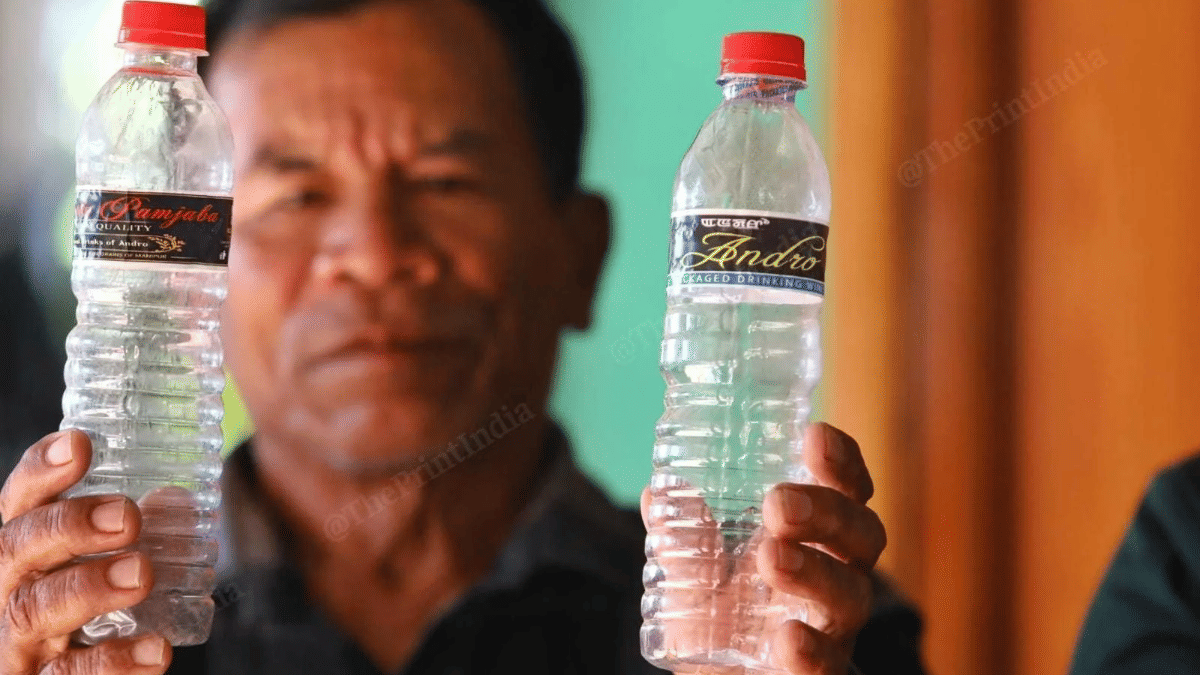
The packaging looks legitimate. One plastic bottle, shaped like a mineral water bottle, carried the label Andro with ‘packaged drinking wine’ printed underneath. Another read ‘Nagola Pamjaba’, marked further as ‘premium quality’ and ‘brewed from the finest rice grains of Manipur’.
Between 17 and 19 November, residents across Chandel and Kakching districts bought these bottles in Sugnu and drank them after returning home. Within hours, the same symptoms came up: severe burning in the stomach, vomiting, and sudden, partial blindness.
Panic ripped through the villages like a tsunami making landfall as families struggled to understand what was happening.
What began as a chaotic night at the Community Health Centre in Chakpikarong and District Hospital, Chandel, quickly reached Imphal, about 100 km away, as ambulances and private vehicles brought hundreds of patients to Shija Hospital, Babina Hospital, Jawaharlal Nehru Institute of Medical Sciences (JNIMS), and the Reginal Institute of Medical Sciences (RIMS).
“On examination, doctors found symptoms consistent with methanol poisoning, prompting suspicions that they had consumed spurious liquor,” Dr Sorokhaibam Jugindra Singh, Director (Medical Services) at Shija Hospital, told ThePrint.
Across Imphal and Chandel, hospital wards ran round the clock to screen incoming patients, run toxicology and organ-function tests, and keep hundreds under 24-to-48-hour observation as the local brew mutated into a mass medical emergency.
From valley to the hills
Half-litre bottles selling for Rs 50 do not move by themselves. It’s a well-oiled machine.
According to a senior Manipur Police officer, liquor from traditional valley brewing hubs like Andro is “packed, concealed inside jeeps and four-wheelers, and taken across places like Sugnu, where middlemen who have worked the trade for years sell it out of basements”.
Police investigations into the recent deaths have pointed to specific links along that chain. Arrested suspects include Khaidem Jadumani Singh (57) of Sugnu Makha Leikai, Kangabam Surjit Singh (40) and Kangabam Ratan Singh of Sugnu Moirangthem Leikai, Khaidem Naoba Meitei (32), owner of Eikhoi Hotel in Sugnu Pamang Leikai, Ningthoujam Joykumar Singh (45) of Andro Kharam Leikai, and Sagolsem Das Singh (40) of Andro Chingdong Leikai.
“Preliminary police findings indicate Surjit Singh allegedly procured liquor from two individuals identified as Das and Nganbi of Andro, with one Dara of Sugnu Awang Leikai storing stock on Nganbi’s behalf, while Ratan Singh allegedly sourced from someone identified as Leima of Andro,” the police officer says.
Former Deputy Chief Minister and former Director General of Police Yumnam Joykumar Singh, explains the geography of the network. “Out here the districts are very small… crossing a district would be maybe about 30–40 km, not more than that,” he says. Inter-district movement of locally distilled liquor has long slipped past weak checks by the excise department as well as the police.
Joykumar, with a science background, doubts the poison began inside Andro’s distillation pots. “If the original brew made in Andro had been toxic from the start,” he said, “deaths would have been reported in Andro and Sugnu as well, and a contaminated batch at source would have killed far more people.”
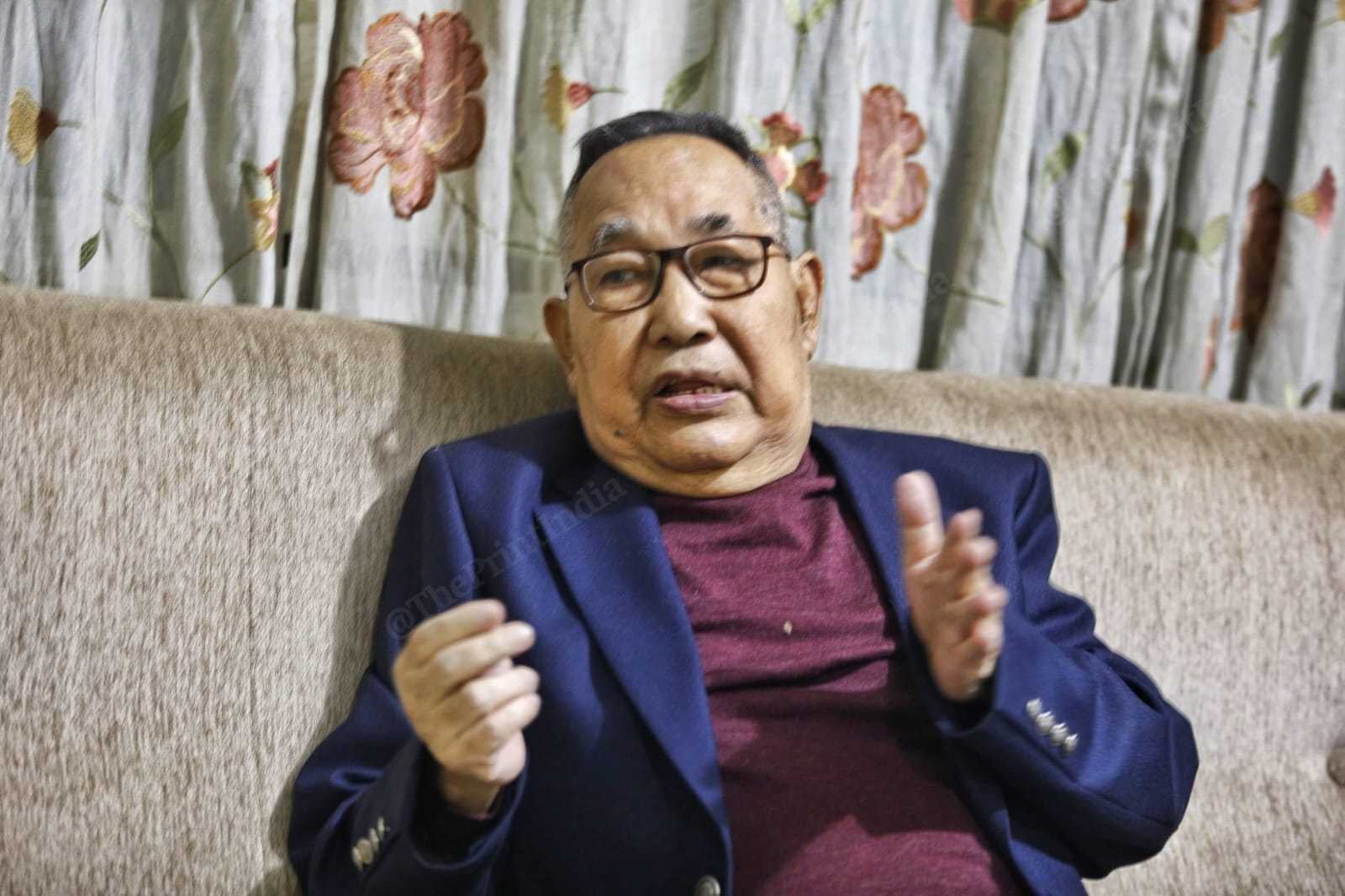
Instead, he points to adulteration along the route or at the point of sale.
That movement is part of a wider smuggling system.
Police officers say that liquor is brought in from cities like Delhi by air, while security forces and state police regularly intercept bulk consignments on the highways and along the porous Manipur–Myanmar border, “where illicit drugs also move freely alongside links reaching toward China in the north and Bangladesh in the south”.
On the ground in Andro, local groups want a temporary ban on liquor sale and consumption until lab reports clarify what happened.
The policy framework
Manipur’s history with alcohol has long been shaped by prohibition, and by the gap between law and habit.
An excise department official told ThePrint that while a prohibition law was enacted in 1991, it took effect in 1994, replacing a time when licensed liquor shops existed. “Through the 1970s and 1980s, rising alcohol and drug use strained households across communities. Women led groups, the Meira Paibis, who had taken to night patrols with flaming torches in the late 1970s,” he said.
Interestingly, he added, “They pressed against addiction and bootlegging, alongside nishaband (nasha mukti) women’s groups, student bodies, and civil society organisations across Meitei, Kuki, and Naga areas.”
Yet bootleggers and habitual drinkers kept finding ways around bans enforced by women’s groups, while liquor poured in from neighbouring states whenever local supply fell short of demand.
Over the years, the state tried to carve out exceptions and rules. Amendments in 2002 allowed liquor in certain areas, and the push toward legalisation gained fresh momentum in 2022 amid debate, protests, white papers, and expert panels.
In December 2023, the government lifted prohibition in four categories of areas: Greater Imphal, hotels with 20 or more beds, district headquarters, and tourist spots. The excise official said, “This was followed by the launch of the Manipur State Beverage Corporation Limited in 2024 for government-run retail, though only six hotels and 15 retail shops have opened statewide.”
Traditionally, brewing and commercial preparation by Scheduled Caste Meitei communities in villages like Sekmai, Phayeng, and Andro, as well as traditional making among some Scheduled Tribes, have existed alongside these shifts, he said.
“The state has been working since 2024 on a Manipur Country Liquor Policy, consulting villages and studying models in states such as Goa, Madhya Pradesh, Assam, and Chhattisgarh to test, standardise, and support a craft tied to village livelihoods and women’s incomes,” the excise official added.
Enforcement, however, remains tough across departments.
Another excise official says the department runs at a thin sanctioned staff strength across 41 excise stations, even though recruitment has been notified and staff from different communities serve in their respective areas, including Kuki and Naga officers in their own community areas. “To track outside liquor, the department uses holograms to trace supply down to the last consumer and mandates UPI or card payments,” he says.
Since 17 November, officials say, over 6,000 checks have been conducted, with 159 Excise Act cases registered and 6,498 litres of illicit liquor seized, while samples were sent to Kolkata for testing and a high-level inquiry was set up.
Joykumar says the staffing crunch dates back years. When he was excise minister, he recalls, roughly 400 of 600 posts were already vacant. While an Opposition-led committee he chaired once recommended lifting prohibition on locally distilled liquor with proper controls on distillation and sales, he lost the subsequent election before those rules were put in place, and says successive governments failed to build quality checks and testing systems even after lifting the ban.
Policing priorities have also been shaped by prolonged unrest.
While Joykumar argues that policing illicit liquor is an additional task rather than the core police mandate of crime detection and investigation, he agrees that years of security and law-and-order duties have heavily taxed Manipur Police.
For now, the tragedy in Chandel and Kakching has turned a policy question into an urgent test of regulation. That question has a bottomline too: the livelihoods of the women who make yu.
Remains of the day
In the middle of conversations around the policy, police reports, arrests, and seizures, affected families continue to struggle in coping with the loss.
Kishun Hrangbung, 40, from the Naga community, cultivated plants for a living in Nungpan village in Manipur. He too drank liquor in Sugnu before returning home. He started vomiting when he reached home and struggled through the night. In the morning, he was taken to the Community Health Centre Chakpikarong, but he died within 30 minutes, his brother said.
As the family mourns Kishun’s death, their anger is palpable. “We demand answers,” they say. “Kishun, and so many other men who have died in our village, made a mistake by consuming alcohol. But, the government has to take strong action against the perpetrators. Who was responsible for making this spurious liquor? Who was responsible for selling it, and then distributing it to our people? Who will take responsibility?”
Nungpan is a Christian village with its own strict rules. Residents say the sale of liquor is prohibited. So, anyone who wants to drink has to go to Sugnu to procure it.
The ethnic violence also changed the way liquor was supplied to the village. Hrangbung Bebising, Kishun’s uncle, explains that earlier, members of the Zou community in Sugnu used to make alcohol. They would share the liquor they made and even allow people to sit in their homes and drink. Public transport was available back then, and buses also plied on the route. A few Meiteis made liquor as well.
“After 2023, the Zou community had to flee the area to Churachandpur,” he said. Bebising’s uncle has kept the two bottles Kishun brought from Sugnu. “I don’t know what to do with these two bottles that killed him. Am I to throw them away? Will the police need it? It haunts us every single day… knowing it was a bottle of alcohol that killed him,” Bebising told ThePrint.
Bebising understands that there are no licensed liquor shops in the area, but he has a question: “Why is liquor being sold with no licence then? Shouldn’t the government do something about it? You can’t ban liquor, but can you not enforce stronger regulations?”
(Edited by Nardeep Singh Dahiya)