


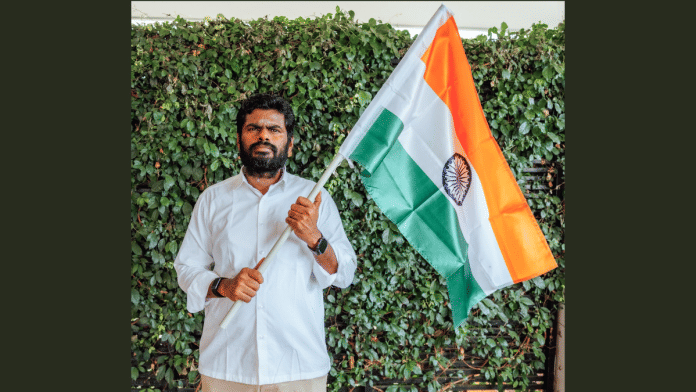
New Delhi: When a democracy cannot hear its young members, it begins to lose its future, and that’s when the “cynicism” of the Cockroach Janta Party becomes visible, former IPS officer and politician K. Annamalai writes in his new book.
“When institutions are slow to respond, citizens must be quick to organise. When power becomes defensive, society must become more vigilant. When students stand up for fairness, they are not being disruptive; they are defending the moral foundation of the republic. A democracy that cannot hear its young has already begun to lose its future,” says the book, titled ‘Unfinished Hope: A Political and Governance Book on Indian Democracy, Public Institutions, Civic Action and Nation-Building’.
It is in such moments, the book says, that “the cynicism of the so-called Cockroach Janta Party becomes visible; the politics that survives in darkness, feeds on decay and hopes that people will eventually get tired, confused or divided.”
“It (the CJP) is not merely a party in the electoral sense. It is a mindset. It is the belief that citizens can be managed, that outrage can be exhausted, that truth can be buried under noise and that public memory is short. But India’s young have shown, again and again, that they are not as forgetful or as helpless as the powerful imagine,” he writes.
The epilogue to the book says that the student protests against the NEET paper leak began as an examination failure, but soon turned into a “crisis of trust”.
“Young students who had spent years preparing, parents who had sacrificed everything and families who believed in the promise of merit suddenly found themselves asking a painful question: If even the gateway to opportunity is compromised, where does the ordinary citizen go for justice?” the book asks.
It asserts that the anger was not just about a single paper, exam or administrative lapse, but about a “deeper fear that the system which meant to protect aspiration had begun to betray it”. It then says that when such a crisis starts snowballing, the response of those in power matters a lot.
“A government can either listen early, act transparently and restore confidence, or it can dismiss, delay and manage perception while the wound deepens. Too often, we have seen the second instinct prevail. Also, when citizens step forward, the time of ‘manufacturing consent’ will also be over,” he writes.
Annamalai on Hindi imposition
The book claims to be a “candid assessment of independent India”, and addresses several concerns standing in the way of making the country easier, cleaner, safer and more dignified to live in.
Talking about religion becoming a tool of political mobilisation in India, and a means of “dividing people, stoking fears and consolidating power”, he asserts, “When a politician invokes religion not to unite but to polarise, not to inspire but to incite, they are committing a kind of spiritual fraud—using the sacred to serve the profane.”
Throughout 21 chapters, the book addresses several such concerns and offers solutions. In the chapter on workers and their dignity, the book appreciates the new labour codes launched in November 2025, saying that they “protect workers without strangling enterprises”. In the chapter on education, the book says that the New Education Policy (NEP) introduced by the Centre in 2020 is a step in the right direction.
“The emphasis given to Indic thinking is a step that was long overdue to make our primary education rooted in our soil. The NEP is interlinked with central government funding to improve public schools like, PM SHRI,” the book asserts.
However, Annamalai says that the policy is, “unfortunately, caught in a political quagmire in states like Tamil Nadu, Kerala and some other opposition states. Therein lies the tale of intent versus political upmanship.”
It also looks at the politics of language, and acknowledges that for Tamil Nadu, the imposition of Hindi has always been a flashpoint.
“This anxiety is not about Hindi as a language, it is about what Hindi represents: The dominance of one region’s culture over others. I understand this anxiety because I have felt it. When I see central government job advertisements primarily in Hindi and English, with Tamil an afterthought, I feel it. When I see national media defaulting to Hindi as if it were the language of all Indians, I feel it,” he writes.
However, Annamalai goes on to say that he also understands the perspective of a Hindi-speaking Indian who sees Hindi as simply the most widely spoken language.
The solution, he says, is not to impose one language or to reject all common tongues. “The solution is genuine multilingualism—where every Indian language is respected, where learning another Indian language is seen not as a threat but as a bridge and where official communication happens in all languages without privileging one.”
(Edited by Viny Mishra)
Also read: Annamalai invokes Modi’s ‘wage a war’ remark to question Centre’s handling of CJP protests