




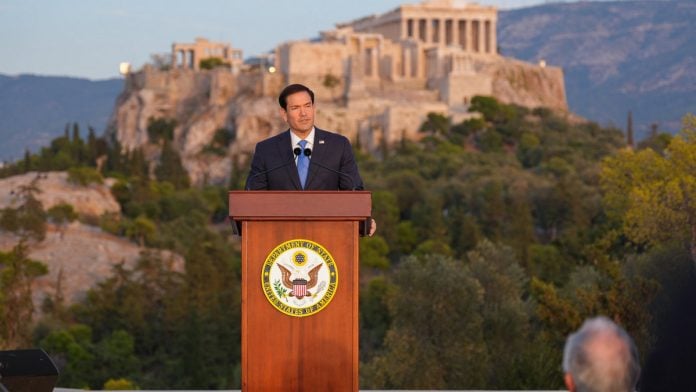

In February of this year, I wrote about Marco Rubio’s speech at the Munich Security Conference. Now the same Rubio has come up with a speech which did not even need an excuse like a conference. He spoke in Athens in an open-air venue as the sun was setting. In the background was the Parthenon. Hollywood could not have done a better job than the one pulled off by Rubio’s event management team. Clearly, young Marco has begun his 2028 election campaign from Athens. JD Vance beware. Gavin Newsom beware.
While Rubio’s election manoeuvring is likely to be of interest to American voters, what are people in the rest of the world supposed to make of his speech? That is the question this column seeks to address.
Rubio, for political reasons of his own, seeks to posit a common “Western civilisation” which, according to him, has three roots: Classical Greece, Imperial Rome and Christianity. It is interesting that while Rubio refers to Greece and Rome by their geographic names, he does not refer to Palestine as a source of Western civilisation, for doing so would require an acknowledgement of Jewish influence. Rubio carefully avoids the use of the expression “Judeo-Christian”, which has been popular in the past. He implicitly denies Jewish influence and confines himself to Christian exclusivism and even supremacism. While referring to great Western scientists, he mentions Galileo, Copernicus, Kepler and Newton. There is no place for Mendeleev or other Russian scientists in Rubio’s “Western” world. Russians and Jews are clearly excluded from Rubio’s West.
Rubio does make a passing reference to English liberal democratic traditions. But it is indeed curious that his West conspicuously includes Spain. Now most of us associate Spain with its horrifying Inquisition and not with any democratic heritage. But Rubio needs to include Spain because he is personally of Spanish descent. The political scientist Benedict Anderson has argued that nations are “imagined communities”. Clearly, Rubio’s so-called “Western civilisation” is an imagined entity which suits his personal and political purposes.
ThePrint editor-in-chief Shekhar Gupta has argued that Rubio’s message is primarily addressed to his domestic electorate and America’s vassal-allies in Western Europe. I concede that. Nevertheless, I believe it is important for us non-vassals to indulge in a serious exercise of content analysis of Rubio’s speech to see how we are affected.
Also Read: Napoleon lost his country trying to root out sanctions evasion. It’s a lesson for US senators
Rubio’s message to the non-Western world
Rubio argues that heroism and valour are uniquely Western ideals. Are members of today’s Sinic, Indic, Russian, Judaic and Islamic civilisations required to concede that we have no valid traditions of valour and heroism? While we all agree that some five centuries ago, Western countries, including tiny ones like Portugal, managed to master ocean-going maritime technologies and firearms-based military technologies ahead of other civilisations, does that automatically imply that we are required to bow and scrape before the West?
I was particularly intrigued by the fact that Rubio singles out the Spanish conquistador Hernan Cortes as a great hero of the West. While Cortes was undoubtedly a conqueror, many people of Native American descent do not see him as heroic at all. Rubio does not care. In his speech, he goes on to emphasise the importance of power and the imperative to use it. If this defines heroism, then Cortes surely qualifies. Needless to say, it is important for Rubio to position himself as a conquistador like Cortes. During the 2016 primaries, Trump certainly did not ascribe any martial qualities to Rubio. But today, Rubio is at least nominally part of Trump’s team. In case Rubio does not know, someone should instruct him that a sense of irony is deeply embedded in many non-Western civilisations that he looks down upon.
Rubio’s message to the non-Western world is clear. The West, led by Rubio’s America, intends to remain “at the head”, implying that it will do its best not to give up its dominant position.
Iran, based on its recent successes, may think it can escape domination. But Iran should remember that President Obama took an interest in Syria in 2011. It took fourteen years, but Assad fell and the West’s Salafi ally is now in charge there. Iran should not be cocksure that it will escape. Rubio made pointed references to Thermopylae and Salamis and the great Greek victories against the Persians. Some of us who have read the American eccentric Gore Vidal again succumb to our sense of irony as we note that these were ‘victories’ recorded by the Greeks in their books. The Persians may have a different view. But then Rubio will probably feel flattered if we tell him that clever propaganda is as much a part of his Western civilisation as valour and heroism!
Russia has been pacified with Minsk I and II, Anchorage and good words. But the attacks persist and the attempt to fatally weaken Russia continues. In the past, US officials such as Victoria Nuland and Lloyd Austin have told us what NATO’s goals are, and the boorish EU foreign policy chief Kaja Kallas makes no secret that the “West” would like Russia to disintegrate into statelets. Rubio has not distanced himself from this objective. In fact, in his Senate testimony, Rubio was clear that the US has “chosen a side” antagonistic to Russia. And the irony is complete when Russian Orthodox Christianity is treated with indifference.
If Iran and Russia are neutralised, then Rubio’s heroic, valorous Western civilisation still has to deal with China. That is not going to be easy. But if Cortes could defeat Montezuma and Pizarro could defeat Atahualpa, then Xi Jinping’s successor had better be careful. Rubio’s plans are clearly telegraphed.
Also Read: The West’s real crisis isn’t war. It is the weakness within
A warning for India—and Rubio
What about India? Well, we should consider ourselves lucky. We are not in the crosshairs like Iran, Russia or China. We are simply not that important, and while we are not vassals like the Europeans, we do try not to create too much trouble for the great hegemon that Rubio represents.
But let us not kid ourselves. If we get uppity or become a threat (real or “imagined”) to Rubio’s “imagined” Western civilisation, then the response will be swift and aggressive. Colour revolutions, student revolts, installation of puppet caretaker regimes and so on have happened in our neighbourhood. We have enough internal fractures and issues. To create a repeat of an Arab Spring or Bangladesh-style uprising in India may be difficult. But the attempt can be made. We have been warned.
My response to Rubio is quite simple. You are welcome to do whatever you want in order to win votes in your country. But some of us have civilisations that look at millennia, not centuries.
The fact that your Western civilisation has been dominant makes it interesting. After all, five hundred years is not a short time even for us. But like everything else in human affairs, dominance is not permanent. We think of civilisations—Sinic, Indic, Persian, Arab, Turkish, Judaic, Russian and Western—as participants in a dialogue without having to frequently assert the superiority of one over the other. Belittling others and declaring open war on them is, at a minimum, not smart. If nothing else, it puts the rest of us on guard.
Jaithirth ‘Jerry’ Rao is a retired entrepreneur who lives in Lonavala. He has published three books: ‘Notes from an Indian Conservative’, ‘The Indian Conservative’, and ‘Economist Gandhi’. Views are personal.
(Edited by Asavari Singh)