




On 14 August, Jason Arday — Cambridge University’s youngest Black professor — was found dead at his London home, days after resigning his post. His family’s statement did not mince words that he had endured a sustained campaign of harassment stretching back over three years, one that intensified into media scrutiny that questioned not just his scholarship but also his life story.
Various newspapers produced dozens of passages from Arday’s 2015 PhD thesis that they claimed closely matched an earlier dissertation. The plagiarism charge didn’t hold and Liverpool John Moores University upheld his degree after review. Cambridge first framed the scrutiny as a smear campaign, then opened its own inquiry – at which point Arday resigned. Simon Baron-Cohen, the university’s autism research director who had spoken to Arday hours before his death, told the BBC that Arday described feeling unable to continue under the weight of relentless scrutiny that discredited absolutely every detail of his life.
Whatever the eventual, sober accounting turns out to be, the story of Arday’s rise and fall should be instantly recognisable to Indian academia: it follows a pattern that runs through the careers of Dalits with grim regularity.
The familiar target in Indian academia
The story is quite familiar in the Indian context. A scholar from a historically excluded community is appointed to a position their community has rarely, if ever, held. The appointment is publicised — sometimes by the institution itself — as a marker of progress, and enough ink is spent on boasting that equality has been achieved. Dalit President, Dalit Chief Justice, Dalit Chief Minister — see, equality has been achieved. So goes the narrative.
For a while, the scholar is a symbol, profiled, feted and held up as proof that the system works, so nothing else needs to be changed. Then the scrutiny begins, if it hadn’t already happened before the appointment. But it’s not the ordinary scrutiny of their work that all professionals invite; it is scrutiny of their credentials, their qualifications, the manner of their appointment, their family history — their right to be there at all. Then, often, anonymous complaints surface.
Institutions that were quick to claim credit for the appointment suddenly become slow, or unwilling, to defend it once the questioning starts. India has its own well-documented version of this arc, and it did not begin with Arday.
In 2018, Subrahmanyam Saderla, newly appointed as an assistant professor at IIT Kanpur, became the subject of scrutiny after four senior faculty members objected to his appointment. Then, an anonymous email reached senior faculty and the institute’s director alleging plagiarism in a PhD thesis that Saderla had completed at the same institution three years earlier. Colleagues who had never raised the matter with him suddenly began discussing whether his appointment had been a mistake—whether he had benefited from reservation and lacked the competence to hold the post.
An internal inquiry found all four senior professors guilty of caste-based harassment and violations of the SC/ST Prevention of Atrocities Act. IIT Kanpur’s Board of Governors declined to revoke Saderla’s degree and recommended action against the four professors. But a day before the Board meeting to decide on that action, the report was leaked. Overnight, 70 faculty members signed a letter to the Board chairman asking it to take no action and instead seek a reconciliation.
Vipin Vijayan, a Dalit research scholar at Kerala University is still waiting for his PhD after his department head, CN Vijayakumari, refused to sign off on his final thesis. She questioned his right to study Sanskrit in explicitly casteist terms, despite the scholar having met every formal requirement. In Telangana, Sujatha Surepally, a Dalit professor of sociology, has alleged that being publicly labelled an “urban Naxal” triggered surveillance, a stalled promotion, and a professional boycott. In Punjab, Harpreet Singh, a Dalit assistant professor in the economics department, faced casteist remarks and was denied promotion, prompting an inquiry after an eight-day sit-in.
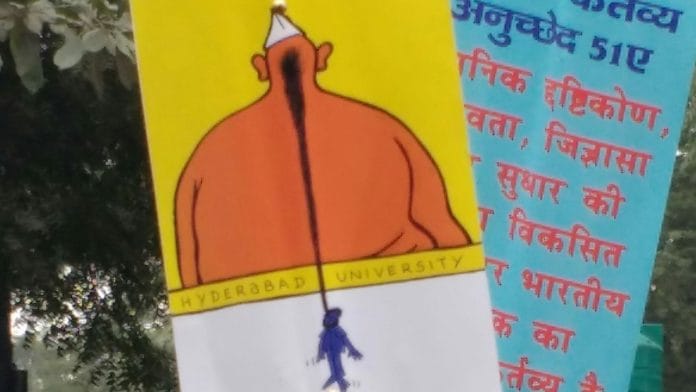
Such cases are the tip of the iceberg. Rohith Vemula’s case was described by activists as an “institutional murder” — language that, however contested, points to the same underlying claim that Arday’s family is making now: professional destruction by narrative can be as lethal as any single act.
Also read: In JNU, works of Gail Omvedt and Dalit scholars are relegated to ‘underground’ networks
Whose plagiarism gets a scandal and whose gets a Presidency
BR Ambedkar argued that caste in India is not merely a division of labour but a division of labourers into a hierarchy of graded worth. Nowhere is that hierarchy of presumed worth more visible than in who is asked to prove they deserve their chair and who is simply assumed to be worthy.
What connects Arday’s Cambridge and Saderla’s IIT Kanpur is the asymmetry of suspicion. An anonymous claim against a scholar from a marginalised group quickly escalates into a referendum on their entire life. Equivalent irregularities — and they are not rare — among dominant-group peers run into a wall of silence. Indian universities have had their own unresolved plagiarism and credential controversies involving upper-caste scholars that generated a fraction of the scrutiny and ended with a fraction of the consequences.
This is not a new pattern. In 1929, Jadunath Sinha — then a young philosophy lecturer at Meerut College — accused his own examiner, Sarvepalli Radhakrishnan, of lifting substantial, unattributed passages from his doctoral thesis. Sinha laid out dozens of parallel passages in the Modern Review and eventually sued for copyright infringement; Radhakrishnan countersued for defamation. The case was settled out of court, possibly under political pressure, with no judgment ever delivered, and the matter vanished from public memory. It cost Radhakrishnan nothing. He went on to become India’s first Vice President and second President, celebrated annually on Teachers’ Day, while Sinha’s name survives mainly in footnotes.
The asymmetry that defined Saderla’s case — an obscure junior academic’s meticulous, documented complaint against a senior figure, absorbed and neutralised by the institution the senior figure belongs to — has a lineage in Indian academia stretching back nearly a century.
There are a number of other similar cases. Chandra Krishnamurthy, Vice Chancellor of Pondicherry University, saw one of her published papers formally retracted after a nine-month investigation found roughly three-quarters of it had been plagiarised. She was placed under a bureaucratic “compulsory wait” and quietly replaced, with no comparable media cycle and no referendum on her life outside the university. Her successor, Gurmeet Singh, carried an undisclosed plagiarism complaint from his time as a Delhi University professor into the same Vice Chancellor post; the university invoked confidentiality to withhold the finding, and he received a clean vigilance clearance regardless. Vinay Kumar Pathak, Vice Chancellor of Dr APJ Abdul Kalam Technical University, was reappointed by the Uttar Pradesh governor for a further three-year term even after an RTI request showed a paper on his CV was substantially lifted from foreign publications, sometimes “100 per cent plagiaristic copy.”
None of these cases produced an anonymous email campaign, international headlines or a resignation. Yet they were followed by promotions and extended periods of authority — in contrast to the case of a Dalit scholar three years into his first faculty post, whose entire PhD was placed under re-examination based on an anonymous complaint traced to one of the professors already found guilty of harassing him.
Also read: ‘Not just Right-wing, even liberal academics have biases against Dalit scholars’
What Indian institutions owe
None of this argues against accountability. Plagiarism should be investigated wherever it is found, and due process should protect everyone, including the accused, from trial by media. But Indian universities, the UGC and funding bodies need to ask themselves a harder question than whether their misconduct procedures are fair on paper: are those procedures, and the informal culture around them, applied with the same weight of doubt regardless of who sits in the chair, regardless of caste?
Arday’s death will likely become, in the UK, a moment of institutional reckoning about how universities protect scholars from disproportionate public scrutiny once the initial celebratory press cycle ends. Indian academia does not need to wait for its own Arday moment. It has already had several — Subrahmanyam Saderla, Vipin Vijayan, Sujatha Surepally, Harpreet Singh, and others whose names never made national news at all. The question is whether it is willing to recognise the pattern before another one becomes fatal.
Pardeep Singh Attri is an Assistant Professor in Strategy and Organisation at the School of Management, University of Bath (UK). He tweets at @pardeep_s_attri. Views are personal.
(Edited by Prashant Dixit)
This is the finest example of charlatanism disguised as journalism. You cry discrimination against Dalits, yet your news agency has no qualms in portraying a particular caste in the worst negative way possible, and you are braying for justice for the Dalits. By the way, Jason Arday is a fraud, and he has been under the spotlight for the poor quality of his work, which shouldn’t even be called research. His colour and race are the only things that an intellectually deprived, ideologically prejudiced and malingering journalist like you would thing of using as an ideal excuse. The world is tired of woke nonsense, and all that comes in without facts and reason and crying for acceptance just because someone fits in perfectly into the image of woke person’s idea of an ideal person.
The quality of our so-called researchers in universities are pathetic, largely because they get hired through an unmeritorious and undeserving quota system, which has effectively shut down actual research progress. The horrible quality of our researchers belonging to the group you are shamelessly trying to defend is evident every time they cry caste discrimination whenever their horrible performance is questioned.
Please visit Mumbai University look at the quality of PhD holders working there from the reserved category across all the department. Some of them have churned out 2 dozen thesis with such abysmal quality. And they will admit candidly how no one can stop them – they can do as they please. One wonders then, why Mumbai University in such abysmal condition. You can’t say a word against anyone there, the moment you do they start crying that they are victimised on account of caste.
Has this author read about a thing called Sc/St act. This is the classic method of anarchist : to accuse the other party / person of the crime that they are committing at any given moment. This fake victimhood narrative needs to to be checked, stopped and rolled back
How does this pass thru basic editorial checks ?
You need to do better research and stop spinning falsely narrative.
Arday lied, not just about his academic achievements but about many other sports and social achievements as well. He died because his lies were outed. You can read all about this in various academic forums that are discussing the topic, that you didn’t do so and are out here spewing lies shows your standing as a journo. He used his ethnicity to rise to the top and now that it is alleged thag same ethnicity got him too much media attention, is simply payback.
This article is meant to forment more trouble. Pls ask if dalit academicians are doing a good job educating others. What we see around is quite the contrary. People who haven’t had to compete can’t teach others how to.
Hey Praveen Attri,
IF you don’t have anything serious to write, then don’t write anything. Importing Western racial theories directly into Indian socio-political dynamics is completely wrong, highlighting pure dishonesty in intent and character. Using an isolated UK event to castigate Hindu society is a lazy, spurious tactic to project foreign frameworks onto local contexts. Wrong! Wrong and wrong.
If you want to talk about ground realities, here is a list for your eyes:
Vishnu Tiwari (UP, 2021): Lost 20 full years of his life in prison on fabricated rape and SC/ST Act charges over a petty land feud before the Allahabad High Court fully acquitted him.
Purushotham Patel (Karnataka HC, 2023): Court quashed fake atrocity charges, explicitly noting that these complaints are “clogging the judicial system” to settle civil property feuds.
Supreme Court Ruling (2018): Apex bench in Dr. Subhash Kashinath Mahajan recognized the Act is frequently weaponized for extortion, revenge, and blackmail.
State High Courts (Section 482): Dockets in Allahabad, Bombay, and Madras are overflowing with quashed complaints tacked onto everyday brawls just to deny bail.
Academic & Service Abuse: High Courts consistently throw out atrocity complaints slapped on superiors by staff facing routine disciplinary action or bad reviews.
High Courts across India are actively quashing these fake atrocity cases every day because people weaponize them to settle personal grudges and property battles. Take your lazy, imported race-baiting and throw it in the trash where it belongs!
Again this nonsense, this country has gone to shit by giving seats and preferences to those who get everything by caste and not merit , from education to jobs to promotion, free this free that , and everytime playing victim card . Why don’t you just divide the country in sc , st , obc and gen category would move out to western countries, apparently they value merit and provide better quality of life .
An article peddling falsehoods by the dozens in an attempt to equate two different injustices which have pretty much nothing in common.
Jason Arday’s plagiarism has been confirmed again and again. Yes. his PhD thesis was not revoked by the university but the investigation by Cambridge found ample instances of him simply lifting passages from other scholar’s works without crediting them ever. And the pattern repeats.
To portray Jason Arday as the patron saint of academic credibility and make a martyr out of him serves no purpose at all.