



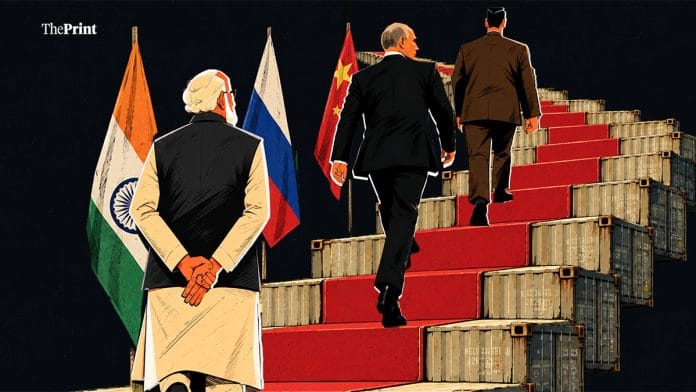
Your TV channels make it seem like the most consequential gathering of world leaders, after the G-20 summit in 2023, is once again taking place in New Delhi. There’s also an extra edge to the ‘josh’ this time.
See, those exaggerated pictures with bright-coloured backgrounds and warlike drumroll showing Narendra Modi, Xi Jinping and Vladimir Putin together. The barely understated message is: the trinity has joined hands against the ‘evil West’. Or to put Donald Trump ‘in his place’.
All governments, especially strongman-led, use summiteering for image-building. The Modi government has turned it into an art form. But, with BRICS, the elements don’t come together given its composition, balance, and contradictions.
The three strongmen in this breathless buildup share more contradictions than congruence. Each has a different worldview, as also a different adversary. Russia is China’s ally—dependent, too, to some extent. India sees China as an existential adversary. And China sees the other two as so weak that it can determine the rules of the game, and be the umpire; first, second and third.
The rude fact is that BRICS is the most irrelevant of all such groupings. We know what NATO stands for, or is supposed to stand for. You can count others. The Shanghai Cooperation Organisation (SCO) is the closest one would come to BRICS. But here, Chinese domination is almost formal. The SCO is China’s multilateral organisation. That’s why we say even SCO has a purpose, whether we like it or not. Even something as inconsequential as the 57-nation OIC (Organisation of Islamic Cooperation) has at least one glue, Islam. Of course, you haven’t seen it weighing in on so many crises and wars within the Islamic world, the ongoing Gulf Arab states versus Iran, and so on.
Also Read: Trump, Netanyahu’s Iran gamble: The regime change rebound
What’s common among the members of BRICS? Is it a joint front against Trump or ‘evil West’? Far from it. Putin and Trump are a mutual admiration society. Xi will soon be in the US, ironing out the creases in bilateral ties. He will also encourage Trump to persist with his strategic shift inwards. America first, and last. Forget Taiwan.
For Xi, Trump is the greatest news. He’s weakening America’s alliances. Some of these countries might turn to China to lower threat levels.
Beijing will then collect concessions. Others, weaker and smaller, especially in the often fancied (only in India, so touchingly) the Global South, have already begun to see China as the new hegemon and ‘salaam’ it. At least Xi won’t humiliate you in public like Trump.
Read my view on the myth of the Global South here.
As for Russia, it’s a giant Xi shares borders with. It has the most nukes in the world and a secure source of pipelined energy.
India falls in a completely different category. There’s the border issue and live militarisation there. Xi needs stability for the trade to grow. And the India-China trade, as we know, is one-sided. At this point, at $112 billion, India accounts for just over 10 percent of all of China’s trade surplus. Surpluses with the US declining, Xi wants alternatives. And like it or not, India has stepped in.
Now, with its demographic debacle and crashing domestic demand, China needs those trade surpluses even more. That’s why Xi has taken a time-out on the border with India.
In 1988, Deng Xiaoping had famously told Rajiv Gandhi in Beijing: ‘since our generation probably doesn’t have the wisdom to resolve the border issue, let’s leave it to a wiser future generation.’ For Xi, that future hasn’t arrived yet. He’d rather buy more time, until the gap between China and India widens further. Meanwhile, he’s got Pakistan to keep India off balance.
Putin, like Xi, rejoices at the weakening of NATO. He either thinks he will get a deal on Ukraine and declare victory, or carry on fighting as the US aid to Kyiv declines and Europe squirms. In short, neither is Xi rallying the world against Washington, nor is Putin joining such an adventure.
Unlike Xi, Putin has no troubles with India. His first interest, however, is no different from Xi’s: a one-sided trade relationship. India is willing to buy more oil than any other except China, and say thank you for it. India also remains by far the biggest current and prospective buyer of Russian weaponry, particularly if the sanctions are lifted. Helped along by oil, Russia also enjoys a trade surplus of $50 billion with India.
However, Russia is a relatively benign trade partner and willing to part with some defence technologies nobody would give India. Beyond this, if you think Putin counts India as a peer, or in the same weight class as Russia or China, you need to think again.
Also Read: China insulated itself against energy shocks. India is ‘all talk, no walk’
These equations form the backdrop of this BRICS summit. India isn’t the party with the strongest hand here, however brilliant its hospitality. It’s a terrible thing to say, but the truth must be spoken. Today, India looks like a modern-day trade colony of China and Russia. It’s compelled to run huge deficits because it’s only buying what it desperately needs.
A lot of India’s exports, for example, will come to a standstill if the components, ingredients or bulk chemicals don’t come in from China. It’s a funny thing, but the Indian business and industry is the biggest lobby for Chinese imports. Plus, India needs the calm on the Line of Actual Control (LAC). It desperately needs the next five years to rebuild its military muscle.
This twin import dependence greatly weakens India’s hand. Even at the top, at the level of the power trio being flaunted on TV screens, India isn’t in the big league. The Trump era has been brutal on middle powers and swing states.
Some of the excitement in influential sections of the Indian commentariat and pro-establishment social media comes from those nursing fantasies of America’s inevitable decline and de-dollarisation. This powerful constituency is so knee-jerked by ad hominem anti-Americanism that it would join hands with Xi to fix the ‘evil West’. Will they concede China’s boundary demands? I’m not sure.
Enemy’s enemy can be your friend, here, is more stupid than simplistic. China wants to treat America as an equal, not an enemy. Nor is America India’s enemy. Three successive Indian prime ministers have hailed India-US ties as a natural strategic partnership. Modi has said so more often than Manmohan Singh and Atal Bihari Vajpayee put together. It will take a much smarter mind to write a book on what blood-feud mindset fires this anti-Americanism at any cost. All I can say is the Modi government has no such fixations.
And de-dollarisation? What happens if the US Dollar vapourises? What comes in its place? That joke called the BRICS currency? Check out some figures. Ten of the BRICS countries together have a GDP of $14.33 trillion. China’s is $20.85 trillion.
The combined GDP of original members (India, Russia, Brazil and South Africa) is less than half of China’s, at $9.93 trillion. If you wish for the end of the US Dollar, are you willing to live in the Yuan era? The US Dollar will not be replaced by INR. Or the Rouble. It’s just as well that S. Jaishankar keeps countering this fantasy.
I’m sorry to be a party pooper. Multilateral summits serve a purpose, most of all for providing a forum for leaders to talk despite bilateral differences. To expect more is a dangerous hallucination. This summit, if anything, reminds us of India’s weaknesses, not strengths. It should sober us down to the task of building ahead.
Also Read: The Vishwaguru delusion, mine vs yours, is ruining our view of the world
not denying the facts in the article , i am pretty much in line but everyone everytime is demeaning india , saying you dont belong here , you are weak , you are poor country that will never achive someting like churchil , but india has withstood more hardship than it in thousand of years and nothing happened to its people , plus people count india weak that never show strengh , dont like that
Rational, logical and sensible analyses. The anger is borne out of the recent trend of Trump humiliating our people while deporting them – otherwise there’s gratitude toward the USA for the employment it has offered to our youth.
Dear SG, please stop thinking of yourself as the greatest analyst and give your skewed opinions. Both NATO and GCC have become almost irrelevant. Has the Muslim religion ever succeeded in bonding the Muslim countries? Look at the Mecca pact? So what made you think that these groupings are so great and BRICS is not. If BRICS is irrelevant then why is Trump so against it? The good thing about BRICS is that it believes in multipolarity and allows each member to maintain sovereignty just as mature countries do.
Russia, one fears, has impaired itself for the long term. It was supplying 40% of Europe’s natural gas, economically through pipelines, before the fateful decision to invade Ukraine. Most western companies operating in Russia have sold out, often at a pittance. Many young Russians, educated, wish to emigrate. Europe itself, stung by President Trump’s reduced commitment to its security, not just support for Ukraine, very substantial under President Biden, is Marshall ing resources to face Russia as a security threat.
Russia has never been a problem for India. A time tested friend, to use the oldest, also entirely accurate, cliche. The economic component of the relationship never glittered, beyond armament purchases, because the Russian economy is overly dependent on natural resources. The conflict in Ukraine created an opportunity to buy large quantities of Russian oil. It will be a challenge to achieve two way trade of $ 100 billion by 2030. 2. China matters for India. Both as our foremost security threat ( fused with Pakistan ) and an economic / trade partner we cannot do without. Any more than the rest of the world, including our Quad partners, can. A reset is much needed. It should with a calm acceptance of asymmetry.
The real story is that signed declaration will end up in a dustbin. India is an expert talker and a zero in execution.
To love India, wish it to do well, is to tell it like it is. This edition of National Interest sails over that bar. Honestly, that is very difficult to say for a vast swathe of media nowadays.
An excellent analysis, as always, of the BRICS summit by Shekhar Gupta.
The huge trade deficit with China, the dependence on imports for most of our fossil fuels, the unsettled borders with China and Pakistan, the constant bickering between the governing party and the Opposition, the GenZ unrest, the very high unemployment among our Youth…..
The next few years are going to be difficult for India because everything in our domestic and international spheres is broken.
Anne Applebaum called John Maersheimer Putin Apologist.
Shekhar historically been NATO Apologist.