



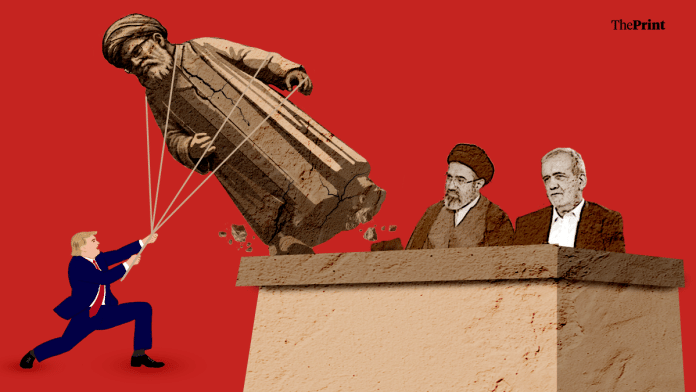
Israel and America opened their ongoing war on Iran spectacularly. Equally dramatic now is how the winners, especially America, are stalled. The ‘spectacular’ element was the targeted assassination of Iran’s top spiritual, military, ideological and intelligence leadership. The stall comes from Iran’s stubborn refusal to capitulate. Some questions follow.
Do decapitation strikes guarantee your adversary’s annihilation? Are there wiser approaches? Did the Israel-America alliance miss a trick? Does the history of such warfare elsewhere tell us something else? Are there some lessons in the Indian experience too? The answer to the first three is a no. To the rest, a yes.
We need to put Israel and the US in different boxes. Both have different motivations and objectives. Israel is always fighting chronic existential threats. They’ll be disappointed that the regime change didn’t come. But, the weakening of Iran, a long setback to its nuclear programme, and decimation of its missile infrastructure are big gains at a relatively low cost: 20 dead, more than 7,000 wounded, though, and multiple neighborhoods struck by missiles, especially the ones with cluster munitions.
The relative clean-up in Lebanon and weakening of a revived Hezbollah will go to its balance sheet on the credit side. If Israel’s history in its neighbourhood has been about buying time, it has done reasonably well. Further, Israel can toggle in and out of war and peace at will. Unlike the US, Israel doesn’t need to bother with the aftermath, constructing peace, securing the Gulf and opening the Hormuz.
Where do we place the US? Most of its objectives were common with Israel, but more were specific to its own interests. In addition to regime change and an end to Iranian nuclear ambitions, it needed to protect and reassure its Arab (Gulf Cooperation Council or GCC) protectees.
It failed in all three. The regime isn’t just there after a mere change of personnel., it’s now led by more radical individuals, as reported by The Wall Street Journal. Trump can say however many times that a regime change has taken place, but then Trump just talks. On uranium, Iran isn’t yet willing to hand over enriched stocks or roll back verifiably. Its missile launchers have greatly depleted but so have the defenders’ interceptors. And each time Trump or his Secretary of War Pete Hegseth boast they’ve destroyed Iran’s navy and air force, you can laugh. Iran had an inconsequential brown-water navy and no air force.
And the Arabs? With the exception of the tiny and plucky UAE, they’re wounded, scared, and hopelessly fight shy. For almost a century they’ve been smug and secure in Western embrace. In return they never fought Israel, kept to pious platitudes in support of Palestine but did nothing.
Some, notably Qatar, played all sides, hosting the biggest American bases while cohabiting with Muslim Brotherhood, Hamas and Iran. The Saudi royalty thought their status as Custodian of the Holy Mosques guaranteed safety. They put their full faith in the American military. All of that’s shaken now. The GCC countries took their first hits in their modern history and neither their own fancily kitted-out armed forces nor the US umbrella fully protected them.
Also Read: Gulf war exposed India’s fragilities. It’s time for navel-gazing, in the national interest
If you lift the one layer, it’s evident that the West Asia war isn’t fundamentally between Iran and Israel. Israel, if anything, is a proxy for the larger war of Islamic ideological and military dominance between Iran and the Gulf Arabs. Iran has more than one and a half times the population of all of the GCC, and a military (with IRGC) bigger than theirs put together.
In the larger, poorer Muslim universe, Iranian Islam is seen to be more credible and chaste than that of the rich Gulf. And this isn’t confined to the Shias. Many of them see Iran as the only Islamic country fighting Israel and the US for the sake of Palestinians, at great cost to itself. How different does that seem from how they might see the ‘rich, effete, amoral Western stooges’, the Gulf Arabs. Except the UAE, none in GCC has even talked of fighting back. They’re looking for deals on both sides.
The GCC fear comes not just from Iran’s military might, but also the havoc it could play with their populations using its intelligence penetration and ideological sway. Now it’s also burnished by what will be seen by many as the first real Islamic fightback against Western power after serial humiliations like Iraq, Afghanistan and in the past Syria. What the Gulf Arabs fear most is their own people rising in Islamic revolt, a new Arab Spring.
Why else do you think the Saudis have activated their mutual defence agreement with Pakistan and brought their forces in? I can bet the Pakistanis would never be found fighting Iranians, or even their proxies spilling over from Iraq. They’re there, paid in full, to protect their employer regimes. So scared are the Saudis that they have written a $3 billion cheque to the State Bank of Pakistan, evergreened an existing $5 billion loan and placed another half a billion in a three-year Eurobond. This came at a time when Pakistan failed to secure an agreement with the UAE to roll over an existing $3.5 billion loan.
To sum this up, all of the American objectives are unmet and they neither have the muscle nor the motivation to resume the war which may inevitably end in a ground assault. Hegseth said the Iranians begged for a ceasefire, but increasingly it’s looking like Trump is keener on getting a deal. He has more to lose from this stall. For Khamenei’s successors, the price of capitulation is death.
Which brings us to our key questions. Was the leadership assassination a masterstroke or a blunder? If the idea was that it would stun Iran into demoralised inaction, the opposite happened. Instead of capitulation, the Iranian fightback was determined and sustained till the day of ceasefire. A deadly flurry of missiles and drones was sustained over Israel and the Gulf countries. If anything the missiles targeting Israel became larger, faster and armed with cluster munitions and thereby impossible to intercept fully.
The assassinations were counter-productive. In the negotiations now, the US would have been better off dealing with the old Ayatollah, battling prostate cancer at 86, and his key aides, after their military defeat. At least his commitments in any peace deal would carry more weight.
The principle of all inter-state warfare is that ultimately you will need to negotiate with somebody. That’s why top leaders are never targeted. See how smart the belligerents in the Russia-Ukraine war have been.
There’s a difference between dealing with a terrorist, non-state group and cohesive states. Hamas, Hezbollah and Houthis fall in the former category, as would Lashkar-e-Taiba and Jaish-e-Mohammed. National leaders is a different matter. Was senior Bush wiser to spare Saddam Hussain in 1991 than the junior Bush killing him in 2006? That resulted in Iraq returning to its majority Shia character (Saddam and his elites were Sunni), becoming an informal Iranian ally, and harbouring its many proxies. Ask Saudi Arabia and Qatar. A US C-135 tanker was also brought down over the so-called ‘friendly’ air space, over Iraq.
It’s convenient to blame the Pakistanis for protecting the top Taliban leaders. But maybe when books are written in the course of time we might find it was a pragmatic idea in partnership with the US to protect that leadership for the day after. Did Libya benefit from Gaddafi’s assassination? Who are you dealing with now? It’s a failed state, broken into many factions, each with its army, navy, air force, and one of them also has a field marshal—Khalifa Haftar, of course self-promoted and self-appointed. That’s the fate of Libya.
Also Read: Trump brings the Age of Humiliation for friends. Modi needs stoicism abroad, humility at home
Finally, we come to the Indian experience. Doctrinally, while fighting the nastiest insurgencies India has conserved the top leaders for future negotiations. Not only did Mizos, Nagas, Manipur and Assam underground leaders never face a strike, often they were spared or even tipped off when cornered. Ask the IPKF veterans how strongly they believed R&AW was tipping off Prabhakaran whenever they closed in. But, R&AW were right. Killing Prabhakaran would’ve involved a carnage that only Colombo could afford, as Mahinda Rajapaksa did in 2009.
In Kashmir, India always draws a line between armed groups and unarmed separatists. The Hurriyat leaders are always protected, irrespective of who’s in power in Delhi. Even the most radical of them all, Syed Ali Shah Geelani was looked after with great care under the best cardiologists at AIIMS New Delhi. If anything, the government would’ve helped him live a few years longer. Whatever his politics and provocations nobody wanted him killed.
The two Hurriyat leaders assassinated, Mirwaiz Maulvi Farooq (21 May, 1990) and Abdul Ghani Lone (21 May, 2002), are well established ISI hits. Similarly the Naxals were given multiple amnesty offers over decades, invited for talks with safe conduct. That’s why many survive and live normal lives with amnesty and rehabilitation.
The only action like a decapitation strike in Indian experience was Bhindranwale and his top leaders in Operation Bluestar. What was the result? Terror was back soon, with greater popular support. Instead of one cohesive group under a leader you could decimate or negotiate, it broke up into multiple amoebic variants, each with a life of its own. Many still survive and operate, especially from Canada and Pakistan.
Of course we can’t read to Donald Trump from any playbook, least of all an Indian one. But, would his military victory, achieved with the Ayatollah still alive at 86, with multiple bouts of prostate cancer, matter less or more is a good question as he negotiates with the successors. My view, which I’m sure you’ve read already, is that however heady, interstate leadership and regime decapitations are counterproductive.
Also Read: The new Great Game—Trump’s playing for time, China for leverage & India for wiggle room
Regime has survived. But are Iranian people surviving? I don’t think so.
As an Indian, I hope USA and Iran come to a durable peace agreement. Ensuring Iran does not become a nuclear weapons state. An end to sanctions, conditions created for Iran to develop its oil and gas reserves. Monetise them in good time before the age of renewables makes them much less valuable. 2. The I2U2 template has not served India’s economic interests in West Asia well. Reciprocal damage to valuable productive assets can lead to a situation where even the continued employment of ten million Indian guest workers comes under threat. 3. The nature of India’s relationship with Israel is such, it does not need to be publicly advertised. Israel is now facing global isolation, moral opprobrium for its actions in Gaza and elsewhere. Including in Europe, Global South almost universally. Better for India to be more discreet.