



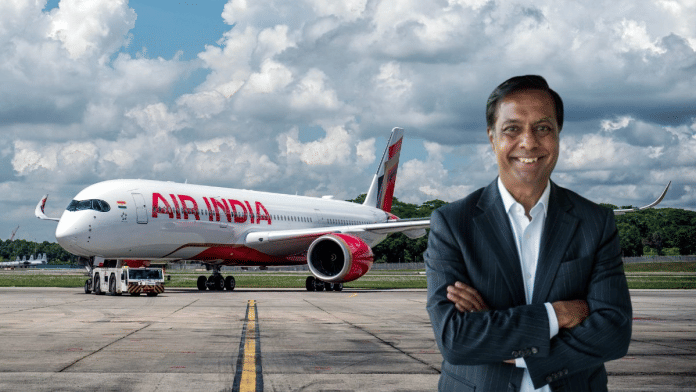
New Delhi: There is no such thing as perfect operations, said the man responsible for Air India’s transformation, even as he acknowledged that his focus area was to improve the airline’s services from ground up.
Jayaraj S, Head of Global Airport Operations at Air India, told ThePrint in an exclusive interview that he holds daily review meetings, on Sundays and public holidays too, to monitor any delays and improve the airline’s response systems.
Air India, which handles nearly 700 flights and over one lakh passengers daily across 60 domestic and 51 international airports, has been trying to rebuild its reputation since its takeover by the Tata Group in 2022.
But the carrier has been facing headwinds for a while, particularly since the June 2025 Boeing Dreamliner crash that killed 260 people in Gujarat. Its many problems have only been compounded by New Delhi’s geopolitical tensions with Pakistan, flight disruptions amidst the West Asia war and soaring fuel costs.
Jayaraj Tuesday conceded that the airline was also up against a perception battle. “Success is silent. Failure is front-page news,” he said.
The airline’s Vihaan.AI transformation programme has produced measurable results, Jayaraj said.
Air India has also adopted upgraded technology by introducing self check-in and baggage drop. The transformations are part of Air India’s broader effort to modernise its operations and elevate the guest experience. Focusing on strengthening accountability and investing in people have shown a positive effect on the ground, he said.
At the centre of his operational thinking is what he called the 85-10-5 rule. “Eighty-five percent of operations run normally. Ten percent of issues are manageable. The remaining five percent can severely affect reputation. That is where leadership and disruption handling become critical,” he said.
Weather, air traffic and technical snags make some degree of disruption inevitable, he said, adding, “There’s no such thing as perfect operations.”
Global supply-chain disruptions have delayed aircraft deliveries and retrofit programmes across the industry, while geopolitical shocks—the Russia-Ukraine war, Pakistan airspace closures and the Iran-US/Israel war—have deepened the financial strain on Indian carriers since the pandemic.
Air India—which reported a record loss of Rs 220 billion in FY2025-26—has been considering multiple cost-cutting measures, including paying out lower bonuses to all employees and pay cuts for those at the top, according to a Bloomberg report.
Its CEO Campbell Wilson, who has resigned but will remain at the post till his replacement is found, also told employees this week that annual increments would be deferred by at least one quarter due to fiscal uncertainties.
Where the airline does have agency, Jayaraj said, is in managing its ground handling network. Air India has cut its global handlers from 18-19 to 11, introducing stricter service-level agreements and penalties for non-performance, Jayaraj said.
Jayaraj rejected the premise that outsourcing ground operations exposes the airline to passenger-facing failures it cannot fully control. But he acknowledged that varying standards among ground handling partners, alongside infrastructure constraints at airports globally, continue to affect both operational efficiency and passenger experience.
“We are not hands-off. We are making sure that we control what they are (partners) doing and we have visibility,” he said, noting that leading global airlines operate on similar outsourced models.
The airline is also renegotiating vendor contracts and expanding self-service systems at airports to ease turnaround pressure. In some locations, he said, ground handling is effectively monopolised, leaving airlines with little flexibility regardless of their preferences.
One growing challenge is wheelchair misuse—requests that airline staff say often have little clinical basis but add to airport congestion and delays. Jayaraj said the airline has no legal room to push back on this issue. “Anybody who asks for a wheelchair cannot be refused under current guidelines,” he said, calling it a global problem that carriers everywhere are grappling with.
Jayaraj, who has previously worked with Singapore Airlines and Jet Airways, joined Air India as part of the Tata Group’s sweeping overhaul following its takeover in January 2022, ending nearly seven decades of state ownership.
The airline’s ambition, he said, is to become a “world-class global carrier with an Indian heart”.
Also Read: There’s an emerging duopoly in India’s aviation sector. 7 reforms to encourage competition
Another fluff piece. Tata is a sponsor for The Print.