





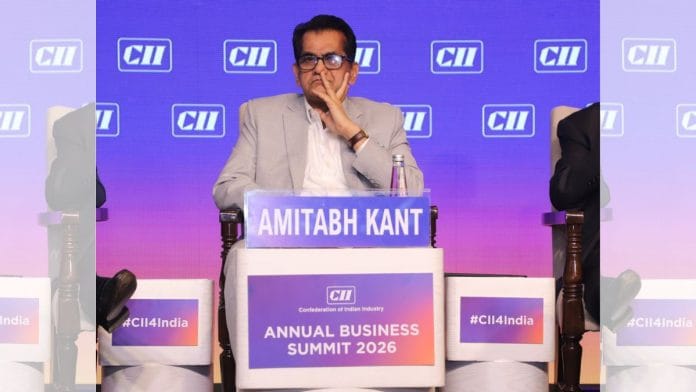


New Delhi: India must aggressively raise its clean energy ambition, abandon “outdated” technologies like hybrids, and move decisively towards an electricity-driven economy if it wants to become a developed nation, former chief of National Institution for Transforming India (NITI) Aayog and ex-G20 Sherpa Amitabh Kant said Monday.
Speaking at the Annual Business Summit 2026 organised by Confederation of Indian Industry (CII), Kant said energy transition would be the defining factor determining whether India can achieve its “Viksit Bharat” ambition by 2047. “All other sessions are a waste of time. The only session critical is the energy session,” Kant said during a seminar on ‘Crafting the Future Energy Landscape: The Here & Now on Energy Transition’.
Pitching for a far more aggressive renewable energy roadmap, Kant said the government must lay down clear mandates to phase out internal combustion engine vehicles. He proposed that India stop registering new two-wheelers and three-wheelers powered by combustion engines after 2027, buses and trucks after 2030, and all four-wheelers after 2032.
“Beyond that, India will not register any combustion engine vehicle. Send out a clear message that the country needs predictability and consistency of policy,” Kant said. “Don’t get locked in by outdated technologies like hybrids. The ultimate technology is zero-emission mobility and that is electric vehicles.”
Kant also called for a dramatic expansion of India’s renewable energy ambitions, arguing that the country should increase its existing clean energy target from 500 gigawatt (GW) to 1,500 GW by 2030.
“We must technologically pole vault to utilise this climatic condition,” he said, describing India as “climatically blessed” and uniquely positioned to emerge as a clean energy superpower.
Kant, however, said that increasing electricity generation alone would not be enough unless India simultaneously builds transmission and grid infrastructure. According to Kant, nearly 31 GW of renewable power currently remains stranded because of inadequate evacuation systems.
“You can’t have a situation where you produce renewables and you are not able to evacuate,” he said, urging the Centre to step in rather than leaving the responsibility solely to financially stressed distribution companies (discoms). “The Central government must work with the discoms and actually put in resources to build up infrastructure to evacuate. You need transmission. You need grid. You need digitisation,” Kant said.
He added that India must fundamentally transform its energy economy from becoming a petro-state to an electric state. A key pillar of that transformation, according to Kant, would be large-scale battery storage. “Storage and storage and storage is the key,” he stressed, warning against sharp price disparities between daytime and nighttime electricity. He said every renewable energy tender should mandatorily include storage components to ensure clean power availability round the clock.
On future technologies, Kant strongly backed small modular reactors (SMRs), offshore wind and large-scale solar deployment. He said India had already passed legislation (Shanti Bill) enabling SMRs, but implementation rules were taking too long to be notified. “The rules should be quickly announced and India’s private sector should be unleashed to put up at least five nuclear projects quickly on the ground,” he said, adding that India’s challenge is now “execution, execution and execution”.
Kant argued that predictable long-term policy signals would allow private industry to drive the transition. He also linked India’s energy ambitions to its digital economy aspirations particularly for data centres. “If you go for 1,500 GW of clean energy, you will provide the backup for data centres,” he said, adding that only India can provide clean energy for data centres, not the rest of the world.
“India’s strength lies in data centres and its ability to provide clean energy for it,” Kant said.
(Edited by Nardeep Singh Dahiya)
Also Read: Clean energy is not just climate policy—it is economic and strategic security for India