








New Delhi: “There’s an IPL match today, you should bet on a team. If you bet Rs 500, it will become Rs 2,500. If you bet Rs 200, it will become Rs 1,000. It is that simple. Don’t think too much about it. Should I give you a betting ID?”
The pitch lands over Telegram, unsolicited, from Anna* who has been running online bets since 2010. His current group has more than 1.2 lakh members, and five are added every day. He sends them a steady drip of AI-generated photos of people making money from cricket, rummy or the casino, alongside forwards that describe his operation as “verified by the government, Google, Bollywood stars and cricketers”.
None of that is true. But the pitch—and the system behind it—is increasingly the template for an industry the government has linked to losses of more than Rs 20,000 crore. Unregulated platforms like Anna’s group can be reached in a few clicks, bypass the law, and pull punters into a cycle of losing bets placed only to recover what was already lost.
Speaking to ThePrint, Anna offers a window into the operation. He works from 3 am till 11.30 pm out of Hyderabad, texting and calling members, urging them to place bets across multiple sites his group hosts under a single promise: “Play big and win big.”
“My job is hectic. I have to call people to remind them of the matches. My job is not to tell them which team is the best. It is to tell them which team has what margin. Our platform offers 24-hour withdrawal, in case the bet is going too well. There is no PAN card needed for withdrawal,” he said.
A cash-out facility allows a punter to pull money out when a preferred team starts to lose.
“This is how people make profits, or one can lose a lot of money… But, don’t worry if you lose money. You can place bets and recover them. Everybody knows a match is unpredictable,” Anna said.
To keep the faith, he routinely shares screenshots of UPI transactions—usually in five-figure amounts—paid out to members who have wagered. “Screenshots give motivation to people,” he said.

Anna once ran offline bets, taking instructions over phone calls. But the reach of the internet, particularly in tier-2 and tier-3 cities, moved him to Telegram, where most of his clientele now sits.
He said cricket remains the most lucrative wagering format. Ludo, by contrast, is “nothing”—a Rs 500 bet pays only Rs 975.
Alarmed by mounting complaints about a $100 billion industry that wears the disguise of harmless gaming, the central government brought in the Promotion and Regulation of Online Gaming Rules this year. While introducing the Act in Parliament in August 2025, Union IT Minister Ashwini Vaishnaw said nearly 45 crore people were adversely affected by online money games and that users had lost more than Rs 20,000 crore. He did not specify a time period.
Till the end of March 2026, the government had blocked 8,376 website URLs linked to online betting and gambling, a statement said. The crackdown is expected to intensify with the Rules coming into force this month.
Across India, addiction to online gaming and betting is pulling ordinary individuals into a spiral of debt—one that, in extreme cases, drives them to robbery, violence, even the killing of family members, or to suicide.
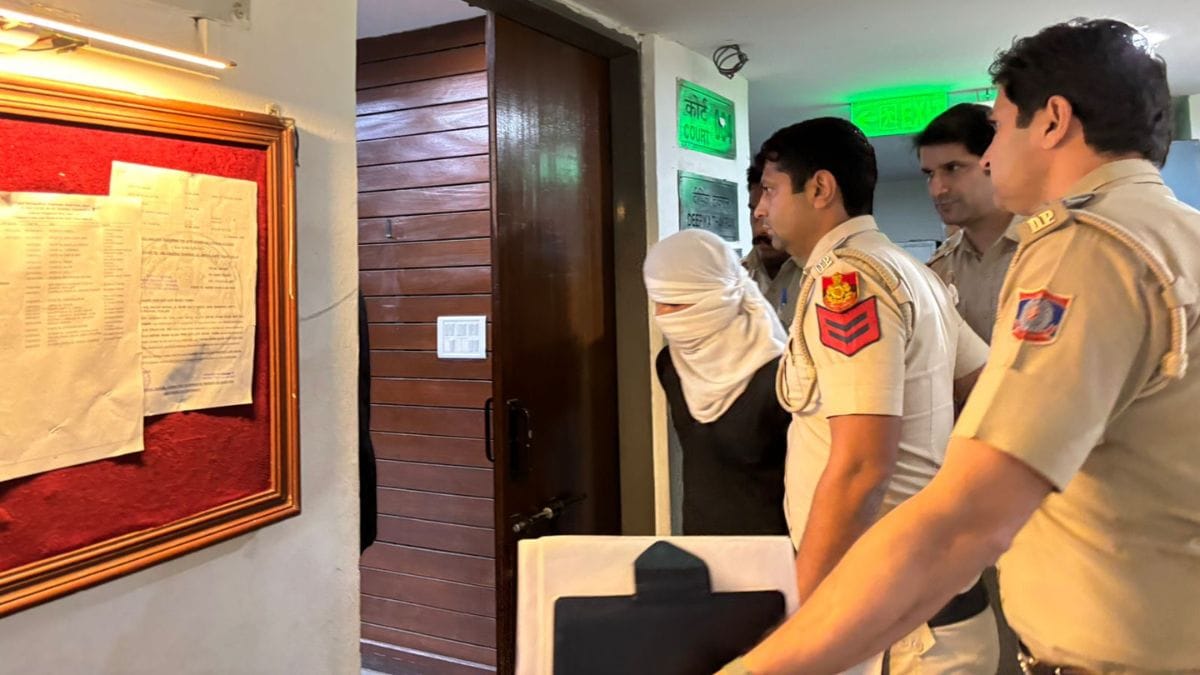
A recent case in southeast Delhi captured the severity. Rahul Meena, 22, was arrested for the rape and murder of an IRS officer’s daughter at their residence, where he was employed, last month. According to police, Meena had incurred debt of Rs 5–7 lakh, much of it linked to online gaming. Investigators say he went to the house intending to commit robbery to repay these debts, but the crime escalated beyond that motive.
Police described Meena as having a “perverted mindset” and said he struck the 19-year-old with a blunt object when she resisted the robbery, leaving her unconscious. He then raped and killed her.
Meena, police alleged, had sexually assaulted another woman in Rajasthan’s Alwar just days earlier.
The fallout from online betting, as the Delhi incident underscored, may not always be confined to financial loss.
Also Read: New online gaming rules give watchdog more teeth, steer clear from guard rails on promotion
The first bet
Aman*, a 20-year-old B.Com student in Chandigarh preparing for the CA (chartered accountant) exam, was scrolling through Instagram in 2024 when he saw popular Punjabi singer Karan Aujla and Canadian rapper Drake advertising Stake.
“If I have to bet online, maybe I could trust this platform,” Aman thought at the time.
Founded in 2017, the Australia and Curaçao-origin Stake describes itself in its LinkedIn bio as the highest-volume betting platform in the world. The strategy it uses, however, is shared by almost all betting platforms.
“Smaller groups advertise on meme pages. They have logos, a catchy phrase, and people fall for it. It sells the dream of luxury,” Aman said.
Creating an account was easy. All it required was an Aadhaar card. A user can begin with as little as Rs 500 as security fee—or invest using crypto-currency—and start with bets as low as Rs 10.
“The app makes sure people start with smaller amounts. That is the motivation. There are multiple AI models and sports analysts that decide the rate and multiplier,” Aman said.
The ‘rate’ or the probability of an occurrence, he explained, is calibrated using AI models. The weather, home ground, players’ fitness and form—are all variables that together shape who wins the match.
When Aman first put in Rs 300–400, it inflated to Rs 2,100. He grew confident. But he’d also watched a close friend start with Rs 2,000 and lose around Rs 70,000 while betting on the last held Indian Premier League (IPL) tournament.
“After my friend started losing money, his focus was only to recover the same amount. He kept betting until the loss became too big,” Aman recounted.
The platforms also track those who waver. “I had invested around Rs 3.5 lakh, and when I stopped playing for a brief period, the customer care kept calling me multiple times. They asked me if I was facing any issues or waiting for a tournament. They kept giving me a coupon code of Rs 500-1,000, gave me an extra bonus, and cashback…all of it, only to call me back to bet and play. I did not fall for it, but people do,” Aman said.
“This is how betting can get addictive,” he said, adding that it happens when a punter starts trusting own predictions and starts looking at gambling as an income stream.
Across social media, influencers compound the pull, posting explainer videos in regional languages with voice-note tutorials on which teams to back.
Stake did not respond to an email by ThePrint with requests for comment.

The trap
In 2020, an offer to earn quickly by playing online games on the website king567.in.net did not sound feasible or attractive to Adesh Thole (34), a resident of Maharashtra’s Chhatrapati Sambhajinagar, formerly Aurangabad.
The callers persisted. He eventually relented, found around 300 games listed at varying rates, registered, and made his debut by depositing Rs 10,000.
His risk appetite grew over the next few months, and the businessman who used to run a petrol pump started placing larger bets. In 2021, Thole made a profit of Rs 1.5 lakh after staking Rs 4.1 lakh on the card game Baccarat—pushing his overall balance to Rs 5.6 lakh.
A withdrawal request was honoured: the money came back in five installments of Rs 1 lakh and one of Rs 1.6 lakh. Trust deepened when he won Rs 1.19 lakh on a Rs 40,000 bet and the credit landed in his account.
He was then encouraged to put in larger sums by people who claimed to be directors of the gaming firm—K.C. Thipeswami and Pruthvi Nagaraj, the brother and nephew of Congress MLA from Chitradurga in Karnataka, K.C. Veerendra.
As Thole’s wins accumulated, the funds he’d won were allegedly withheld in the name of “server errors” or technical glitches. Over a couple of years, he said he placed bets totalling Rs 8.4 crore and went bankrupt after the platform froze his withdrawal requests.
“I lost my house and my petrol pump in Aurangabad. I have been left bankrupt,” Thole told ThePrint. “Such has been my situation that my father has been sending money for my monthly expenses,” he said.
“When a withdrawal request is submitted for a small amount up to Rs 2 lakh, it used to get approved. But a withdrawal request for a higher amount is submitted if it was rejected or not approved by the back-end team. The reason for the same, as shown on the website, was either ‘withdrawal cancelled by Admin’, ‘technical error’ or ‘bulk reject’,” Thole told the Enforcement Directorate (ED) as the agency was probing Veerendra’s alleged empire of betting platforms.
Arrested by the ED in August last year, Veerendra was granted bail by a Bengaluru court in January this year. A special PMLA (Prevention of Money Laundering) court in the Karnataka capital took cognisance of the agency’s prosecution complaint in April. The case is ongoing.
Also Read: ED’s arm reaches Dubai’s Burj Khalifa, properties worth Rs 1,700 cr attached in Mahadev betting case
Stars in the dock
Betting platforms rely heavily on proven formulas for advertising and celebrity endorsements.
The ED, in one case involving 1xBet, penalised several former cricketers—Yuvraj Singh, Shikhar Dhawan, Suresh Raina and Robin Uthappa—alongside actors Urvashi Rautela and Sonu Sood, Mimi Chakraborty (also a former Trinamool Congress MP), Ankush Hazra and Neha Sharma between October and December 2025.
Their movable and immovable assets, amounting to over Rs 19 crore, were also attached as part of a money-laundering probe, with the agency drawing a line between high-profile endorsements and public allure.
“As the individuals are former Indian cricketers with a large following, their promotions were naturally seen by Indian audiences. By endorsing 1xBet and its surrogate brands, they helped increase the platform’s visibility and credibility in India,” an ED official had said after the agency attached Raina and Dhawan’s assets.

Humans vs machines
In November 2024, Dinesh Kumar walked into the Cyber Crime Police Station in Gurugram, alleging a cumulative loss of Rs 42 lakh on the WinZO gaming app over what he described as deployment of bots in games played by users.
“These bots are falsely presented as regular opponents. In this scenario, the goal appears to be to engineer repeated financial losses through unfair match-ups and concealed algorithmic logic,” Kumar said in his complaint.
He told police he had incurred losses in games like Ludo and Snakes & Ladders, presuming he was up against other people. He later realised he had been set up to lose in contests stacked against bots.
The ED, which went on to file a money laundering case, agreed with that reading. The agency told a court that WinZO’s promoters deployed an algorithm called Past Performance of Player (PPP) in real-time games against users.
The algorithm, it said, was built on historical profiles of existing users—derived from their data without consent—and the games were allegedly automated without informing users that their opponents were customised learning tools rather than individuals.
The predatory tactics, the agency alleged in its prosecution complaint (equivalent to a police FIR), did not stop at tampering with the games. Even if the users win the games, the path to redeeming their winnings is paved with denials, bars and, in some cases, complete blockades.
WinZo has since suspended operations.
Also Read: ED takes note of leading dailies for ‘surrogate ads’ of illegal betting platforms ‘preying’ on users
Skins, crypto & the VPN workaround
Rohit*, 29, who works in the semiconductor industry in Hyderabad, has been gaming for a decade. He was 20, and in college, when he started playing Counter-Strike: Global Offensive and Dota 2 with a group of friends.
The gaming habit slowly drifted into betting on characters’ skins.
The first hit, he says, was “a crazy good feeling”.
A skin is something that gamers can usually purchase or win within a game to change the appearance of their character. These can be anything from outfits to specific characters with special powers. In video games, skins can be bought for different prices and/or the games may offer skins as rewards if players complete certain achievements.
Gambling on skins is often done on third-party sites. A user may bet one’s own skin by playing a game. On winning, the user can keep one’s own skin and claim the one bet by the opponent too. The same can happen for the opponent if victory was theirs.
Another form of skin gambling is spectating, or put simply, betting on other players in tournaments or livestream games.
At the time, Rohit said, he used to get a monthly pocket money of Rs 1,500.
“With that, I would buy some skins for Rs 100 or 200, and place bets. Winning anything or winning a skin worth Rs 1,000 would be a great feeling. We, among friends, would even compare who had a bigger inventory of skins,” he said.
When he landed an internship paying Rs 28,000 a month, the stakes climbed. “My earnings, in those years, crossed lakhs on a single bet, so it is a very, very deep sinkhole,” he said.
If not games, Rohit placed bets on international sports competitions–NBA (National Basketball Association), NHL (National Hockey League), MLB (Major League Baseball), EPL (English Premier League) and La Liga, among others.
And when Steam, an online gaming platform, banned skins from being traded, Rohit and his friends moved to cryptocurrency.
“We would send money on UPI to a person and he would send crypto currency to our wallets. We then use the crypto money in dollars to place bets on websites,” he said.
Rohit said it was very easy to convince him to get into online betting; everybody promises good returns, though the industry needs to be navigated.
“Since apps were banned in India, some began operating illegally. For instance, Roobet (an online casino) was restricted on mobile networks, but people used VPN (virtual private network) to get to other countries’ servers and then log in. Now, this is also being restricted by crypto casinos as they are doing some kind of initial KYC to assess profiles of each customer,” he explained.
In Rohit’s case, an alternate account he opened was banned from withdrawals after he moved from Bengaluru to Hyderabad.
“I don’t know the exact reason, but I believe they can track IP’s location and if they see it has changed, they block the account and ask for verification,” he said, adding that he has since stopped betting.
What the new rules do
The Promotion and Regulation of Online Gaming Act, 2025, formally recognised e-sports and online social games while imposing a blanket ban on all online money gaming. It established a central Gaming Authority to register permitted games and enforce prohibitions.
“Money games are banned,” MeitY (Union Ministry of Electronics and Information Technology) Secretary S. Krishnan had said at a press briefing on 22 April.
MeitY and the MHA are actively collaborating to develop a regulatory framework. The Indian Cyber Crime Coordination Centre (I4C) under the Ministry of Home Affairs (MHA) is writing a report in the measures that can be taken. Sources said the report would also look into online skills-based and non-skills games and how the games generate revenue, dupe investors and launder money.
The spokesperson for a popular platform, Dream11, told ThePrint that it “discontinued all paid fantasy sports contests” in compliance with the Rules.
Under the new Rules, banks must also verify a game’s registration certificate before facilitating any transaction. When the Gaming Authority issues a direction on an online money game, banks must, without any delay, suspend or cut off related transactions entirely and provide the authority whatever information it asks for.
Government sources told ThePrint the Centre is also taking a deeper look at the industry, which has been flagged for fraud and money laundering.
Government sources told ThePrint that several ministries, departments and agencies were working together on a comprehensive report on the industry’s growth and its national security implications, with a view to recommending fresh regulation.
The aim is to bring online gaming companies under anti-money laundering laws, subjecting them to stricter compliance and financial scrutiny, and curbing unchecked mushrooming of online gaming apps already under probe for cheating users, a source said. Currently, ED can initiate a money laundering case only on the basis of a police FIR. With more regulations, the government can choose to bring such firms under a regulatory umbrella.
A public policy expert, who requested anonymity, told ThePrint that an outright ban on online gaming is self-defeating.
“A ban might not be the smartest idea, there needs to be regulations implemented. Tax the people. Cap the income. Educate people. Once it is banned, people find more illegal ways of betting,” the expert said.
“We all know Futures and Options trading is similar to online betting, but it is being widely regulated by the government. People are being made aware of the impact. While companies have already shut most of these games, illegally and globally, many continue to run,” he said.
People, the expert said, place bets on everything: petrol, elections, offline bets. The case was for limits. He added, “Beyond your income, people should not bet.”
*Names have been changed to protect the individuals’ privacy. They spoke with ThePrint on the condition of anonymity.
(Edited by Prerna Madan)
Also Read: Why Karnataka HC upheld arrest of Congress MLA in PMLA case, but opened window for seeking relief