



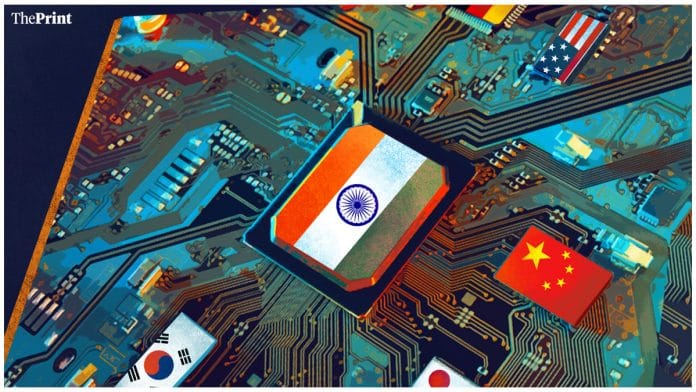
New Delhi: India imports 90-95 percent of the semiconductors it uses today. This dependence could become a major economic and strategic vulnerability as domestic demand is projected to exceed $200 billion by 2035, according to the NITI Aayog roadmap report released Friday.
The report, ‘Future of India’s Semiconductor Industry,’ states: “This widening gap between demand growth and limited domestic capability represents a critical strategic vulnerability and yet also a historic opportunity.”
According to the report, India spent nearly $150 billion importing semiconductor products between FY 2017 and FY 2025. If current trends continue, annual semiconductor import costs could rise to around $240 billion by 2035.
To address this dependence, NITI Aayog says India must stop trying to catch up with global leaders in cutting-edge semiconductor manufacturing and instead focus on areas where it can become irreplaceable within the global chip supply chain.
The roadmap argues that India should move away from the race to build the world’s most advanced chips and focus instead on advanced packaging, system integration and manufacturing scale.
“Winning the semiconductor race will not be easy if India continues to run the existing race; instead, it should shift gears and target becoming the ecosystem player that the global semiconductor industry cannot run without,” the report says.
Prepared by NITI Aayog’s Frontier Tech Hub, the roadmap lays out a vision for India’s semiconductor sector till 2035. It recommends building on domestic strengths in mature-node chips, advanced packaging, semiconductor design and compound semiconductors such as Silicon Carbide (SiC) and Gallium Nitride (GaN).
The report says India’s semiconductor demand is projected to grow at a compound annual growth rate of 19 percent, reaching around $90 billion by 2030 and expanding to over $200 billion by 2035.
This demand is expected to be driven by electronics manufacturing, rapid expansion of data centres, increasing semiconductor content in vehicles particularly electric vehicles and advanced driver assistance systems (ADAS), and the rapid adoption of artificial intelligence across consumer and enterprise applications.
Given the rising demand, the report argues that excessive dependence on imported chips poses risks not only for economic growth but also for national security.
“Chips have become increasingly important to national security and defence programmes,” the report notes, adding that many semiconductor components are being used in defence systems, unmanned aerial vehicles and aerospace platforms are sourced from abroad.
It also warns that currently semiconductor production remains concentrated in countries like China and Taiwan, which makes supply chains vulnerable to geopolitical tensions, natural disasters and trade disruptions.
NITI Aayog also acknowledges the scale of the challenge involved in building a robust domestic semiconductor ecosystem.
Semiconductor manufacturing is among the most capital-intensive industries in the world. A modern analogue fabrication facility can require investments exceeding $5 billion, while advanced-node fabs can cost more than $15 billion.
Overall, the report estimates India will require between $135 billion and $180 billion in capital expenditure over the next decade to build infrastructure for semiconductor manufacturing, packaging, design and related ecosystem capabilities.
What NITI Aayog proposes
The roadmap projects India to build a semiconductor value chain worth $120-$150 billion by 2035, accounting for 10-13 percent of the global semiconductor market and achieving self-sufficiency of 35-50 percent of domestic chip demand.
To achieve these goals, the roadmap proposes five strategic pillars: Pioneering, Policy and Investment, Production, People and Partnership.
Under the Pioneering pillar, the report calls for strengthening domestic design and research capabilities through advanced R&D infrastructure and wider use of artificial intelligence in semiconductor engineering.
The federal think tank suggests creating a unified platform “that integrates silicon design, package design and system integration, enabling rapid prototyping and commercialisation”.
The roadmap also calls for lowering barriers to semiconductor innovation by improving access to critical design tools, intellectual property and fabrication pathways.
Under Policy and Investment, the report says governments should contribute at least one-third of the estimated investment of $135-180 billion required to reduce risks for private investors and support long term ecosystem development.
“Implement a single window clearance and fast-track approval mechanism for semiconductor investments,” it says. Adding, “Alongside funding support, the focus should also be on stability, predictable incentives and coordinated execution across the value chain.”
Within Manufacturing, the report argues that India should not attempt to replicate the entire global semiconductor value chain. Instead, it should focus on selective areas where it can build scale and competitive advantage. These include wafer fabrication, advanced packaging, critical materials and substrates, and mission-critical manufacturing linked to defence, aerospace and strategic infrastructure.
The roadmap also places emphasis on talent. It recommends setting up National Fab Academy, semiconductor-focused engineering curriculum, large-scale technician training programmes and a global talent initiative to attract experienced semiconductor professionals.
Finally, under the Partnership pillar, the report recommends deeper cooperation with trusted semiconductor partners such as the United States, Japan, South Korea and the European Union. “As semiconductor technologies become increasingly shaped by export controls, technology blocs and national security considerations, India must position itself as a trusted, long-term partner within allied and friendly semiconductor ecosystems,” the report argues.
(Edited by Amrtansh Arora)
Also Read: What is ISM 2.0 launched by Sitharaman to boost India’s semiconductor sector?
We need to match the nation’s needs- human, technological, and self-sufficiency in all big plans. In the semicon filed, there are some basic truths to be understood that should determine how we go about semicon plans:
1. Many areas in the semi world are highly cyclical in demand. Memories and wafers are commodities, whose prices can swing by 50% in a short time- up or down. These need to be avoided.
2. Again, wafer manufacturing consumes enormous resources, but does not yield back to the community =local or state or country. A major share of the financing comes from abroad- Indian finance units- banks, agencies etc are too weak to fund $ 10 Billion projects. And this 10 billion employs less than 5000 people, direct and indirect- meaning $ 2 Million per person (5000) employed. or a country like India, there are far better ways to employ capital that can employ 100 to 1000 times the number of people for the same amount.
3. Forget “self sufficiency” or “Atmanirbhar” in ICS. No country is self sufficient in chips. Typically a country will import from 70% to 10% of its chip needs, even though it manufactures a big variety of chips. Why ? The items imported are diverse and no country can make all the chips. Best course is make as much as possible within technological, commercial and financial limits, and import other chips for local needs. Theoretically, a country can import 50 billion $ worth of diverse ICs, and export 200 billion of its own products. Nothing wrong with it.