



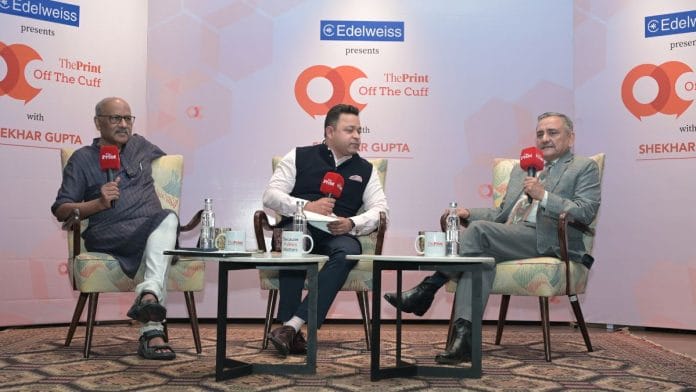
New Delhi: India’s military think tanks need greater intellectual autonomy without compromising on basic protocols, and should not have to seek support from industry or foreign sources, former Chief of Defence Staff General Anil Chauhan (Retd) said.
Speaking at ThePrint Off the Cuff Saturday, Chauhan, who retired at the end of May after an extended tenure in the country’s top military post, said that one of the initiatives he had pursued as CDS was a government-approved funding boost of Rs 5 crore for think tanks affiliated with India’s Army, Navy, Air Force and the tri-services establishment. The initiative is now nearing completion, he added.
“I always thought that the backbone of the armed forces should be the development of a strategic culture among all of us. So, we wanted our think tanks to have autonomy and their own funding, government funding at that. They should not be looking for funds from outside, from industry or foreign sources,” General Chauhan said.
The former CDS also advocated greater civilian participation in India’s military education system. He said instruction at institutions, such as the National Defence College, War Colleges and Staff Colleges, is currently handled entirely by military officers drawing on operational experience, rather than by academics with formal expertise in strategic studies. He contrasted this with countries such as the United States and the United Kingdom, where career academics play a larger role in military education.
“Presently, all our War Colleges, Staff Colleges and CDM have faculty drawn entirely from the armed forces. We all come for a very short tenure, and whatever we teach the future generation of leadership is based on our own experience. There is no academic background to it, that’s the part which is missing. I wanted civilian faculty to be part of the War Colleges and CDM. That should also come through,” he added.
When asked whether government funding could compromise the think tanks’ independence, Chauhan distinguished financial support and intellectual freedom.
He said intellectual autonomy should be preserved even as think tanks operate within a broader institutional framework, although researchers would still be expected to follow basic protocols, such as informing superiors about external engagements and participation in public events.
Pressed further on the limits of that autonomy, whether, for instance, a researcher affiliated with a naval think tank could publish an argument that aircraft carriers were obsolete, Chauhan drew a distinction between personal views and official institutional publications.
“What you feel, you should be able to convey. That is a separate thing altogether. But if that paper is to be issued by the think tank, that is a different thing,” he added.
He cited the Centre for Air Power Studies as an example, saying it had occasionally published contrarian views without facing institutional pushback.
Gen. Chauhan also discussed plans for a second initiative: developing an independent geospatial data agency for India’s military. He said the effort followed a breakdown in cooperation with the Survey of India, after which military personnel who had been working alongside the agency returned to their parent services. As a result, the armed forces needed to develop their own in-house geospatial capabilities.
The third initiative he highlighted focused on preparing the military for the changing character of warfare. Gen. Chauhan said he had launched a course on future warfare, which now runs three times a year with formal government approval after initially operating without official sanction.
He said the initiative was complemented by a small analytical cell embedded at military headquarters to study how future wars are likely to be fought and the adaptations they would require.

(Edited by Jeyasri AT)
Also Read: PoK bloodbath: Pakistan Army says it exercised ‘restraint’, ‘monopoly of violence belongs to state’