





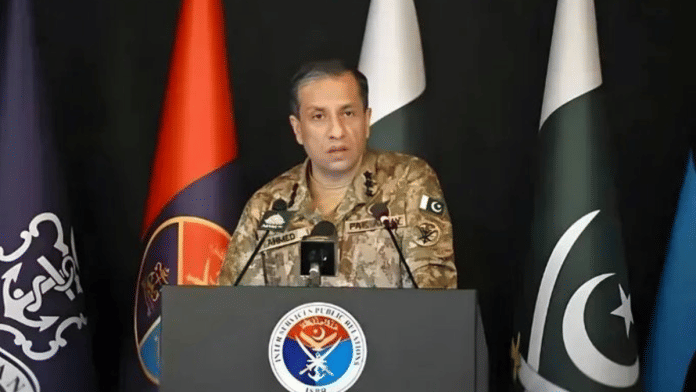


New Delhi: Amid brutal violence in Pakistan-occupied Kashmir (PoK) that has claimed at least 100 killings since June, the Pakistan army claimed Friday it was ‘restrained’ in its approach and even justified the killings claiming the ‘monopoly of violence belongs to the state’.
In a two-hour press briefing, Ahmed Sharif Chaudhry, Director General of Inter-Services Public Relations (ISPR), deflected pointed questions, spoke extensively about Balochistan, and resorted to theatrics.
“Politicians need to decide how to understand the will of the people. We can see the stagnation but it is on the politicians… Over a period of time, it is clear that the ideological state of Pakistan is the most consequential country in the world,” he said in a winding response to a media question of the violence in PoK.
The ISPR D-G then in textbook style blamed India for the violence, without a mention of the PoK killings in the last month. “India made the protesters ask about rights.. But Kashmir is the darling of Pakistan when it comes to rights. Their (Joint Awami Action Committee, or JAAC) protest is agenda based.”
The Pakistan army, he claimed, had no role in the violence and added that no killings or violence had taken place. “This is the police backed by the government of PoK and their police forces. Nobody can be given a free pass to violence.”
A day after Interior Minister Mohsin Naqvi—considered close to Field Marshal Asim Munir— claimed that Pakistan’s governance had ‘collapsed’, the DG ISPR echoed similar claims to argue that the country’s security problems stem from weak governance, insufficient adherence to the rule of law and a failure by citizens to fulfil constitutional obligations.
At the center of Chaudhry’s remarks was what he described as the need for Pakistan to become a “hard state”— a term he defined not as military rule, but as a state where the Constitution and the law apply equally to everyone.
“Are we a hard state? Unfortunately not,” he said. “A hard state is one where the Constitution and law are the same for everyone. It does not mean a military-run state or an armed forces-dominated state.”
The military spokesperson argued that effective governance was indispensable to national security, saying Pakistan’s security challenges could not be addressed without strengthening state institutions and ensuring equal enforcement of the law.
“If we are loyal to the state and obedient to the Constitution and the law, then you can talk about your rights,” he said, adding that public discourse had become heavily focused on grievances while giving insufficient attention to civic responsibilities.
Quoting recent remarks by Munir, Chaudhry questioned why there was no corresponding “movement for obligations” alongside movements demanding greater rights.
He argued that Pakistanis should place national identity above ethnic or regional identities, saying that being Pakistani should come before affiliations based on province or ethnicity.
The briefing came as violence has intensified in multiple regions of Pakistan, including violence in PoK. Local and international reports have accused the authorities of responding with excessive force against protesters.
(Edited by Tony Rai)
Also Read: Deadly violence mars polls in Pakistan-occupied Kashmir, 30 civilians killed in clashes with Army
Wow! Asking for rights by citizens is a problem for Pakistan. Only God save this country.