







New Delhi: Voters in Pakistan-occupied Kashmir (PoK) are heading to the polls to elect a new Legislative Assembly and prime minister to head the territorial administration. While Islamabad calls the shots in the occupied territory, it has granted PoK special status to symbolically portray it as autonomous.
All candidates, including the prime minister, however, are required to furnish an undertaking affirming PoK’s accession to Pakistan. Any candidate advocating independence, or arrangement other than union with Pakistan, is barred from contesting.
The voting, which began Monday and will continue till 10 August, unfolds against internet shutdowns and a spate of arrests, besides deadly clashes between protesters and security forces which have claimed at least 40 lives, including that of six police and paramilitary personnel. As many as 14,000 personnel from Pakistan’s Punjab have been deployed in PoK to oversee the polling process. Instead of a single day, polling for PoK’s 53 seats is being held in three phases for the first time—a plan of action attributed to the security situation.
Polling was held in 13 constituencies in Mirpur division on 27 July, and will be held in 9 constituencies in Muzaffarabad division and 12 seats reserved for refugees across PoK on 1 August. The remaining 11 constituencies in Sudhanoti division, hit hardest by the unrest, will go to the polls on 10 August. Preparations had formally begun on 5 June, when the territorial poll panel announced the schedule.
But the two political forces that have historically dominated PoK’s politics are missing from this election, the Joint Awami Action Committee (JAAC) and Imran Khan’s Pakistan Tehreek-e-Insaf (PTI).
The JAAC, which campaigned on the promise of electoral reforms and subsidised flour and electricity, was banned by the territorial administration in June under anti-terrorism laws. The poll panel then barred its candidates from contesting. Several of its leaders and workers tried to run as independents, but their nomination papers were reportedly rejected on various technical grounds.
Former prime minister Imran Khan’s PTI, meanwhile, chose to sit out the contest, saying that it saw little chance of a free and fair vote.
For Islamabad, peaceful polling with a sizable turnout would bolster its argument that it governs the occupied territory with some credibility.
A disputed election, or continued protests, on the other hand, would likely fuel calls for greater autonomy and a change in PoK’s constitutional status.
While the territorial administration oversees day-to-day governance, Pakistan’s federal government exercises control over PoK’s defence and foreign policy, besides core constitutional questions about autonomy—signifying a division of power that considerably limits the authority of elected representatives in the disputed territory.
According to the occupied territory’s polling body, more than 3.8 million voters are registered to vote in the elections this time, up from roughly 3.2 million in 2021. Of those, about 439,000 are registered in the 12 constituencies reserved for refugees.
Direct contests are held on 45 of PoK’s 53 seats. The Assembly was expanded in August 2019 with one additional seat allocated each to Muzaffarabad, Neelum, Sudhanoti, and Kotli. This raised the majority mark in the Assembly from 25 to 27.
Of the 45 directly-contested seats, 33 represent constituencies inside the occupied territory itself. The remaining 12 constituencies—spread across Pakistan’s provinces including in Lahore, Rawalpindi, Gujranwala, Faisalabad and Sialkot—are reserved for those registered as refugees from India.
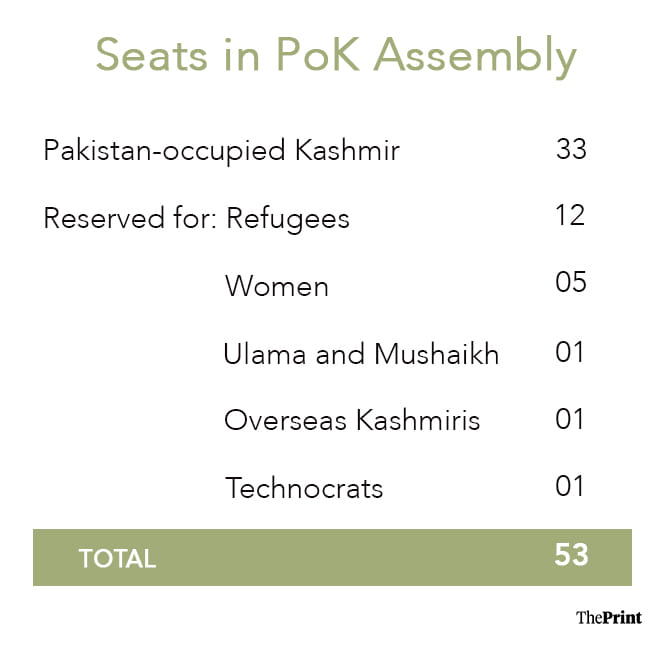
Apart from the 45 directly-contested seats, the remaining 8 seats are reserved: 5 for women, and 1 each for a technocrat, religious scholar, and an overseas Kashmiri. These are filled by appointees of major political parties through proportional representation after the general election.
A chaotic first phase on 27 July was marked by scuffles, arrests, and allegations of rigging by allies-turned-rivals PPP and PML(N). A PPP worker was also killed, with Bilawal Bhutto Zardari demanding action. Roughly 18,560 security personnel, backed by police, Rangers, and army units were deployed across Mirpur division. The vote has increasingly become a proxy battle between PPP’s Bilawal and PML(N)’s Nawaz Sharif, who traded barbs on the campaign trail over “gifts” like e-buses being handed out ahead of polling day.
JAAC charter: Yes to subsidised flour, no to reserved seats
The ongoing protests across PoK first broke out in June when JAAC—an umbrella outfit of trade groups, civil-society organisations and religious bodies—called for abolition of the 12 seats reserved across Pakistan for refugees. It called for a march on the territorial capital, Muzaffarabad, on 9 June to emphasise its demand. But the JAAC was banned four days prior, on 5 June, by the territorial administration which accused it of sedition, violence and activities prejudicial to State security. The ban did little to halt the mobilisation.
In written proposals submitted on 30 May, the JAAC, formed in 2023, had proposed two alternatives: preserving token refugee representation until the broader Kashmir dispute is resolved, or replacing the 12 seats reserved for refugees with 4 seats on the PoK Council, the 14-member body chaired by Pakistan’s prime minister to oversee public utilities, banking and the taxation regime which falls outside the purview of the PoK Assembly.
Both proposals were rejected at an all-party meeting in Muzaffarabad on 3 June.
For JAAC, the core objection is one of geography: representatives elected by voters in Lahore or Rawalpindi should not decide the composition of a legislature that governs people living hundreds of miles away.
Islamabad rejected that argument. Seats reserved for refugees, it said, have existed for five decades now and are woven into the territory’s constitutional structure, recognising displaced Kashmiris as stakeholders in a dispute that remains unresolved and reinforcing the territory’s claim to represent the entire former princely state, not merely the part of it Pakistan has occupied in 1947.
Weighing in on the issue, Pakistan’s Supreme Court ruled on 7 June that seats reserved for refugees are constitutionally protected and can only be abolished through an amendment passed by the PoK Assembly, and not public pressure.
It described such an amendment, if it would come to pass, as a deliberate constitutional act rather than something to be extracted under duress. It also ruled that such an amendment cannot be passed until a new Assembly is seated.
Faisal Mumtaz Rathore of the Pakistan Peoples Party (PPP), the incumbent prime minister of PoK, said during a press conference in June that any decision on the seats reserved for refugees rests with elected parliamentarians.
Pakistan’s Defense Minister Khawaja Asif, meanwhile, told the National Assembly that the issue should be settled by voters rather than street protests.
Addressing supporters at a sit-in in Rawalakot in mid-July, JAAC leader Umar Nazir Kashmiri said the outfit bypassed government channels and wrote directly to Pakistan’s Army chief Field Marshal Asim Munir, claiming that its concerns were not reaching him through official channels. He also expressed gratitude to Munir for what he described as “understanding the grievances of the people of Kashmir”.
In addition to the demand for abolition of reserved seats, JAAC also held demonstrations in the run-up to the polls to call attention to rising electricity prices, unemployment and inflation, besides its demand for a larger share of revenue from the Mangla and Neelum-Jhelum hydropower projects located in PoK.
Those frustrations had fuelled the rise of JAAC.
Its 2023 charter initially focused almost entirely on subsidised flour and electricity rather than constitutional questions. It was only in October 2025 that the demand to abolish seats reserved for refugees appeared in the outfit’s expanded charter.
Another flashpoint this time is the constitutional requirement that candidates affirm the territory’s accession to Pakistan if they wish to contest the elections.
A game of musical chairs
Political parties are in the fray in PoK are PPP, Prime Minister Shehbaz Sharif’s Pakistan Muslim League (Nawaz), the far-Right Tehreek-e-Labbaik Pakistan (TLP), and the Muslim Conference, which identifies itself as the oldest party in PoK.
In the 2021 territorial elections, PTI garnered the highest vote share at 31.4 percent, followed by PML(N) at 25.1 percent, and PPP at 17.9 percent.
Smaller parties trailed well behind. The All Jammu and Kashmir Muslim Conference (AJKMC), for instance, garnered 7.86 percent of the vote, the Jammu Kashmir Peoples Party (JKPP) 6.08 percent, and TLP 4.94 percent, while independent candidates collectively secured 6.8 percent of the vote.
With 32 seats, Imran Khan’s PTI emerged as the single-largest party and appointed Abdul Qayyum Khan Niazi as the prime minister. In 2022, PTI replaced him with Tanveer Ilyas Khan, who was disqualified by the PoK High Court a year later for contempt of court. The PoK Assembly subsequently elected Speaker Chaudhry Anwarul Haq as prime minister on 20 April 2023. After assuming office, Haq formed a forward bloc within the PTI, comprising 12 members, and established a coalition government with the PPP and PML(N). Political realignments continued over the following months as members defected from PTI’s forward bloc, allowing PPP and PML(N) to increase their representation to 29 and 9 seats, respectively.
At one point, PTI’s strength in the PoK legislature was reduced to 13 members, eight of whom were part of the forward bloc. On 17 November 2025, Haq was removed through a vote of no-confidence supported by 36 members affiliated with PPP and PML(N). The same day, Faisal Mumtaz Rathore, elected on a PPP ticket, was chosen as prime minister, enabling PPP to form a majority government in PoK for the first time since 2016, with PML(N) and PTI in the opposition benches.
Also Read: Gen Aamer Raza to oversee nuclear assets as Pakistan’s 1st chief of National Strategic Command
‘Karachi Agreement’
For nearly eight decades, Pakistan-occupied Kashmir has held elections, operating under a constitution of its own. Yet, by nearly every objective account, its politics has been steered more from Islamabad than Muzaffarabad, its capital.
No country or international body recognises PoK as a sovereign state.
Multiple UN resolutions have over the years referred to it instead as territory under the control of local authorities pending a resolution of the broader Kashmir dispute.
What has unfolded as a result, historians and political scientists say, is the birth of a dependent state rather than an autonomous territory.
In an article she wrote in 2006 for India Quarterly, flagship of the New Delhi-based think tank Indian Council of World Affairs (ICWA), Seema Shekhawat describes how this framework was laid down in 1949, when Muslim Conference—then the dominant player in PoK—signed what became known as the ‘Karachi Agreement’ with Pakistan’s federal government and the president of PoK.
The ‘Karachi Agreement’ handed Islamabad control over eight core areas of governance, including defence, foreign affairs, and negotiations with the United Nations commission then overseeing the Kashmir dispute.
The scope of residual powers were left deliberately vague, and control over the neighbouring territory of Gilgit-Baltistan—which was also part of the former princely state—was placed under Pakistan’s federal jurisdiction.
For years, real power in PoK rested not with any elected official but with a civil servant known as the Chief Plebiscite Officer, who reported directly to Islamabad. From 1949 until 1968, that joint-secretary-level appointee was, in practice, PoK’s top authority, accountable to none other than the federal government in Islamabad.
Genuine electoral competition did not emerge in PoK until 1960, when Pakistan’s then military ruler, General Ayub Khan, who banned political activity after seizing power in Islamabad in 1958, extended his “Basic Democracies” system to PoK.
The scheme restricted voting rights to those meeting certain education or income thresholds, a design intended, Shekhawat writes, to keep the electorate small and manageable. Under a 1964 amendment to PoK’s constitution, the president was chosen indirectly by a 12-member Council elected by roughly 2,400 “Basic Democrats”—half residents and the other half representing Kashmiri refugees.
K.H. Khurshid became the occupied territory’s first elected president in 1961. But his tenure was short-lived. Khurshid was dismissed in 1964 and later jailed.
The pattern repeated itself under General Yahya Khan, who scrapped the indirect-election system in favour of a 25-member Council. Its first choice for president, Sardar Qayyum Khan of the Muslim Conference, was later removed in 1974 after Zulfikar Ali Bhutto took over as prime minister the previous year.
A new interim constitution, adopted in 1974, restructured the administration framework in PoK yet again, shifting executive authority from the president to a prime minister and establishing a 13-member Council with Pakistan’s prime minister as chairman and PoK’s president as vice-chairman.
Islamabad appoints six of the Council’s other members, all sitting federal ministers or parliamentarians. This structure gives Islamabad a built-in majority over the state of affairs of a territory it has no authority to govern.
The 1974 interim constitution also contains a clause that has shaped and limited PoK’s politics: Article 56, which allows Islamabad to take whatever action it sees “necessary or expedient” to carry out its responsibilities, including the dismissal of any elected government irrespective of its strength in the territorial Assembly.
Islamabad’s influence
The power Islamabad draws from the 1974 interim constitution has been exercised without restraint over the years. General Zia-ul-Haq used it in August 1977 to dismiss the PPP-led administration and dissolve the territorial Assembly after seizing power in a coup. An army brigadier at the time, Mohammed Hayat Khan was installed as president with sweeping powers.
When the Chief Justice of the PoK High Court accepted petitions challenging the legality of that appointment, he too was removed. Political protests were met with arrests and detentions; and in July 1979, martial law was imposed. Political activity in PoK remained suspended until the middle of the following decade.
What emerged after martial law was more a recurring cycle than restoration of self-government—elections held in line with a schedule, followed by allegations of manipulation, and dismissal of the elected administration.
The pattern was evident as early as 1975, in the first Assembly elections held under the interim constitution which brought to power the PPP, which was also in power in Islamabad. The Muslim Conference boycotted that election and later alleged large-scale rigging. According to the Urdu-language newspaper Nawa-i-Waqt, only about 60,000 of some 145,000 registered voters cast their ballots. That administration did not survive Zia’s coup two years later, notes Shekhawat.
Elections resumed in 1985, but only for parties formally registered with the PoK administration—a restriction that excluded the PPP altogether. The Muslim Conference won that election, amid complaints that Islamabad had tilted the scales, and Abdul Qayyum Khan became president, with Hayat Khan as prime minister.
This see-saw continued through the 1990s.
The 1990 elections led to Raja Mumtaz Hussain Rathore assuming the office of PoK prime minister, with backing from the PPP then in power in Islamabad. But he faced immediate friction from president Sardar Qayyum, a Muslim Conference figure who put off the swearing-in of members of Rathore’s winning bloc.
When the political tide in Islamabad turned in favour of Nawaz Sharif’s party, the 1991 elections delivered the Muslim Conference a majority amid what observers described as widespread rigging. Rathore refused to accept the results and was dismissed under Article 56 of PoK’s constitution. He was later imprisoned.
Benazir Bhutto, who returned to power in Islamabad in 1993, chose not to move against the Qayyum-led PoK administration.
Three years later, in the 1996 election, the PPP reclaimed power in PoK, mirroring the political complexion of the federal government, as has often been the case.
Then came the 1999 military coup in which General Pervez Musharraf seized power in Pakistan. This sent ripples through PoK’s politics. In the 2001 election, Muslim Conference won 29 of the 40 directly-contested seats. Sikandar Hayat Khan became prime minister, while the presidency went to Major General (Ret.) Sardar Muhammad Anwar Khan, a former army officer whose retirement was cleared, days before his election, under a Musharraf-era waiver of the two-year cooling-off period for government employees or military personnel entering politics.
Underlying this is a provision that many in PoK say makes self-determination a near impossibility. Section 4, Clause 2 of PoK’s constitution bars any person or political party from “propagating against, or taking part in activities prejudicial or detrimental to, the ideology of the State’s accession to Pakistan”.
In practice, that clause has been used to bar candidates who favour autonomy, rather than union with Pakistan, from standing for office. Those who declined to sign a declaration affirming the territory’s eventual accession to Pakistan were excluded from the 1996 election—and again in 2001, 2006 and other elections.
The clause itself is not new, dating to earlier versions of the constitution, but it has drawn far more scrutiny in recent years as PoK’s politics came under greater scrutiny. The Assembly formed after the ongoing elections, according to analysts, will likely be forced to confront the question of how PoK is represented within Pakistan’s broader federal structure, at least on an interim basis.
In an article for Dawn, published on 26 July, Pakistan-based political analyst Ahmad Bilal Mahmood wrote that the people of PoK, “especially the youth and the Gen-Z segment, are dissatisfied with the current arrangement” since the territory has “no representation in constitutional forums such as the CCI, NEC, NFC, Irsa etc. whose decisions impact them”.
Mahmood argued that in order to “prevent a stronger protest wave”, Islamabad must consider a “de facto provincial status” for PoK and Gilgit-Baltistan “on an interim basis without adversely affecting Pakistan’s legal stand on the Kashmir dispute”.
(Edited by Amrtansh Arora)
Also Read: The mediator who cannot chose: Caught between Iran & Saudi Arabia, Pakistan’s West Asia dilemma