





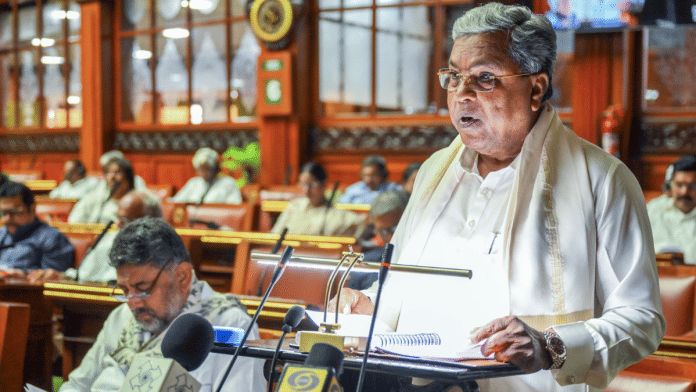


Bengaluru: Declaring politics has become “corrupted”, former Karnataka chief minister Siddaramaiah has announced he will not contest the state’s 2028 Assembly elections. Making clear his intentions of remaining politically active, the Congress Working Committee member went on to say that the influence of money and muscle has gained too much significance, making it harder for him to continue.
“The reasons given by him (Siddaramaiah) are very important. He said that politics is corrupted, there is too much influence of money, especially black money… that is 100 per cent correct… he has become frustrated and announced to resign,” Karnataka Pradesh Congress Committee (KPCC) president B.K. Hariprasad said on Monday.
Touching 80, the two-time chief minister of Karnataka has made similar announcements in the past, notably ahead of the 2023 Assembly elections. Cabinet ministers like Eshwar Khandre and several of his loyalists like Santosh Lad said that they would like Siddaramaiah to contest the 2028 elections.
It does appear, however, that Siddaramaiah is dead serious this time. “Earlier also, my father mentioned this, even when he was chief minister he said that he will not contest the 2028 Assembly elections. He has made this decision and we should all respect that,” Siddaramaiah’s son, Karnataka Cabinet minister Yathindra Siddaramaiah, said on Monday, adding that his even if he does not contest elections, his father would remain politically active and continue to raise his voice for the exploited and oppressed classes. “If he makes a strong decision, then no one can change his mind,” Yathindra said, adding that he also expects his father to pay more attention to his health.
Since stepping down as chief minister in May this year, Siddaramaiah has kept a low profile but remained in the thick of all political matters, especially in the new D.K. Shivakumar-led Congress government that replaced him. He remains a central figure in the Congress party under the D.K. Shivakumar-led government. Analysts, however, say this likely marks the end of Siddaramaiah’s half a century in electoral politics but outlines a possible larger role for the leader.
Also Read: Shivakumar launches permanent resident certificates; BJP alleges bid to legitimise illegal migrants
Mass politics
Influenced by Dr Ram Manohar Lohia’s school of socialism, Siddaramaiah entered politics to advance social justice, advocating the rights of oppressed and backward classes in the southern districts of Karnataka. He first contested on a Bharatiya Lok Dal ticket in 1983, winning from the Chamundeshwari seat to enter the Karnataka Legislative Assembly. Since then, he has carved out a niche for himself despite the presence of stalwarts like H.D. Deve Gowda, Ramakrishna Hegde, Veerendra Patil, Devaraj Urs and several others.
For most of his political career, Siddaramaiah has remained focused on building the AHINDA support base (Kannada acronym for minorities, backward classes and Dalits). This grouping remains central to the party’s politics in Karnataka, particularly since 2006 when Siddaramaiah parted ways with his mentor, H.D. Deve Gowda, to join the Congress. Despite being a relatively new face at the time, he managed to edge out senior leaders like Mallikarjuna Kharge and G. Parameshwara, pivoting from the Congress’s earlier strategy of aligning with dominant castes and minorities.
Narendar Pani, a Bengaluru-based political analyst and faculty at the National Institute of Advanced Studies, said that Siddaramaiah appears to be the only political personality within the Congress who has positioned himself as anti-Bharatiya Janata Party (BJP), anti-Rashtriya Swayamsevak Sangh, and pro-social justice–three topics mirrored by Congress leader Rahul Gandhi. “This time it appears that he will focus on mass politics. It’s more a political strategy than retirement,” Pani told ThePrint, adding that Congress requires someone who can mobilise the AHINDA bloc on the ground.
Analysts also point out that while the 80-year-old’s trajectory shares similarities with the BJP’s B.S. Yediyurappa—in that their respective parties can neither fully manage nor do without them—a key difference is how Siddaramaiah stepped down as chief minister without resistance, thereby enhancing his standing with the Gandhis. Also, there are no alternative Kuruba mass leaders like Siddaramaiah in the Congress, again similar to how BJP has no substitute Lingayat leader other than Yediyurappa.
The Kurubas, traditionally shepherds, are a politically significant community with a large presence in several constituencies spread across the state. More importantly, there is a significant Kuruba population in most constituencies, making them a good swing vote that can decide closely fought contests.
The Kuruba vote
Narayana, a Bengaluru-based political analyst and faculty member at the Azim Premji University says that though the Congress has a specific support base, the Kurubas remain loyal to Siddaramaiah. He says that the Lingayats are believed to back the BJP while the Vokkaligas, who constitute a majority in several southern districts, are seen to side with Deve Gowda-led Janata Dal (Secular) or JD(S). “The only bloc that Siddaramaiah can claim to have a significant influence over are the Kurubas,” Narayana told ThePrint. He added that Dalits are divided between the Left and Right while the larger backward classes are splintered, with communities choosing different sides based on their requirements. With the BJP making an aggressive outreach to Dalits, the Congress needs to retain its core support bases like minorities, especially Muslims, and a large chunk of the backward classes. Though the Muslims have nursed some disenchantment with the Congress, they are likely to remain with the party. But it also enhances the standing and significance of the Kuruba community, Narayana says.
He adds that the BJP has no leader who can challenge Siddaramaiah’s hold over the Kurubas either. “The BJP is now trying to cultivate Kuruba leaders in each constituency to split the community’s votes,” Narayana says. While Siddaramaiah remains key to the Congress plans in Karnataka, it has also posed some hurdles for the functioning of the Shivakumar government, analysts say.
Deadlock in Cabinet expansion
Shivakumar replaced Siddaramaiah on 3 June alongside 13 Cabinet ministers. However, Shivakumar has not been able to convince the party high command to fill up the remaining Cabinet seats largely due to the presence of two opposing blocs–Siddaramaiah and Mallikarjuna Kharge. This delay has bred more dissent, with a chunk of legislators spending more time in Delhi lobbying with the high command and not paying enough attention to their own constituencies even as elections are just a couple of years away, analysts say.
These delays have given the BJP and JD(S) more ammunition to corner the Shivakumar government, especially around the contentious Bidadi township project, drought relief for the farming community and unravelling of scams like the Karnataka Public Service Commission among others.
Shivakumar has spent a good portion of his time as chief minister in Delhi, trying to break the deadlock. With elections for Bengaluru City Corporation, Zilla and Taluk Panchayats round the corner, the challenges continue to pile up on Shivakumar. Siddaramaiah has accompanied Shivakumar to Delhi on most occasions as well, painting a picture of hope and despair for the chief minister.
Shivakumar also has to act on the second ‘socio-economic and educational survey’, or the caste census, that can help the Congress build some confidence among the backward classes. However, Shivakumar’s earlier opposition to the leaked findings which downward revised the estimated population of Vokkaligas and Lingayats, has not gone down well with the AHINDA bloc.
Siddaramaiah’s continued patronage remains the key to keeping a significant portion of this section with the Congress, analysts say. “They (Congress) need somebody who can bring these people together on the field rather than in the Assembly,” Pani says. And that can only be Siddaramaiah.
(Edited by Nardeep Singh Dahiya)
Also Read: Karnataka will need Rs 20,000 crore in next 2-3 yrs to decongest its highways & major district roads