







Bengaluru: Karnataka will require anywhere between Rs 15,000-20,000 crore in the near-term to help decongest the approximately 13,000 km of state highways (SH) and 20,500 km of major district roads, according to government officials.
According to a new report by Boston Consulting Group (BCG), 45 percent of the SHs, or 8,600 km, fall into the priority category required to be addressed in the near-term (2026-32). The report was commissioned by the state’s Urban Development Department of the Karnataka government, and has been submitted to the government.
“Depending on the current status of the road, estimates vary between Rs 2-3 crore per km for state highways and (major) district roads. The costs could go up to Rs 10-20 crore if it is a National Highway,” a senior government official told ThePrint, requesting anonymity.
With a growing funding crunch, the government is exploring multiple options to fund decongestion of these road networks, which is key to retaining Karnataka’s growth trajectory.
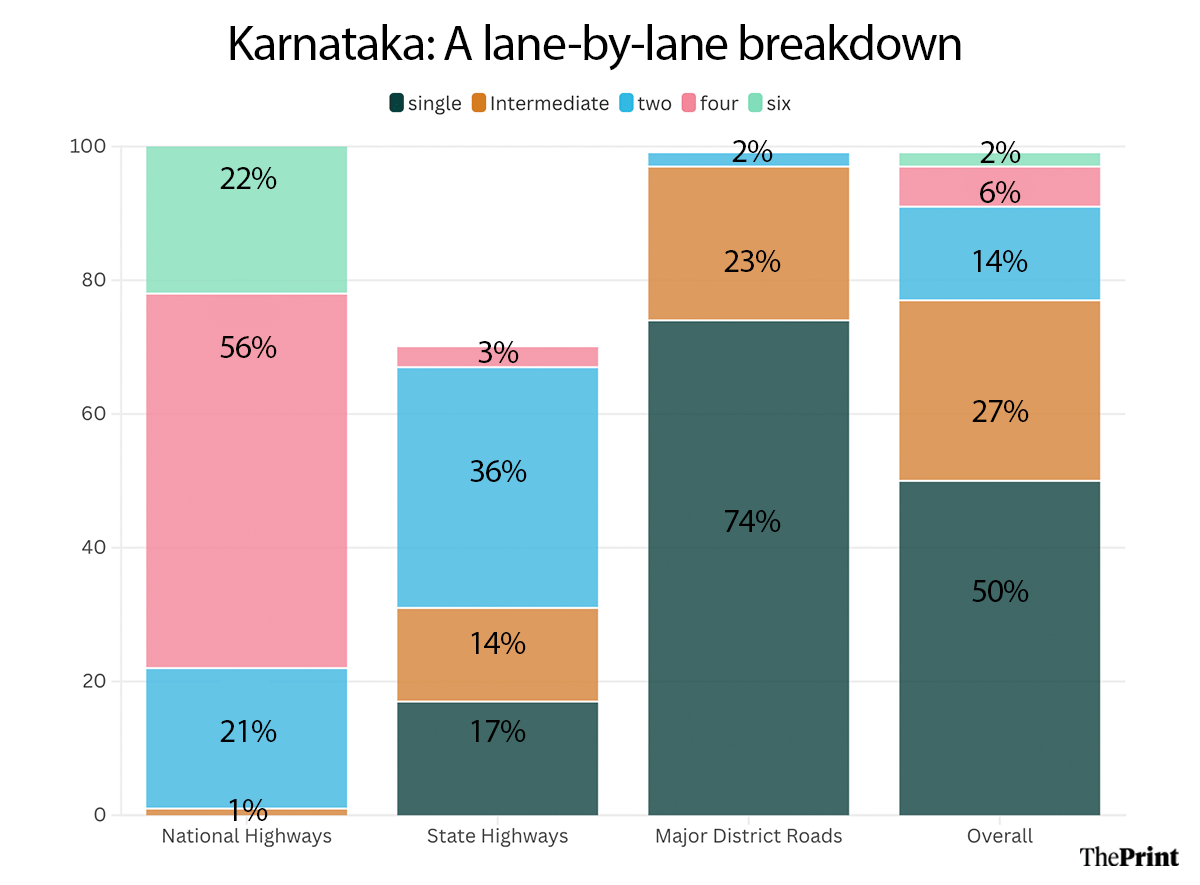
The BCG data shows that only 2 percent of the overall existing road networks (including NH, SH, Major District Roads or MDR) are six-lanes, while just 6 percent are four-lanes and 14 percent are two lanes.
Twenty-seven percent are intermediate lanes while 50 percent of all road networks are single lanes or one-lane highways or roads.
The Bengaluru-Mysuru Expressway has brought down travel time between the two cities to just over 1.5 hours (approximately 145 km). However, it takes well over two to three hours to even get to this road from the city centre during rush hours.
The BCG states in its report that the existing roads and load estimation on highways is going to reach saturation point by 2047.
Of the state highways, the report estimates that more than 25 of them, each requiring about 100 km of upgrades over the next five years, together account for nearly 4,800 km of road improvement works.
The D.K. Shivakumar government in Karnataka has announced several big-ticket projects, including the Rs 40,000-crore Tunnel Road in Bengaluru, major underpasses within India’s IT capital as well as expanding or improving existing road networks in other parts of the state.
The official cited above said a road measuring about 10 metres in width requires about Rs 3-crore per km for improvement work.
“Depending on the economic potential, we can look at various options. There are toll roads, Public Private Partnerships, extending Viability Gap Funding (plus toll) and the Hybrid Annuity Model or HAM,” the official said.
The BCG report highlights the importance of addressing concerns over congestion in these networks as regional connectivity, passenger and cargo movement, day-to-day transactions and the larger economic functions are directly linked to efficiency in movement.
Also Read: Bengaluru traffic woes may get ‘London-style’ solution. State finance panel proposes congestion tax
‘Upgrades needed’
The BCG report recommends developing new road links to improve connectivity between urban centres, particularly those with weak transport links. It also proposes building ring roads and bypasses around major urban local bodies (ULBs) to divert through traffic, ease congestion on arterial roads, and improve intercity connectivity.
However, the rising cost of land acquisition, especially near existing roads, adds to the high cost of construction. Delays, alleged corruption, poor quality and other challenges significantly add to rising costs and prolonged inconvenience that stalls highway traffic which in turn impedes swift economic transactions.
For instance, the Peripheral Ring Road (PRR) project which aimed to build a road circling Bengaluru was envisioned in 2007 at an estimated cost of around Rs 3,000 crore. This road, which connects with the existing NICE (Nandi Infrastructure Corridor Enterprises) and goes a full round of the city, was left unfinished on account of several challenges, including policy paralysis due to political uncertainty in Karnataka and stiff resistance from landowners.
The approximately 73-km road was meant to divert traffic entering into Bengaluru to other cities and regions, through a ring road and also form a boundary of sorts where the city ends.
The current Congress government has revived the project in the last couple of years even though the city has grown well beyond the originally planned boundary.
The PRR has been rebranded Bengaluru Business Corridor and cost has now escalated to Rs 27,000 crore.
In the last 20 years, Bengaluru’s population has more than doubled and it currently has over 1.3 crore vehicles, making it one of the most congested cities in the world, and giving it the highest vehicle-to-people density ratio in the country.
“Approx 30% of the stressed NH network comprises high PCU (Passenger Car Unit) 6-lane toll plaza stretches, with over 250 km requiring immediate solutions within the next five years,” BCG states in its report.
PCU refers to Passenger Car Unit or one car measure. It is a standard metric used in to measure mixed traffic flow by converting different types of vehicles (like trucks, bicycles, and motorcycles) into a single equivalent value based on the space they occupy and their impact on traffic speed
Similarly, a significant chunk of the current 4-lane network reaches design capacity by 2037 and 2-lanes require immediate upgrades (expansion to 4-lane) in the next five years.
For MDRs, out of the over 20,000 km that require upgrading by 2032, an estimated 3,000 km need to be converted into four-lane roads, and the remaining need to become two-lane, BCG states.
(Edited by Ajeet Tiwari)
Also Read: Driving solo on Bengaluru’s streets? You may soon have to cough up a congestion tax
Reduce the 95,000 crore freebie expenditure. There you go- 20,000 crore.
After socialism and corruption, only ₹2 will be left for decongesting highways and major roads.