



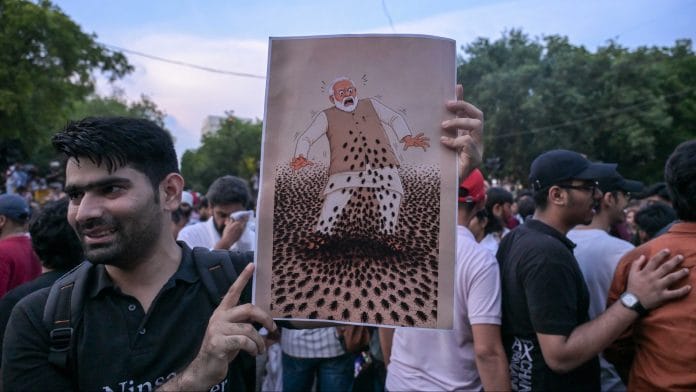
In The Discovery of India, Jawaharlal Nehru made an observation about MK Gandhi, capturing a feeling that was experienced widely but never articulated as sharply. To slightly paraphrase Nehru: “The dominant impulse in India under British rule was that of fear; pervasive, oppressive, strangling fear; fear of… the police; fear of the official class; fear of the laws meant to suppress and of prison… And then Gandhi came… Suddenly, as it were, the black pall of fear was lifted from the people’s shoulders.”
I start this way not to equate the BJP’s rule with British colonialism. The British rulers, after all, were not elected by Indians. Nor do I wish to draw any equivalence between Gandhi and Sonam Wangchuk. I use Nehru’s description as a political metaphor. It is well known that elected governments can also create a pervasive climate of fear by suppressing dissent, threatening dissenters, unleashing ubiquitous surveillance, and seeking hegemony at all costs. The BJP’s rule over the last decade or so has had these features. Electoral victories have been projected as securing legitimacy for total domination over society and non-elected institutions.
The student protest at Delhi’s Jantar Mantar and elsewhere in India has lifted “the pall of fear”. Though the protest was initially about educational reform, it eventually became a stinging critique of the Narendra Modi government’s methods. The rulers saw the nature of the threat and used force to nip it in the bud. But even the pellet guns and lathis fitted with nails could not cower the students into silence. The number of protesters kept swelling, and the flow became unending. Eventually, the government did not have the temerity to hit the nation’s youth any more. It caved.
An unprecedented opening
Given the times we live in, it is also important to note another form of student courage and backbone. During these protests, virtual intrepidity accompanied physical fearlessness. The BJP has heavily dominated social media in recent years. The students overturned this reality. The mocking, the derision, the humour – some of it dauntingly irreverent – interlaced their critique, just the way Hindu nationalist circles have used these online tactics for years.
In the end, the BJP’s formidable social media power was rendered ineffective. The standard stigmatising devices – which called the protesters anti-national, their movement funded by foreign powers, and their language an insult to Bharatiya Sanskriti (Indian culture) – failed to pass muster. Even the television anchors and reporters of the so-called “Godi media,” who tirelessly announce the epochal greatness of the BJP government, could not evade the students’ anger. Narrative control, so central to the Hindu nationalist political strategy, simply withered away.
But has the climate of fear collapsed for good? It would be wholly unwise to say yes. The BJP will likely strike back when the tide turns. It does not believe in freedom of expression. Instead, like right-wing populist parties across the world, the current BJP would like to reserve free expression for itself while curtailing the freedom of adversaries and dissenters, sometimes ruthlessly so. But for now, critical spaces for dissent have undoubtedly opened up.
There is a conceptual way to frame this. Citizen protest can be a check on democratic backsliding. But whether democratic vigour fully returns will depend more on how the non-electoral gains are leveraged in electoral politics. Despite its name, the Cockroach Janta Party (CJP) is not an actual political party; it is a movement. Movement politics and electoral politics are two different things.
But the movement has already achieved something wholly unprecedented. Education has never been a driver of India’s mass politics. It has been debated in university seminar rooms, in English-language newspapers, and in conferences discussing Nobel Laureate Amartya Sen’s famous theories about capabilities, but it has neither driven mass movements nor election campaigns. The famous JP movement in 1974-75 did have students as its backbone, but it was driven by unemployment, inflation and corruption, not education.
There have been two partial exceptions to this. In the early 20th century, Narayana Guru drove the anti-caste movement among the Ezhava of Kerala with the slogan, “Enlighten through education and strengthen through organisation”. And the central slogan of BR Ambedkar’s politics for Dalit emancipation was also “Educate, Agitate, Organise”. But Ambedkar’s influence today is greater than it was during his lifetime. It was largely in Maharashtra that Ambedkar’s influence had a significant impact on mass politics. On the whole, India’s electoral and movement politics have not been driven by education-related issues. As a movement that has echoed cross-regionally, the CJP may well dent India’s political stupor regarding education.
Also read: How student protesters rewrote the language of political dissent—with humour
What comes next
Regarding its larger impact on democracy beyond the current moment, the real issue is how the CJP’s movement fervour will shape electoral and party politics. The BJP has been targeted; its old allies have been quiet; and its newer allies might even have wondered whether their unembarrassed switching was such a great idea after all.
But the Congress and Samajwadi Party (SP) have clearly gained from the movement. In particular, Rahul Gandhi, dismissed yet again after the recent Assembly elections as ineffective, has been substantially restored. Rahul Gandhi bleeding from the mouth, while being dragged through the street from his dharna by the Delhi Police, is one of the movement’s arresting images. Whatever his stance in the beginning, his support for the movement was eventually fearless and unwavering. India’s youth could not but have noticed.
An immediate question for party politics is this: What will be the impact of this movement on parliamentary strategies in the coming days and months? Important legislative bills, with lasting consequences, are to be debated and voted upon. Another critical issue is electoral. Will this movement impact the forthcoming Assembly elections in Uttar Pradesh, where both Congress and SP are in alliance? UP has a large young population, its education sector is a mess, and the employment situation is as bad as anywhere else, if not worse. Given its size and importance, what happens in UP nearly always has national ramifications.
As of now, I don’t think we can answer the last question with confidence. But whatever happens, two significant immediate results of the student protest are worth repeating. The BJP’s march towards narrative hegemony has been seriously halted. And the pall of fear has been lifted, at least for now.
Ashutosh Varshney is Sol Goldman Professor of International Studies and the Social Sciences and Professor of Political Science at Brown University. Views are personal.
(Edited by Prashant Dixit)
Jo kaam vipaksha nahin kar paaya, who inn wonderful young logon ne kar dikhaya. One understands where their angst is coming from, at the confluence of education and employment. Dr Kaushik Basu has summed up his assessment of the economy in a recent tweet.
Professor sit down. The only thing that happened was Bjp learner a lesson that anarchy should be dealt with anarchy.
Question is….Do you support wilful destruction of tax-paying public’s property like the CJP did? Do you implicitly or 3explicitly support physical violence by CJP on Parliament?
And, how much did you accept to write this baseless. hyperbole? Lol
The writer seems so gleeful, yes let us create chaos, so that india is miserable place and all the specialists sitting in usa and uk can make a living.