




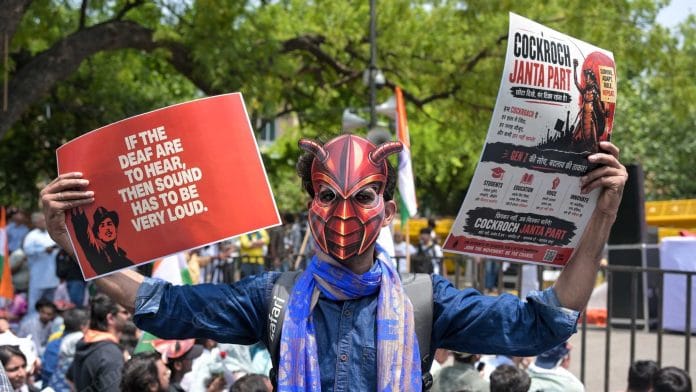

Since students first took to the streets near Delhi’s Jantar Mantar, it became impossible to scroll through Instagram or X without running into a video captioned “most unserious generation ever”. Jokes at the expense of those in power—instead of the oppressed—made a comeback after many years. The memes, the posters, and the placards made by protestors read like punchlines aimed squarely at the establishment.
Several protesters were dressed as Mahatma Gandhi and BR Ambedkar. “Season 1 players respawned,” announced captions on Instagram (Season 1 being the Independence movement). We also saw, in what is the most influential protest in recent times, many a Spider-Man and Cockroach in attendance. Underneath the costumes and the choreography, what we witnessed was a generation using humour to survive tragedy in real time.
The comments were broadly divided into two sections. The first insisted that this is no laughing matter: that violence, hunger strikes, and student deaths demand nothing less than sombreness. This is also the demographic occasionally delegitimising this protest on such grounds. The second section salutes the students precisely for their refusal to be sombre, often adding to the humour and reading their irreverence as its own form of commitment to democratic dissent.
What the jokes were wrapped around
Scroll for long enough, and the specifics start to feel like genres unto themselves. People joked about the beatings they anticipated while leaving for the protest while simultaneously taping a “rate my outfit” video. The background music of the mobile game Subway Surfers, plugged into the video of protestors sprinting away from the police, turned the chase into a meme in real time. People shot lip-syncs to viral audios as they were being detained, expressions and body language both sincere. A viral video playfully ranked “things to bring to a protest”, where swimming goggles were placed in the S-tier. Information was shared without being burdensome and difficult to engage with. A journalist has even made a video decoding Gen Z lingo for Delhi Police.
What made the protest distinct were the symbols that the jokes were wrapped around. Students reached for the same vocabulary the State claims to own: the Constitution held aloft, the national flag draped like a shield. The crowds broke into the national anthem as a tactic to stop Delhi Police from moving. It was a clever reclamation of national symbols to hold those in power accountable.
Scratch beneath the memes and something more sobering emerges. Through the ease and agency that phones and the internet provide for storytelling, we see what protestors were documenting. Testimonies of people feeling safe at protest grounds, an unnamed sense of community, people from all walks of life together—the visuals remind us of the peaceful co-existence and harmony that makes India secular. The humour has generated enough algorithmic reach that stories of individual suffering, injuries, and arrests included, are finding their way to the front of the feed and disarming a section of society which may not have engaged with the issue otherwise.
This is the real function of humour: it’s a Trojan horse. Content that would otherwise be too heavy, too political, or too easy to scroll past, lands instead on the feed of someone who considers themselves apolitical. A meme does not feel like a threat. It gets watched, shared, laughed at, and in the process, allows one to also absorb that a student was beaten. A focus on humour does not translate to a lack of love for the country.
Also read: Drag or bangles aren’t insults. Students’ protest posters need to catch up
Funny dissent has a long history
Although Gen Z has applied humour with unprecedented fluency, this is not a new insight. Scholars of social movements have long argued that humour does real political work rather than merely decorating protest. In a 2017 article, Marjolein ‘t Hart traced how laughter has served protesters from 16th-century Augsburg to the Solidarity strikes in Gdansk, functioning as a genuine “weapon of the weak”. Satire and humour helped protesters build collective identity and frame their cause for wider publics, even under conditions of real repression.
The use of strategic humour in the recent protest sits within a long, documented lineage of strategies deployed in protests pre-internet. The protesters at Jantar Mantar simply found the internet-native version of this strategy.
The discomfort in the comment section may come from an older generation’s difficulty reading unfamiliar forms of dissent or from genuine concerns for the gravity of the moment. However, dismissing the protest based on the fact that humour occupies centre stage misses what actually happened—humour was a delivery mechanism, not an absence of conviction.
On 25 July, education minister Dharmendra Pradhan tendered his resignation. Was it spectacle, rather than solemnity, that finally got the state to blink?
Ambica Shailja Naithani graduated from the University of Sussex and Miranda House. Her X handle is @naithaniambica and she is on Instagram @ambicanaithani. Views are personal.
(Edited by Prasanna Bachchhav)