



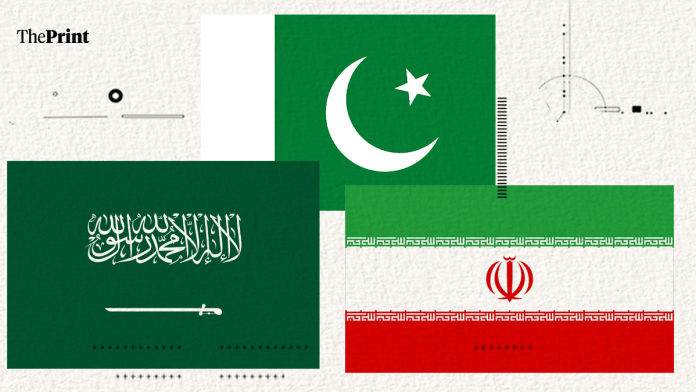
New Delhi: Days after the Iran-backed Houthis fired ballistic missiles at Saudi Arabia in retaliation for an airstrike on Sanaa International Airport, Pakistan Prime Minister Shehbaz Sharif on Tuesday condemned the attacks and re-affirmed Islamabad’s unwavering support for the kingdom’s security.
“Pakistan will continue to support all sincere efforts aimed at promoting peace, stability, security, and mutual understanding across the region,” he said on social media platform X. Absent from that statement was any mention of either the Houthis or Iran.
The omission reflects the impossible balance Islamabad has spent decades trying to maintain, a contradiction that now defines Pakistan’s foreign policy.
The missile exchange marks the most serious confrontation between Saudi Arabia and the Houthis in years. The Houthis have accused Saudi Arabia of threatening to unravel the United Nations-brokered truce that has largely held since 2022.
The Houthis Monday declared an immediate naval blockade on Saudi Arabia, escalating regional tensions. In a televised statement, the group’s military spokesperson, Yahya Saree, announced the enforcement of “a maritime blockade against the criminal Saudi enemy”, saying the move was based on the principle of “an eye for an eye” and would take effect immediately.
The attacks on Saudi Arabia have put Pakistan in an increasingly difficult position, raising the possibility that Islamabad could be drawn deeper into the conflict while undermining its emerging role as a mediator between the United States and Iran. “Pakistan’s role as a US-Iran intermediary emerged from a unique set of circumstances, but the space for such diplomacy is narrowing,” former high commissioner to Pakistan Ajay Bisaria told ThePrint.
He then added that as West Asia undergoes a major geopolitical realignment, Pakistan is finding it increasingly difficult to balance competing interests. “This is not a new challenge—it has previously struggled to navigate rivalries between Saudi Arabia and Turkey, as well as tensions with the United Arab Emirates (UAE),” he added.
Pakistan, which helped facilitate an interim understanding between Washington and Tehran last month, signed a mutual defence pact with Saudi Arabia last year. Thousands of Pakistani troops and a squadron of fighter jets are stationed in the kingdom under the agreement. According to Reuters, senior Pakistani leaders have conveyed to Tehran that any attack on Saudi Arabia would be viewed as an attack on Pakistan under the bilateral defence pact. Analysts quoted in the report say Islamabad was caught off guard by the sudden escalation, and is increasingly worried that continued Houthi attacks could force it into a direct role in the conflict, particularly as Pakistani troops are deployed near the Saudi-Yemen border.
Pakistan is also concerned that a wider conflict could disrupt Red Sea shipping, a critical trade route, and ultimately compel Islamabad to honour its defence commitments to Saudi Arabia if the kingdom comes under sustained attack. If the fighting no longer remains confined to Yemen, Pakistan’s commitments under its defence agreement with Riyadh could become more relevant.
“If pressure increases and Saudi Arabia insists, Pakistan will deploy,” Pakistani political scientist Ayesha Siddiqa told ThePrint. “We’ve seen this before. Even when parliament opposed involvement in Yemen, Pakistan’s military still provided training to Saudi forces and maintained a naval presence in support of the kingdom,” she said referring to the 2015 incident when Pakistan’s parliament under the Nawaz Sharif government unanimously passed a resolution affirming the country’s “neutrality” in the Yemen conflict.
For now, she argues, Islamabad is unlikely to be forced into choosing sides. “The conflict at the moment is essentially between the Houthis and Saudi Arabia,” she said. “I don’t think it is moving anytime soon into a direct Saudi-Iran war.”
But she drew a distinction between supporting Saudi Arabia and confronting Iran directly. “Pakistan is with Saudi Arabia. There’s no doubt about that,” she said. “But I don’t think it is about to start a war with Iran.”
As the war escalated, the contradiction only deepened. As Trump’s favourite, Field Marshal Asim Munir, emerged as the personal interlocutor between the US president and Tehran, Saudi Arabia announced that Pakistani fighter aircraft and support planes had arrived at King Abdulaziz Air Base, marking the first visible operational deployment under the Strategic Mutual Defence Agreement.
Pakistan is helping prevent a wider regional war while simultaneously activating the military alliance that could, in theory, draw it into one.
Also Read: Pakistanis are taking loans to bury their dead. Tax hike has led to rising funeral costs
The Saudi lifeline
The limits of Pakistan’s neutrality begin with economics. Saudi Arabia is not simply another diplomatic partner. It is central to Pakistan’s financial survival.
Repeated Saudi deposits into Pakistan’s central bank have become essential to maintaining foreign exchange reserves and satisfying conditions attached to International Monetary Fund programmes. Riyadh rolled over a $3 billion deposit in 2025, maintained a separate $5-billion facility and added another $3 billion in April 2026 to help offset maturing loans (including $3.5 billion owed to the UAE) and reinforce balance of payments.
Saudi financing also comes on substantially more favourable terms than either commercial borrowing or many alternative lenders.
The kingdom is also Pakistan’s largest source of remittances. Pakistani workers in Saudi Arabia sent home nearly $10 billion during the 2025-26 fiscal year, accounting for almost a quarter of all remittances and exceeding Pakistan’s merchandise exports in several major sectors.
For an economy that has cycled repeatedly through IMF bailouts, these relationships are not optional. Bisaria said this economic dependence ultimately shapes Islamabad’s strategic choices. “Saudi Arabia remains Pakistan’s most critical regional partner because of deep defence, financial, and strategic ties. While acting as a mediator with Iran has been useful, it is ultimately secondary to Pakistan’s relationship with Riyadh.”
Field Marshal Munir has sought to expand them further, pursuing tens of billions of dollars in Gulf investment while presenting Pakistan as what he has described as “a resilient fortress of the Muslim world”. His vision extends beyond bilateral cooperation, with suggestions that the Saudi-Pakistan partnership could eventually evolve into the nucleus of an “eastern NATO”.
Gulf influence
Munir’s words turned into action at the peak of the escalating war, as it was revealed that Egypt and Turkey are also working with Saudi Arabia and Pakistan to create a new bloc. In March, Turkish Foreign Minister Hakan Fidan said this will be a security platform that will enable greater cooperation in the defence industry and “broader defence matters”.
According to a report in Middle East Eye, the foreign ministers of these four countries held talks on the sidelines of the Riyadh summit of Islamic countries. “We are exploring how, as countries with a certain degree of influence in the region, we can combine our strengths to solve problems,” Fidan said.
Ankara has earlier condemned Iranian strikes and called it the primary instigator of the war. Pakistan shares close “brotherly relations” with Turkey. Moreover, Pakistan also joined the Arab-Islamic states in condemning Iran’s retaliatory military strikes across the Gulf, calling on Tehran to “halt its attacks” and warning that the “future of bilateral relations would depend on respect for sovereignty and non-interference”.
The condemnation spotlighted the growing alliance among Azerbaijan, Turkey and Pakistan against the backdrop of Pakistan’s Strategic Mutual Defence Agreement with Saudi Arabia. The three countries have increasingly strengthened cooperation around shared diplomatic and security concerns.
Their partnership took shape following the 2020 Karabakh war, after which the three nations launched a trilateral cooperation framework. Then, in June 2021, Turkey and Azerbaijan signed the Shusha Declaration. Pakistan was the first nation to join this strategic alliance.
The March statement, endorsed by foreign ministers from Saudi Arabia, Qatar, the UAE, Egypt, Turkey and Azerbaijan, denounced Iran’s actions as “unjustifiable” and called for an immediate cessation of hostilities. It also warned of the threat Tehran’s actions posed to key maritime routes, particularly the Strait of Hormuz which is critical to global energy supplies.
Why Pakistan cannot be anti-Iran
Geography prevents Pakistan from becoming part of an anti-Iran bloc. Nadeem Ahmad Moonakal, a research scholar at Riyadh’s Rasanah Institute for Iranian Studies, said Pakistan’s diplomacy reflects economic realities more than geopolitical ambition.
Iran shares a nearly 900-kilometre border with Pakistan through Balochistan. Informal fuel trade sustains livelihoods and Iranian electricity supplies much of the Makran coast. Persistent insurgencies on both sides of the frontier require continuous security coordination as well.
“Pakistan shares a long and often volatile border with Iran, making stability along its western frontier a strategic priority,” Moonakal added. “Pakistan’s approach is primarily about preserving strategic flexibility while protecting its core economic and security interests.”
That balancing strategy, he added, has become increasingly difficult. “The recent conflict certainly tests Pakistan’s balancing strategy and has revealed how difficult it has become to maintain neutrality in an increasingly complex and polarised geopolitical environment,” Moonakal said.
On the day Iran was attacked, US president Donald Trump called on Iran’s ethnic minorities to rise against the regime. Among Iran’s minorities are also the Iranian Baloch along the Sistan province in the region.
In April 2026, Iranian security forces destroyed an operational cell of the militant group Jaish al-Adl after it infiltrated from across the Pakistani border into the Rask region of Sistan and Balochistan Province in southeastern Iran. Iranian officials have long accused the group of carrying out attacks inside Iran and maintaining links to Pakistan’s intelligence services, an allegation Islamabad denies.
Jaish al-Zulm is how Iranians refer to Jaish al-Adl, or the ‘Army of Justice’, a Sunni militant group founded in 2012 that operates along the porous Iran-Pakistan border. It has been designated as a terrorist organisation by both Iran and the United States and has claimed responsibility for multiple attacks on Iranian security forces.
Also important is that Iran has repeatedly accused the United States, Israel, and Saudi Arabia of supplying weapons and support to Jaish al-Adl, though it has not publicly presented evidence to substantiate these claims.
It has also repeatedly accused Pakistan of failing to stop Jaish’s activities, alleging that militants are sheltered in Pakistan’s Balochistan Province. Pakistani officials, in turn, have denied that the group operates in any organised manner on their soil.
Those realities have historically pushed Islamabad toward neutrality. During the Iran-Iraq War, Pakistan resisted intense pressure from Arab allies to align against Tehran, preserving relations with both sides.
That history helps explain why Iran continues to trust Pakistan as an intermediary even as Islamabad remains deeply embedded in Saudi Arabia’s security architecture.
Mediation born of necessity
Islamabad has attempted to preserve neutrality through active diplomacy, maintaining contacts not only with Saudi Arabia and Iran but also with Qatar, Türkiye and Egypt while supporting efforts to de-escalate the crisis.
Pakistan has additional incentives to prevent a wider conflict. “It has been one of the countries most directly affected by the conflict because of higher energy prices, inflationary pressures, disruptions to fuel supplies and broader economic instability,” Moonakal said. “This gives Islamabad a strong incentive to support de-escalation.”
Remaining in the middle, however, carries growing costs. Border closures with Iran have disrupted livelihoods across Balochistan, where informal cross-border trade underpins local economies. Higher oil prices have fuelled inflation and increased pressure on an already fragile economy.
Elsewhere in the Gulf, Pakistan’s balancing act has reportedly generated unease. Many analysts interpreted the deportation of thousands of Pakistani nationals from the United Arab Emirates — many of them Shia — as reflecting dissatisfaction with Islamabad’s refusal to adopt a harder line against Iran.
Pakistan had little leverage to respond. Its dependence on Gulf capital, remittances and investment leaves few options when partners express displeasure. The same economic vulnerabilities that compel neutrality also make that neutrality increasingly expensive.
Pakistani officials increasingly frame mediation not only as diplomacy but also as economic strategy. By positioning itself as indispensable to regional stability, Islamabad hopes to convince both Washington and Gulf capitals that a stable Pakistan serves their own interests. It echoes an earlier era when Pakistan’s strategic importance during the Cold War and the war in Afghanistan translated into substantial foreign assistance.
Today’s geopolitical landscape is different. American security assistance no longer flows as it once did during the war in Afghanistan. Gulf capital has become far more central to Pakistan’s economic survival, narrowing Islamabad’s room for manoeuvre even as its diplomatic ambitions have expanded, a Financial Times report noted last month.
Bisaria too argues that Pakistan’s balancing act extends well beyond West Asia. “Pakistan is also attempting to balance its relationships with the United States and China. As regional and global dynamics evolve, sustaining this multi-vector diplomacy is becoming more difficult.”
The UAE, frustrated by Islamabad’s mediation efforts, demanded the immediate repayment of $3.5 billion in loans in April, threatening to deepen Pakistan’s already fragile financial situation. The pressure eased only after Saudi Arabia stepped in with a fresh $3-billion support package.
Pakistan’s economic vulnerabilities extend beyond its finances. Nearly all of its land borders face varying degrees of disruption, complicating the movement of textiles and other exports.
Seeking alternative trade routes, Islamabad approved six overland transit corridors to Iran in April to ease congestion at Pakistani ports, expand bilateral commerce and reduce reliance on routes through Afghanistan. But traffic remains minimal.
Moonakal believes Pakistan still has incentives to preserve its balancing strategy, but only if broader regional tensions ease. “Pakistan’s balancing strategy will become increasingly difficult to sustain if Saudi-Iran tensions deepen,” he said. “While Islamabad seeks stable relations with both countries, the broader strategic and economic landscape provides greater incentives to deepen engagement with Saudi Arabia and the Gulf.”
Bisaria says that if the conflict intensifies, Islamabad’s room for neutrality will shrink further. “If attacks on Saudi Arabia continue, Pakistan is likely to align more closely with the Saudis, even at the cost of distancing itself from Iran. This could undermine Pakistan’s credibility as a mediator between Washington and Tehran, with Gulf states such as Qatar and Oman potentially taking on a larger diplomatic role. If the conflict escalates, Pakistan may have little choice but to significantly reduce or even abandon its mediation efforts under growing Saudi pressure.”
Siddiqa, too, noted that Pakistan is “trying to find a role for itself in the Middle East, which it aspired for. And that was stated in the national security paper (for 2022).” However, at this point, it does not seem to have much of it. A lot depends on how the peace plan pans out. For now, Pakistan’s role is left in the lurch.
(Edited by Nardeep Singh Dahiya)
I thought The print was cheering for team pakistan for mediation and even wrote a article how pakistan helped restored peace pushing India..