



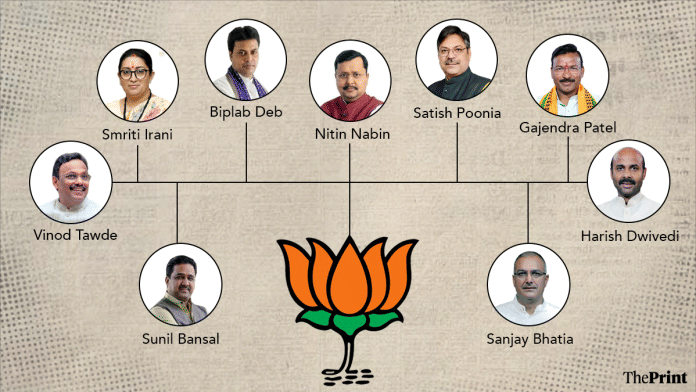
New Delhi: There was a time when BJP was known as a ‘Brahmin Bania’ party, but it has come a long way since then, with Prime Minister Narendra Modi—an OBC leader—leading its transition into an all-inclusive party with sway over backward castes, dalits, tribals and other communities. ‘Upper’ caste leaders continue to occupy top positions within the party ranks as well as the BJP-led governments in states.
Over 50 percent of the new office-bearers, appointed by BJP national president Nitin Nabin—a Kayastha—last week, belong to the ‘upper’ castes, according to an analysis by ThePrint.
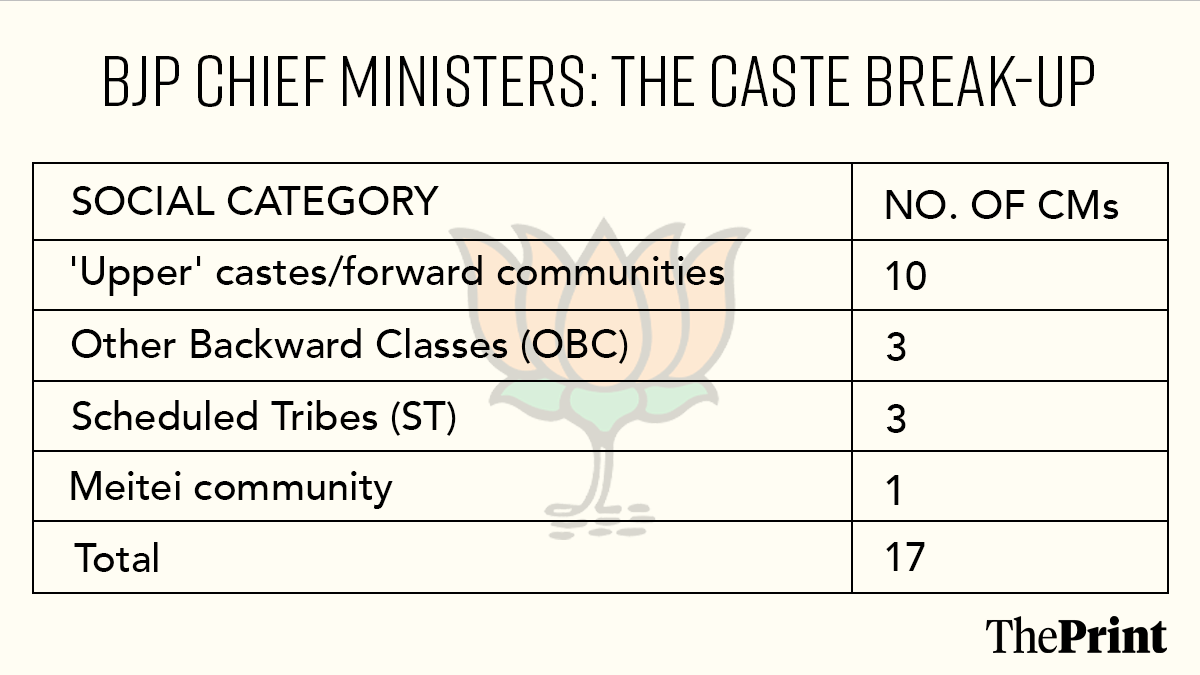
Additionally, of the 17 chief ministers in BJP-ruled states, 10 are from ‘upper’ castes or forward communities, three from Other Backward Classes, three from Scheduled Tribes, and one from the Meitei community.
Himanta Biswa Sarma (Assam), Rekha Gupta (Delhi), Pramod Sawant (Goa), Bhupendra Patel (Gujarat), Devendra Fadnavis (Maharashtra), Bhajan Lal Sharma (Rajasthan), Manik Saha (Tripura), Yogi Adityanath (Uttar Pradesh), Pushkar Singh Dhami (Uttarakhand) and Suvendu Adhikari (West Bengal) belong to ‘upper’ caste groups. Pema Khandu (Arunachal Pradesh), Vishnu Deo Sai (Chhattisgarh) and Mohan Charan Majhi (Odisha) are from ST category, while Samrat Choudhary (Bihar), Nayab Singh Saini (Haryana) and Mohan Yadav (Madhya Pradesh) are OBCs. Yumnam Khemchand Singh (Manipur) is a Meitei.
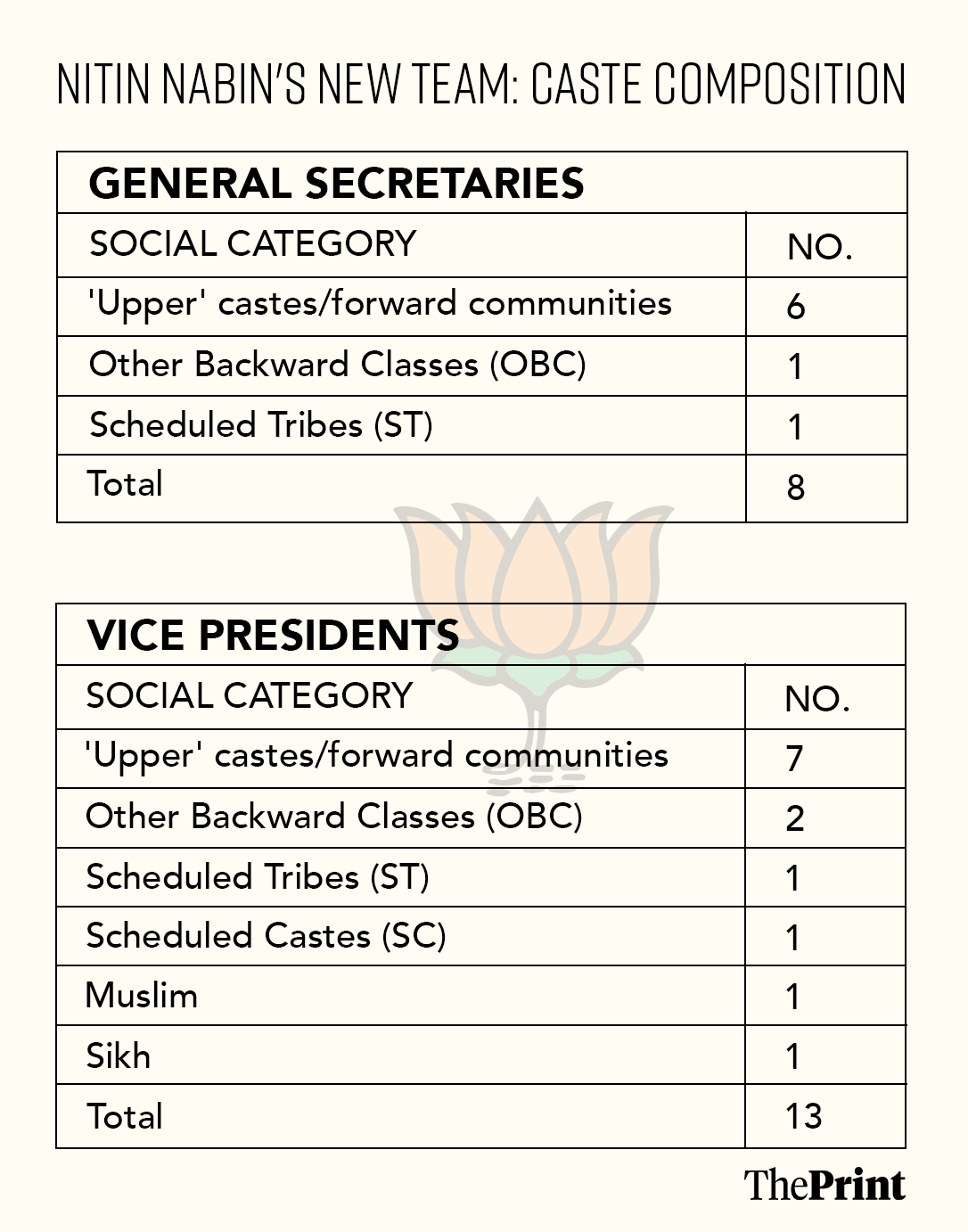
Of the eight newly appointed national general secretaries of the Bharatiya Janata Party, six are from ‘upper’ castes. Satish Poonia, who was elected Rajya Sabha MP in June, is the only OBC face. Gajendra Patel, Lok Sabha MP from Khargone seat in Madhya Pradesh, is an ST leader.
Among the 13 newly appointed national vice-presidents, seven belong to ‘upper’ castes (including Jain baniya), two OBCs, one ST, one SC, one Muslim and one Sikh.
Rekha Verma, former Lok Sabha MP from Uttar Pradesh’s Dhaurahra constituency, and M Nagaraja, Rajya Sabha MP from Karnataka, represent the OBC community. Among the new V-Ps is Lal Singh Arya, who was previously in-charge of the party’s National SC Morcha and is one of BJP’s senior Dalit leaders. He has also served as an MLA from Gohad assembly seat in Madhya Pradesh.
Tariq Mansoor, former vice-chancellor of Aligarh Muslim University, is the lone Muslim V-P, while Manpreet Singh Badal is the only Sikh name—across Nitin Nabin’s new team.
A senior BJP leader told ThePrint that the party has taken special care to ensure the new team represents all sections of the society.
“Around 40 percent or more of the members are from marginalised sections of society. The idea is to give adequate representation to all sections and regions,” the leader said. “PM Modi is the biggest OBC face of the country, and under his leadership, care has been taken to reach out to all sections of society, especially the downtrodden and those considered socially backward.”
For Rahul Verma, Fellow at Centre for Policy Research, the composition of the new BJP team exhibits dual reality.
“It is important not to draw too strong a conclusion from the composition of a relatively small set of office-bearers. The BJP has undoubtedly expanded beyond its traditional ‘upper’-caste, urban and middle-class base, but that core remains an important part of the party. The composition of Nitin Nabin’s team reflects both realities: the continued presence of the traditional core, and the accommodation of the OBCs, Dalits and other communities among whom the BJP has expanded,” Verma told ThePrint.
“This is only possible because the presence of religious minorities, especially Muslims, in its political leadership and elected ranks is low. This gives the BJP greater room, relative to other major parties, to distribute political positions and nominations among different Hindu communities, including OBCs and other historically underrepresented groups,” he added.
In 2024, 71 Union ministers were sworn in with PM Modi when the NDA government entered its third term. That list included 10 Dalits, 27 from OBCs, 21 from ‘upper’ castes, five from tribal groups, and five representing various religious minorities.
ThePrint had reported earlier that after the 2019 general election, 57 ministers were sworn in—of whom 32 were from ‘upper’ castes, 13 from OBCs, six from SCs and four from STs. However, the Council of Ministers was subsequently expanded in 2021 and included 27 OBCs, 12 SCs, eight STs and 30 from ‘upper’ castes. The share of representatives of ‘upper’ castes came down after many ‘upper-caste’ candidates lost in Uttar Pradesh.
“The BJP national team embraces vital tribal voices by including tribal representatives from West Bengal, Madhya Pradesh, Maharashtra, and the North-East, two of whom are notably women. Also, Scheduled Castes are represented by four members from Uttar Pradesh, Tamil Nadu, Madhya Pradesh and Bihar,” another leader told ThePrint.
BJP national spokesperson Gopal Krishna Agarwal, however, said that several factors, besides caste, are taken into consideration.
“Caste is not the only consideration by which office bearers are appointed. There are several other factors, including their past contribution, their connect with people. The caste factor is definitely taken into account, and care is taken by the party to give representation to all, but capabilities to strengthen the organisation and ideological commitment are also very important,” he remarked.
Meanwhile, another party functionary pointed out that the party has attempted to ensure representation for a “truly diverse cross-section of society by bringing together Hindu leaders alongside one Sikh member, two Christian members, one Muslim member, one Jain member, and one Parsi member”.
(Edited by Mannat Chugh)
Also Read: Nitin Nabin’s team is not as ‘young’ as Nadda’s but why RSS and BJP leaders are happy about it
why is this article written by an upper caste ? I as a reader demand that the paragraphs in article be representative of caste arithmetic. Each paragraph should be written by a person belonging to different caste.
Shameful article. Not expected from The Print.
Look in any direction, BJP is underperforming and infact it is taking India back to the Stone Age. But this article is trying to find a mole out of nothing. A desperate attempt to divide people. Be it Godi media or not, journalists have stopped so low that they keep dividing the electorate.
Aren’t you ashamed to rake up a caste issue on how a political party functions? Are you aware that most of the founding fathers/ mothers of major political parties in India are upper caste, even brahmins? Were they not the people who decided that the effects of caste discrimination should be abolished, and hence brought caste based reservation in various fields such as education and jobs? Are these reservation not prevalent even to this day, and being taken advantage of by various rich people, especially politicians and bureaucrats?
Was the purpose of reservation not to eventually eliminate caste system? Except in Government jobs, is anybody bothered about what caste you are from?
Since all my questions are valid, why is the press so adamant on highlighting who belongs to which caste?
So this is the new charge against the BJP.
Did you all care to count the upper castes in the UPA era National Advisory Council (NAC)?
Or even currently, in the Congress Working Committee (CWC)?
Is it not a high time that responsible news houses stop categorizing composition of a group or appointment of a persons solely on the basis of cast/religion/gender, where it is not really warranted? Would that not be responsible journalism? Same goes for victims of a crime.
Of course, where such categorization is the proximate cause for a particular occurrence, then you must do it. But why do it when the basis is something else?
Are Rahul Gandhi Priyanka Gandhi are from low caste. You journos play caste card
Is BJP a government body that it should follow th stupid reservation policy. May be BJP decided to recognise merit. Do the politicians send their children to government schools or get treatment at government hospitals or travel in government buses? The Print stop preaching what you do not practice. I am a common citizen.