



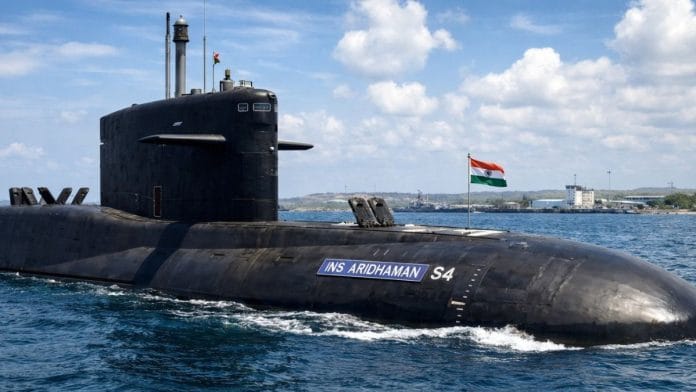

New Delhi: India Friday commissioned its third nuclear-powered ballistic missile submarine (SSBN) Aridhaman (S4).
While the event in Visakhapatnam remained under wraps, Defence Minister Rajnath Singh posted an innocuous message on X: “It’s not words but power, ‘Aridhaman’!”
Sources in the defence and security establishment confirmed that India’s third SSBN has been commissioned. SSBN stands for ship submersible ballistic nuclear or nuclear-powered ballistic missile submarines.
Navy Chief Admiral Dinesh Tripathi had last December said that INS Aridhaman was in the final stages of trials and would be commissioned soon.
India’s SSBN programme is a closely guarded project.
INS Arihant was the first vessel under the SSBN project, and was followed by INS Arighat. INS Arihant was launched in July 2009 and was quietly commissioned in 2016. The second indigenous SSBN, INS Arighat, was commissioned in August 2024.
INS Aridhaman is bigger and more potent than the first two. The 4th SSBN in the series is undergoing sea trials and will be commissioned next year. It is of the same class as the Aridhaman.
Work is already ongoing on the fifth SSBN, which will be bigger and more potent than anything built so far.
India has completed the nuclear triad, meaning it can launch a nuclear weapon from air, land and under the sea.
India is also among a select group of countries having nuclear-powered submarines. The others having such assets are the US, Russia, UK, France and China.
The Indian Navy plans to commission its first fully indigenously designed nuclear attack submarine (SSN) by 2036-2037 and the second one in about two years from then.
The Cabinet Committee on Security (CCS) has given approval to the first two SSNs.
According to the 30-year-old submarine building programme fixed in 1999, India was to induct 24 conventional submarines by 2030. However, only six have been inducted.
The plan for building the next six conventional submarines with Air Independent Propulsion (AIP) system under Project 75 (India) is yet to be contracted for and will be done in the next six months.
Experience from the P75(I) programme is to be used in Project 76, under which 12 totally indigenous submarines are to be built.
Under the Modi government, the late defence minister Manohar Parrikar had decided to convert six of the 12 submarines into nuclear attack submarines that will remain with the Indian Navy and be part of the naval budget.
The SSBN programme is a different one, its funding is through a separate system and it operates under the Strategic Forces Command.
(Edited by Nida Fatima Siddiqui)
Also Read: GE delivers sixth F404 engine for Tejas Mk1A to HAL, but delays continue