







West Bengal has had five distinct phases of politics since Independence. In the first article in this series, I covered the period from BC Roy to SS Ray. In this, I look at the uninterrupted 34-year period of Left rule from 1977 to 2011.
The Bamfront comes to power
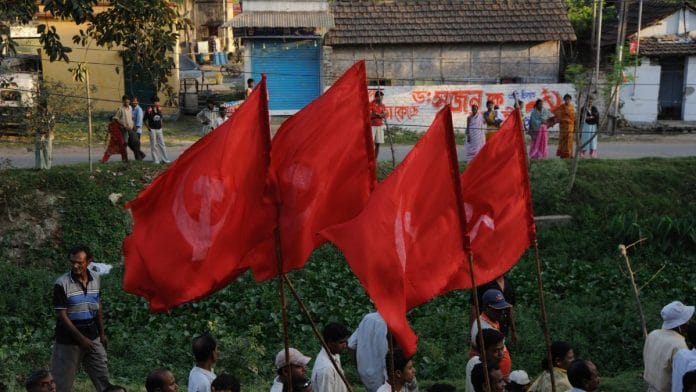
Contrary to its own expectations, the six-party Left Front coalition—led by the CPI(M), with the All India Forward Bloc (AIFB), Revolutionary Socialist party (RSP), Marxist Forward Bloc (MFB), Revolutionary Communist party of India (RCPI) and Biplobi Bangla Congress (BBC)—was voted to power in the post-Emergency 1977 elections.
The CPI(M) secured a comfortable majority of 178 by itself in the 294-member house. The partners’ tally was: AIFB-25, RSP-20, MFB-three, RCPI-three and BBC-one. They came to power with CPI(M)’s Jyoti Basu as CM.
Incidentally, the Janata party, which was offered 52 per cent of the seats in the pre-electoral seat-sharing, won only 29 of the 289 seats it contested.
The erstwhile ruling party, the Congress, came a distant third with just 20 seats. From the 1982 elections, the Communist Party of India (CPI), Democratic Socialist Party (DSP), and West Bengal Socialist Party (WBSP) also joined the coalition.
The WBSP joined the Samajwadi party in 1996, and thus it too became a part of the coalition. The Left Front, colloquially called the Bamfront ruled the state for the next 34 years. It was the longest democratically-elected communist regime in the world.
Also read: West Bengal has only had 9 CMs since Independence—and 5 phases of politics
Democratic miracle
How did the Left Front achieve this democratic miracle?
It had pro-people policies. It carefully cultivated a Bhadralok image and had an ability to build a broad social consensus.
It also controlled patronage over the resources of the three-tier panchayat. It had a party-based organisation working with all sections of society—from Students’ Federation of India (SFI) among students, the All India Kisan Sabha (AIKS) amongst the farmers, the Centre of Indian Trade Unions (CITU) in the industrial belt and Employees Coordination Committee among government staff.
It was a well-oiled party machinery. It began well, but over time party workers became the point of contact for everything. Someone wanting to build/repair a house was directed to a set of party workers who organised the construction material— from bricks to cement to steel and paint—often at a premium.
Many of these ‘success factors’ were taken over and perfected by the TMC, which in its heyday won 215 seats in 2021 with a vote share of 48 per cent. The real question is: Will Suvendu Adhikari, BJP’s first CM in Bengal, be able to make a break from this circuit?
Also read: Writings on the wall: Bengal’s epitaph for Left is, I let doctrine become dogma, ideology obstacle
Operation Barga
Let us first begin by giving credit where it is due. Operation Barga was a success. Launched in 1978, the land reform movement recorded the names of sharecroppers (bargadars). It protected them from eviction by landowners.
It ensured security of tenure, and three-fourths of the produce to the tiller. From 1977 to 1982, the Land Reforms Minister Benoy Choudhury and Land Reforms Commissioner D Bandyopadhyay galvanised the state machinery to record 1.7 million bargadars and provided them with secure land rights and access to credit.
The state government also acquired ceiling-surplus land and distributed over 1 million acres to nearly 2.5 million landless households and poor peasants. Thus, West Bengal transitioned from a chronic food-deficit state to a food-surplus state by the 1981–1982 crop year—a status it successfully maintained ever since.
Bargadars and marginal farmers were incentivised to install shallow tubewells, adopt High-Yielding Variety (HYV) seeds and grow the third crop “Boro” (summer) rice. The government distributed subsidised agricultural mini-kits containing seeds, fertilisers, and insecticides to marginal farmers. Between 1977 and 1994, agriculture grew at a CAGR of 4.6 per cent—no mean achievement for the agriculture sector.
With three crops a year, supplemented by the efficient management and monitoring of the centrally-funded National Rural Employment Programme (NREP) and the Rural Landless Employment Guarantee Programme (RLEGP) for vulnerable landless laborers, poverty registered a marked decline.
Between 1977 and 2011, West Bengal experienced a steady decline in its poverty rate, dropping from roughly 68 per cent of the population to less than 20 per cent. This was reflected in the increasing share of the Left Front’s popular vote—it achieved its peak in the 1987 elections with 53 per cent of the popular vote, winning 251 of the 294 seats.
In the late eighties and early nineties, the Left Front leveraged the centrally-funded National Literacy Mission (NLM) to reduce adult illiteracy in the state. This allowed the party cadres to expand their outreach right up to the gram panchayat level through well-curated andragogical tools—both in terms of instructors as well as instruction materials.
The Left Front was also able to address three major concerns of the urban middle class. Power sector reforms saw the beginning of the end of ‘load shedding’. The sanctity of the academic calendar was restored—in the earlier decades, many students had lost an extra year. Even though the cops were often accused of being partisan, the outright terror on the streets in the Naxal decade and the extra-judicial killings under SS Ray came to a halt.
Also read: Has Bengal forgotten Left? After hat-trick of ducks, it can learn from Rahul Gandhi
The cracks appear
However, just as the party stepped into its third term, cracks began to appear. Operation Barga and land distribution had been successful, but the next step—that of value addition, cold chains, food processing, contract farming for corporates—were frowned upon.
So, while potato production went up, cold stores did not.
To save their lands from further alienation, the middle peasantry joined the party in hordes—thereby ensuring that the party became ‘reformist’ rather than revolutionary. The next step—that of making the Bargadars the owner through long-term financing through land mortgage banks—did not happen. Rather than build a coalition with industry for capital infusion and modernisation, CITU took a very short-term view of labour rights. It only spoke of higher wages and bonuses—without even trying to understand the competitive challenges faced by the jute, textile, sugar, leather, light engineering and pharma sectors.
SFI ignored academic excellence and became obsessed with winning every student’s union election. The coordination committee ensured that its members got the more influential desks in the offices of DMs and SDMs.
The police were not spared either. The Left Front officially recognised the West Bengal Police Association, the West Bengal Non-Gazetted Police Karmachari Association (also referred to as the Karmachari Samiti) and the Calcutta Police Association. They functioned largely as Left-affiliated entities, actively lobbied for transfers, promotions, and influenced departmental decision-making, which occasionally complicated internal administrative discipline.
From then on, the party perfected the art of winning elections—from selective inclusions and deletions in the rolls, ‘queuing up’ ( forming uncomfortably long lines at polling stations to discourage the middle-class voter), appointment of partisans as presiding and polling officers to outright movement restrictions in several middle-class apartments on the day of voting. These tactics were called ‘booth management’ techniques.
The decline of the Left
Popular resentment was building up—agriculture growth was stagnating, no new jobs were coming up, the industry was getting contradictory signals, the infighting within the Left Front partners on ‘spoils of office’ was in full public view, and the old stalwarts—including Benoy Choudhury—were being marginalised, as the new brash party managers took the place of the revolutionaries who had devoted their life to the party.
By 2000, Buddhadeb Bhattacharya had taken over as CM from Basu.
The decision to leave the UPA in 2008 due to the nuclear deal with the US did not cut much ice, and the attempts to lead a non-Congress, non-BJP coalition backfired completely.
Thus, the score for the 2009 Lok Sabha elections in West Bengal were as follows: TMC-Congress-SUCI Alliance won 26 seats and the Left Front won 15. The BJP also opened an account with Jaswant Singh winning the Darjeeling seat, albeit with the support of the Gorkha Janmukti Morcha.
In the Assembly elections that followed two years later, Mamata Banerjee of the TMC emerged as the clear winner. We will take up her rise and fall in the next column.
This is the second in a three-part series mapping West Bengal’s political economy.
Sanjeev Chopra is a Senior Fellow, Centre for Contemporary Studies, PMML, New Delhi, a Trustee of the Lal Bahadur Shastri Memorial, and the festival director of Valley of Words, a pan-India literature and arts festival based out of Dehradun. He tweets @ChopraSanjeev. Views are personal.
Note: The columnist was SDM Kalimpong, ADM Cooch Behar and DM Murshidabad during the tenure of Jyoti Basu. He was Secretary, Agriculture, Horticulture and Food Processing with Buddhadeb Bhattacharya. During the Mamata Banerjee government, he was Additional Chief Secretary, Agriculture, Tourism, and Industrial Development. He was also the President of the WB IAS Association from 2016-2018.
(Edited by Theres Sudeep)