





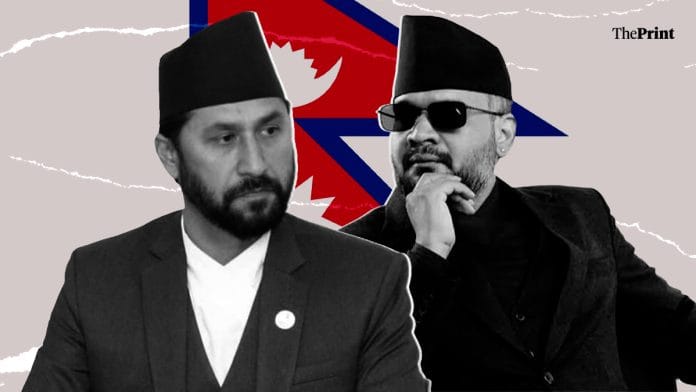

New Delhi: Six months after Nepal’s Rastriya Swatantra Party (RSP) swept to power riding on a wave of anti-establishment sentiment, the uneasiness between its two most prominent figures, Prime Minister Balendra Shah and party chairman Rabi Lamichhane, is manifesting through disputes over party rules, cabinet appointments, and foreign policy.
There are now allegations of a section of RSP leaders being under surveillance, according to reports in Nepalese media.
The two sides had arrived at a broad pre-election understanding under which Shah was to run the government while Lamichhane looked after its internal affairs. It was an arrangement that allowed the RSP to combine Shah’s appeal among educated, urban voters with Lamichhane’s mass following in the hinterland. The RSP went on to win nearly a two-thirds majority in the ensuing elections.
But that was in February. From differences over the selection of the Deputy Speaker, removal of riverside settlements in Kathmandu to the handling of communal tension in Nepal’s southern plains, there have been several flashpoints between the two sides.
The current rift burst into the open at a Central Working Committee meeting on 13 July, when a faction aligned with Shah presented a written document cataloguing grievances against Lamichhane’s leadership. This was reported in the local media.
However, there was another issue. At the center of the complaint was a provision added to the RSP’s newly adopted party structure allowing the chairman to remove the leader of the parliamentary party—a position held by Shah—for straying from the party’s official line.
According to the Shah faction’s account, the provision was inserted between a Central Committee session on 20 June and the statute’s public release two days later, without the knowledge of convention delegates. Shah’s supporters had already left the convention venue when an important organisational resolution was passed. The amendment empowered the party chairperson to remove the parliamentary party leader if that individual acted against party directives, ThePrint has learnt.
Supporters of Balen Shah reportedly viewed the move as both procedurally unfair and politically targeted. More importantly, they believed it handed Rabi Lamichhane the authority to remove Balen whenever he chose, which “created a schism”.
The document, delivered by Central Committee member Ganesh Karki, argued that Shah’s political appeal was the decisive factor behind the party’s strong election showing, and said the party owed Shah the space to serve a full five-year term as a result.
“The decisive reason for obtaining such a large public vote in the election is the political agreement that the RSP made with Balen Shah,” said the document presented by Karki, as reported by Nepal Khabar. “If it were not for that agreement, the RSP would not have received so many votes and if it were not for that agreement, Balen Shah would not have been able to become the Prime Minister,” it added.
Lamichhane, then addressing the committee directly, rejected the idea that the provision reflected any hidden agenda, telling colleagues he could not treat fellow party leaders with suspicion and offering to resign if members doubted his intentions.
Compounding the dispute, leaders in Lamichhane’s camp have accused state security agencies of monitoring senior figures aligned with him, including Finance Minister Swarnim Wagle, and Foreign Minister Shishir Khanal, claiming that the surveillance intensified after Lamichhane’s visit to India, Nepal Khabar reported. Lamichhane on 2 June visited India at the BJP’s invitation for party-to-party talks, among other engagements.
Also Read: Nepal gets a new govt: Balen Shah now world’s youngest PM, leading world’s youngest cabinet
A foreign policy divide
The tension has now extended into how the two leaders engage with foreign governments, a dynamic examined by Nepali journalist Biswas Baral in a July piece for The Diplomat, a magazine focusing on Asia-Pacific politics, security, and diplomacy.
For the first three months of his premiership, Baral noted, Shah avoided one-on-one meetings with foreign dignitaries almost entirely—going so far as to decline an invitation from Prime Minister Narendra Modi to visit New Delhi.
Lamichhane instead made the trip himself, meeting Modi and Union Home Minister Amit Shah and receiving what Baral described as a notably warm welcome, a gesture many in Nepal read as India signaling its willingness to cultivate ties with Lamichhane if Shah continued keeping New Delhi at arm’s length.
Since the party’s general convention, Baral wrote, Shah appears to have reconsidered that posture, meeting with a senior Asian Development Bank (ADB) official in what may signal a broader shift toward re-engagement—a recalibration Baral suggested Shah will need to manage carefully, given India’s unease over being ‘sidelined’ and China’s own frustration with what it perceives as the rising American influence in Kathmandu since last year’s Gen Z-led protests.
“Shah needs to tread carefully. India is unhappy with the way he has ‘sidelined’ it, especially by refusing to meet the visiting Indian Foreign Secretary Vikram Misri, who was coming to Nepal to extend Modi’s invitation. Many in Nepal saw Lamichhane’s warm welcome in New Delhi as a signal from India that, should Shah continue to rebuff it, it would be prepared to cultivate an alternative power center in the RSP. China, too, is unhappy with the drastic reduction in the clout of the Nepali communist parties in the March elections and a recent increase in ‘anti-China activities’ on Nepali soil,” he noted.
Fault lines laid bare
Political analyst Kanak Mani Dixit told ThePrint the roots of the rift lie partly in Nepal’s parliamentary system itself, in which the leader of the ruling party typically also heads the government—a role split between two rivals in the RSP’s case by design.
Baral’s analysis reached a similar conclusion from a different angle, noting that such personality-driven alliances have unravelled before in Nepali politics, most notably the 2021 implosion of the Nepal Communist Party amid a power struggle between its own two dominant leaders, K.P. Sharma Oli and Pushpa Kamal Dahal ‘Prachanda’.
He argued that the Shah-Lamichhane split was, in some sense, inevitable as the RSP shifted from an anti-establishment movement into a governing party with patronage and positions to distribute—pressures that inevitably surface latent divisions among a coalition once united mainly by shared opposition to the old order.
ThePrint had reported in March on how during the Nepal elections in March, multiple analysts suggested an inevitable rift, calling it a matter of when and not why.
One such recent instance was Finance Minister Wagle claiming that he had one single unpaid adviser compared to the multiple ones that Shah had. The comment was interpreted as an unusually direct criticism of the Prime Minister from within his own government.
The communal violence in the eastern Terai region seemed to be the last nail in the coffin. When tensions escalated in the Kosi and Madhes region last week, the government’s top leadership appeared absent.
“The Prime Minister was absolutely silent,” Dixit said.
Shah addressed the nation on 30 July calling for harmony and peace, five days after the violence at Dewanganj in Sunsari district.
In contrast, Rabi Lamichhane stepped into the political vacuum as he convened an all-party meeting on the violence and briefed the President. These actions, Dixit said, suggested should ordinarily have been initiated by the Prime Minister.
“For all the social media savvy, he (Shah) is quite feckless in statecraft,” Dixit noted. “When the public needed him, he was nowhere to be found.”
Also Read: A street mandate put Nepal in hands of an interim govt led by first woman PM. How it fared
The social media win for Balen
On the growing rift, policy analyst and GenZ protest organiser Aakriti Ghimire, who had worked with the interim government, suggested that within RSP, many genuinely do not know how to operate within Parliament.
“It is like walking into a society where you do not know the rules,” she said, adding that Balen functions more as a political shield than an independent decision-maker. “Balen is just a proxy. All the mistakes will be made by Balen.”
However, it was Swarnim’s economic stewardship which was seen as politically consequential for Rabi’s future ambitions, she explained. “If Swarnim messes up the economy, then Rabi’s popularity will go down.”
In such a setting, newcomers naturally follow the cues of experienced politicians. The consequences of stepping out of line, however, were described as severe. “The way they (the older brigade of politicians.) punish you, is by orchestrating public dissatisfaction against you,” she said, citing the example of the street protests that took place last week after Ganesh Nepali, a 25-year-old auto driver, self-immolated over an altercation.
The Opposition, including the Nepali Congress and the Communist Party of Nepal (Unified Marxist–Leninist), voiced their criticism inside Parliament, however Ghimire pointed out that it does not reach the masses anymore. “They might be speaking up, but have we heard about it? We haven’t.”
The explanation offered was not simply media bias but the changing structure of political communication.
“The space is controlled by the current government,” Ghimire added. “The algorithm and the social media space—the space where we do democracy—is literally altering how we perceive and consume politics.”
Both Dixit and Ghimire described Shah’s communication strategy as a textbook example of social media-driven politics. Despite rarely holding press conferences, the PM continues to enjoy strong public support because he communicates directly with citizens online. Major decisions often appear on social media before formal administrative procedures are completed. “He keeps posting on Facebook and Twitter, so he’s continuing to use social media as his tool. He probably didn’t even sign the documents. He just decided to publish it first,” Ghimire said.
What lies ahead
A 100 days in government and nearly three weeks after its general convention, the RSP has yet to complete its central committee or fill several office-bearer positions, a delay attributed to continued disagreement between the Shah and Lamichhane camps over nominations.
Whether the party can manage the widening rift or whether it follows the trajectory of past Nepali political alliances undone by rivalries remains, as Baral put it, an open question for a party that faces a test of whether it can hold together at its own summit.
“This is not a minor arrangement. If Shah, the current RSP parliamentary leader, is removed from the position for some reason, his hold on the prime minister’s office would become untenable,” Baral wrote. “The new party statute also provides for another senior leader besides Shah. This appears to be another way for Lamichhane to check Shah’s growing influence in the party.”
Dixit suggested that the rift has become especially significant in light of the government’s handling of communal violence in Nepal’s eastern Tarai. While both the Prime Minister and Home Minister Sudan Gurung were seen as losing credibility over their response, Rabi Lamichhane was portrayed as projecting greater political maturity.
“In the context of the Prime Minister and the Home Minister losing credibility, Rabi Lamichhane has taken certain steps that indicate more maturity and are helping him develop credibility of his own,” Dixit added.
“He is seen to be more experienced than Balen Shah, who remains inscrutable.”
(Edited by Tony Rai)
Also Read: Gen Z gets its way: Nepal’s 1st woman chief justice Sushila Karki takes over as interim govt head
Gen-Z elected Gen-z leader has been faltering and spiraling down since day !. Lol. So, much for Gen-Z jingoism.
I yearn for a time when leaders delivered, however modestly. This new social media stardom, complete with algorithms, is beyond me.