





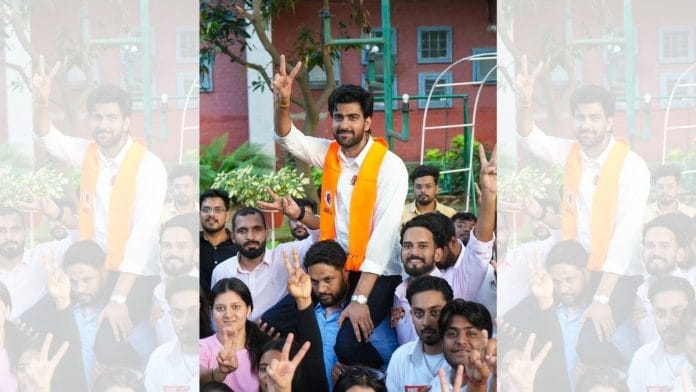

Chandigarh: Akhil Bharatiya Vidyarthi Parishad (ABVP), student wing of the Rashtriya Swayamsevak Sangh (RSS), has bagged the post of president of the Panjab University Campus Students’ Council (PUCSC) for the second year in a row. ABVP’s Ankit Bidhan was elected president of the student council Monday, a year after ABVP created history by securing the post for the first time in nearly 50 years.
This time, however, ABVP had open support from the Student Organisation of India (SOI), student body of the Shiromani Akali Dal (SAD), for the election of president. With talks of a possible tie-up between the BJP and the Akali Dal for the forthcoming Assembly elections in Punjab, a collaboration playing out at the university level is being seen as part of a larger arrangement.
The PUCSC polls also marked the first set of student elections in a prominent university in Punjab after the Jantar Mantar protests last month which forced the resignation of Education Minister Dharmendra Pradhan.
Vineet Punia, director of public relations at Panjab University, said a total of 9,610 votes were polled out of 16,468 registered voters, marking a turnout of 58.35 percent.
“The results today show that the Gen Z is with BJP and Modi ji,” Bidhan told the press following his victory. Punjab BJP in charge Satish Poonia and national general secretary B.L. Santhosh, too, congratulated Bidhan on his victory.
पंजाब विश्वविद्यालय में फिर गूंजा राष्ट्रवाद का जयघोष।
पंजाब विश्वविद्यालय छात्रसंघ चुनाव में @ABVPVoice के अंकित बढ़ान जी ने अध्यक्ष पद पर शानदार विजय हासिल की। उन्हें हार्दिक बधाई एवं शुभकामनाएं। pic.twitter.com/5uD0uUHRXZ
— Satish Poonia (@DrSatishPoonia) August 31, 2026
ABVPs Sri Ankit Bidhan wins the Punjab University Student Union President’s elections convincingly . Second time in a row . SOI also supported ABVP nominee in last 48 hours .
Congratulations to Sri Ankit Bidhan & @ABVPVoice for the stupendous victory .
— B L Santhosh (@blsanthosh) August 31, 2026
Bidhan, who comes from Jind, is a PhD student at Panjab University’s Centre for the Study of Social Inclusion. He defeated his nearest rival, Adil Brar of the Association of Students for Alternative Politics (ASAP), by a margin of more than 500 votes. ASAP is the student wing of the Aam Aadmi Party (AAP).
Last year, ABVP broke a 48-year jinx by winning the presidency for the first time since direct student elections were first held in Panjab University in 1977. Its candidate Gaurav Veer Singh Sohal had defeated his nearest rival with a margin of less than 500 votes.
This time around, the ABVP did not contest any other seat in the council other than the presidency.
Panjab University has historically been one of the most politically active campuses in the region, with student bodies such as the Student Organization of Panjab University (SOPU), Panjab University Students’ Union (PUSU) and Students For Society (SFS) once dominating the council.
But those traditional campus organisations have declined considerably. SOPU last won the presidency in 2012, PUSU in 2016 and SFS, through Kanupriya, gave PUCSC its first woman president in 2018. National and state-level political organisations—ABVP, NSUI and ASAP—have since taken over the space.
Also Read: Patna University Students Union is now run by women. ABVP prez calls it arts students’ lab
NSUI, ASAP & SATH
National Students Union of India (NSUI), the Congress party’s student wing, had in collaboration with Student Front (SF), HIMSU (Himachal Students Union) and HSA (Hindustan Student Association) fielded Gurman Singh Sidhu for the post of president.
The NSUI campaign focused on the use of force by Delhi Police during the ‘Sansad Chalo’ march called by Cockroach Janta Party (CJP) on 20 July. “Pellet ka jawab ballot se” (answer the pellet with the ballot) was the NSUI candidate’s refrain.
The ASAP, the ruling AAP’s student wing, had fielded only one candidate for the post of president. In 2022, ASAP had in its earlier avatar as Chhatra Yuva Sangharsh Samiti (CYSS) made history when its candidate Ayush Khatkar won the presidency. In 2024, its presidential candidate Prince Chaudhary came in second.
Last year, its presidential candidate Mankirat Mann lost to ABVP’s Sohal.
SATH, the student outfit that draws ideological inspiration from human-rights activist Jaswant Singh Khalra, was in the contest this time only for the post of president. Its Ashmeet Singh Mann had won the vice presidency last year.
V-P, Gen Secy & Jt Secy
This time around, Armaan Bhinder of the Panjab University Democratic Front (PUDF), a conglomerate of multiple smaller student bodies, won the post of vice president with ASAP’s support. The Urdu department student defeated his nearest contender Akanksha Thakur, supported by NSUI, by more than 500 votes.
Manmeet Kaur of the newly formed SAAKHI, a breakaway faction of SATH, garnered more than 1,100 votes.
Supported by NSUI, independent candidate Dhyan Singh of the University Institute of Legal Studies won the post of general secretary, defeating his nearest contenders Aryan Saharan of INSO and Muskan Chauhan of HPSU.
Supported by ASAP, independent candidate Vishal Bamal of the University Institute of Applied Management Studies won the post of joint secretary by defeating Ameen Kaur of All India Students Association (AISA) and Devraj Nain of the HSA.
SOI attendance row, charges of ABVP ‘bias’
The most consequential controversy of the election season this year revolved around SOI, the student wing of the Akali Dal.
On nomination day, SOI’s presidential candidate Pranav from the Department of Chemistry was told that his nomination could not be accepted because he did not meet the required attendance threshold. SOI disputed this vehemently. Its leaders claimed Pranav had his attendance checked on the preceding Saturday and was told that he had sufficient attendance, reportedly around 78 percent.
When he came to file his nomination, however, the attendance reflected in the university system was allegedly only 68 percent. The student body accused Panjab University of making a last-minute change to keep its candidate out of the fray.
The controversy also had a ripple effect, with Punjab Congress chief Amarinder Singh Raja Warring alleging that the sequence of events was proof that the Akali Dal is now doing the BJP’s bidding.
The @Akali_Dal_ and its President @officeofssbadal stand completely exposed after the Akali student outfit SOI announced its support for the ABVP, the student wing of the @BJP4India for the Panjab University Students elections.
It is not that Sukhbir Badal has decided it. It is…
— Amarinder Singh Raja Warring (@RajaBrar_INC) August 31, 2026
The ABVP, too, had encountered objections to its pick Ankit Bidhan’s candidature for the post of president owing to an FIR arising from an alleged clash between ABVP factions in 2024. The ABVP argued that Bidhan was eligible under the applicable election guidelines since there had been no chargesheet or convictions in the case.
The run-up to the highly charged student elections this year witnessed campaigns focusing on university administration’s neutrality, nomination rules, attendance records, campaign restrictions and the role of outside political organisations.
The university administration declared elections on 22 August, announcing a rather compressed polling schedule. Student groups immediately objected to the timing since admissions were still continuing while the election process had been brought forward. The shortened campaign window was further complicated by Raksha Bandhan on 28 August, with many hostel residents expected to remain out of Chandigarh. Student leaders argued that established outfits with a pre-existing cadre would consequently have an advantage over smaller or newer groups.
Opposition student groups also alleged that the administration was selectively enforcing rules and favouring ABVP.
SATH presidential candidate Darshpreet Singh publicly linked the rejection of the SOI candidate’s nomination and the compressed election schedule to what he described as an administrative bias in favour of ABVP. The NSUI subsequently made a similar allegation, alleging that it had been denied permission for a rally while ABVP was allegedly granted similar permissions. Even during voting Monday, several students gathered outside the law department alleging that they were not being allowed to cast their vote and that the gates were shut before time.
The university rejected the broader charge and maintained that it was conducting a fair election.
(Edited by Amrtansh Arora)