





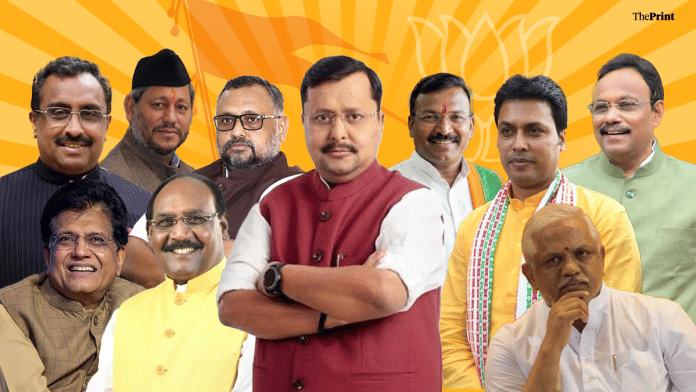

New Delhi: One out of two national office-bearers of the Bharatiya Janata Party (BJP) under president Nitin Nabin—46 percent to be precise—have had no links with the party’s ideological fountainhead, the Rashtriya Swayamsevak Sangh (RSS). Around 54 percent of Nabin’s new team, announced earlier this month, have been previously associated with the RSS—slightly more than the 49 percent Sangh imprint on his predecessor J.P. Nadda’s team.
The trend is in sync with Nadda’s famous remarks ahead of the 2024 Lok Sabha election that the BJP needed RSS in the past, but was “saksham” or competent now to run its own affairs.
ThePrint’s analysis of BJP’s national office-bearer teams over the last 20 years shows that the RSS imprint had peaked during Amit Shah’s term as the party president (2014-2019), when 78.7 percent of the members in top posts were associated with RSS, or its student wing, the Akhil Bharatiya Vidyarthi Parishad (ABVP).
The number stood at 77.41 percent during Rajnath Singh’s tenure as BJP president (2005-09), and at 60 percent under Nitin Gadkari (2010-13). Nadda had succeeded Shah as president on 20 January, 2020. Nabin succeeded him in January this year.
For the purpose of this analysis, ThePrint looked at Vice Presidents, General Secretaries, Joint General Secretaries (Org), Secretaries, Spokespersons and Media teams picked by the various BJP presidents. It doesn’t include the social media teams.
Nabin’s profile on BJP website does not mention his association with RSS, although his father, Nabin Kishore Prasad Sinha, was said to be a regular visitor to an RSS shakha in Patna. Sinha was a senior BJP leader and a four-time Member of Bihar Legislative Assembly from Patna West.
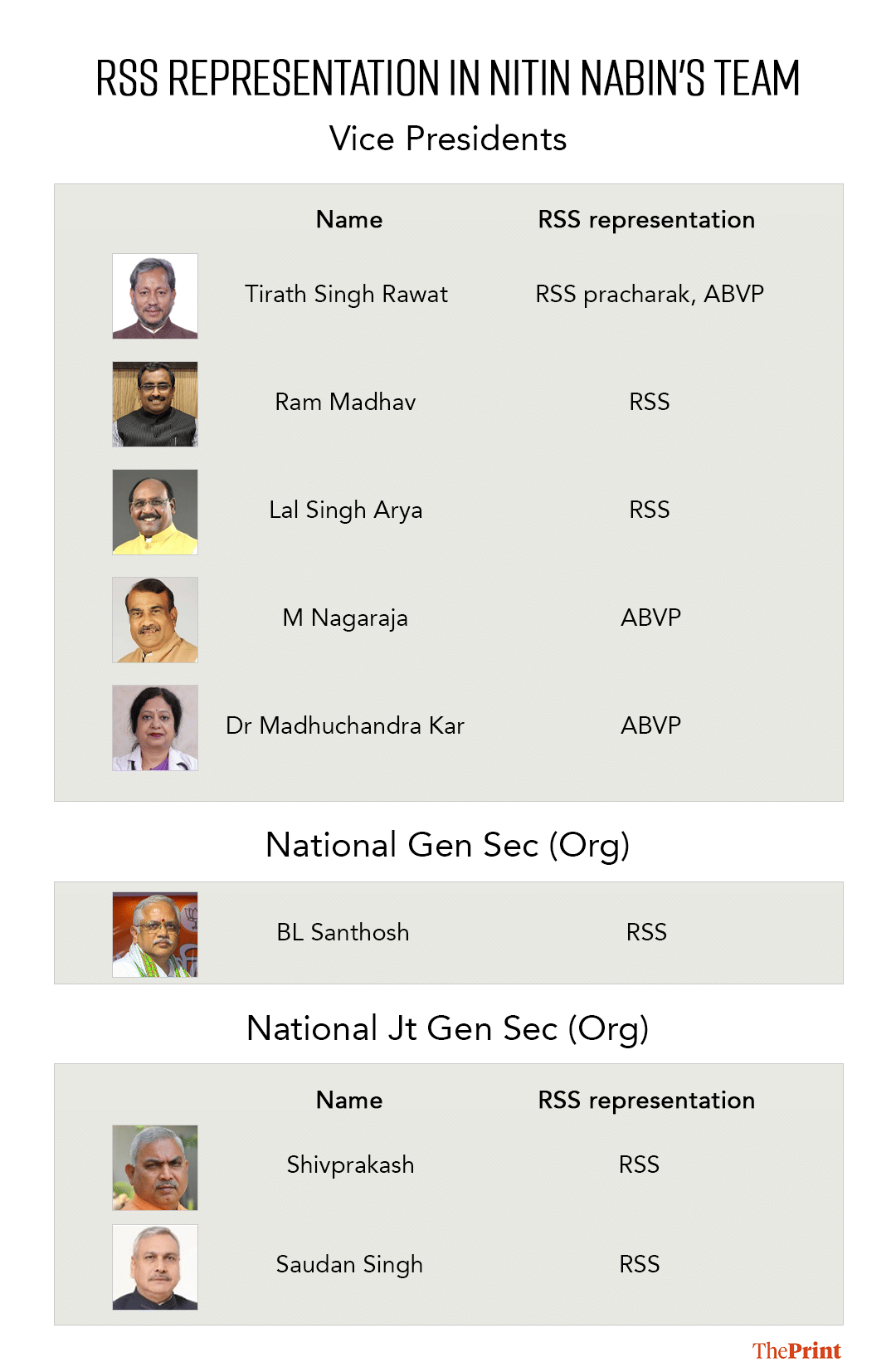
Among the 13 new V-Ps, at least five—Tirath Singh Rawat, Ram Madhav, Lal Singh Arya, M. Nagaraja and Dr Madhuchanda Kar—have RSS (including ABVP) background.
Rawat worked as an RSS pracharak, and held positions in the ABVP in the 1980s. Madhav’s association with the Sangh began in his teenage years, while Arya has been going to shakhas since he was seven years old. Both Nagaraja and Kar have been ABVP members.
Nabin retained B.L. Santhosh as National General Secretary (Org), and Shivprakash and Saudan Singh as National Joint General Secretaries (Org). A general secretary (organisation) is an RSS swayamsevak, who is virtually on deputation in BJP to serve as a link between the two organisations.
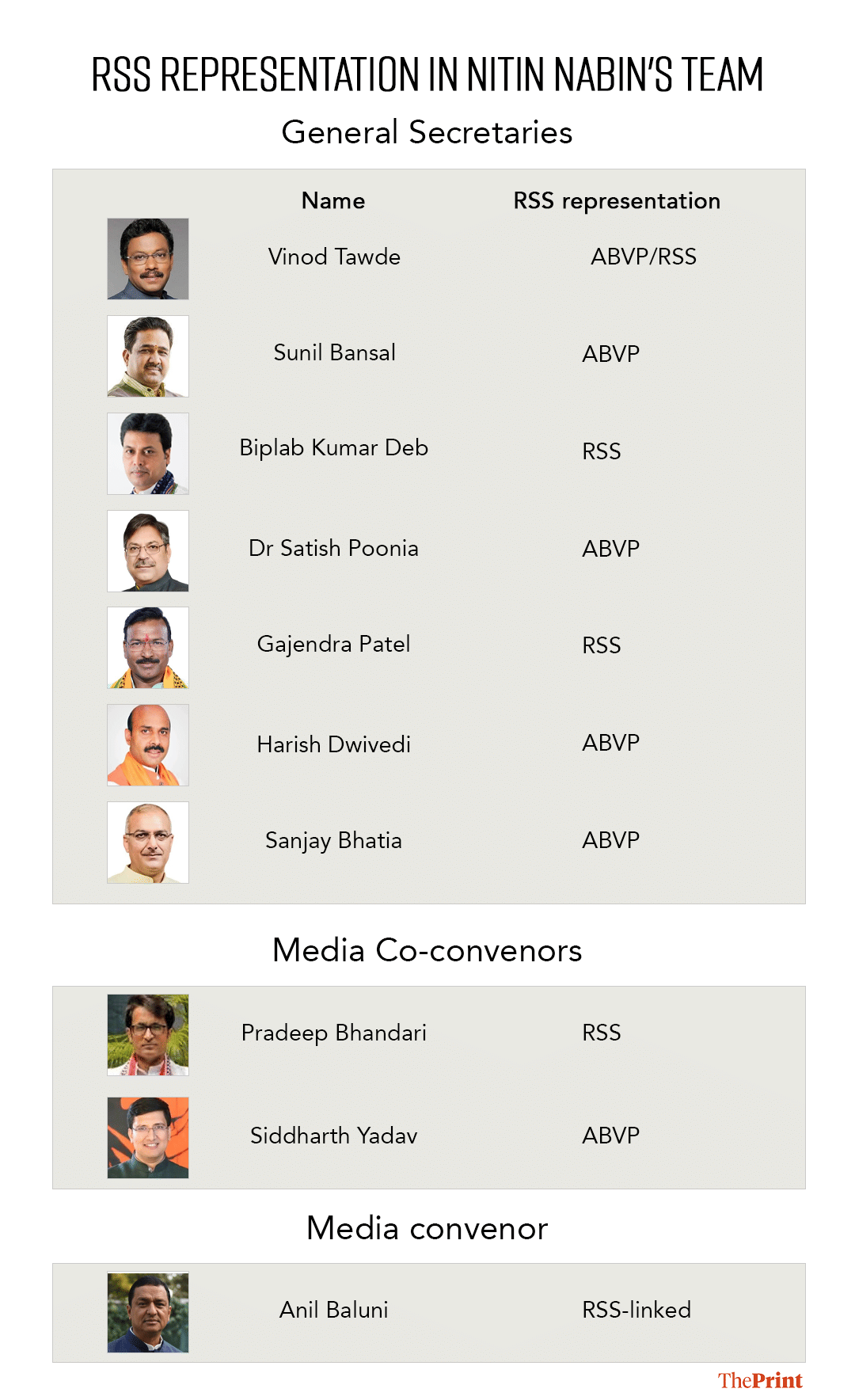
Among the eight general secretaries, at least seven have RSS or ABVP connections.
Vinod Tawde has been an RSS member, having held various posts in ABVP as well. Sunil Bansal, Harish Dwivedi, Sanjay Bhatia and Dr Satish Poonia have all been associated with ABVP. Biplab Kumar Deb was an RSS volunteer for 16 years, having trained under leaders like Gobinda Acharya and Krishnagopal Sharma. Gajendra Patel completed a three-year training programme offered by RSS, and went on to hold several posts in the organisation.
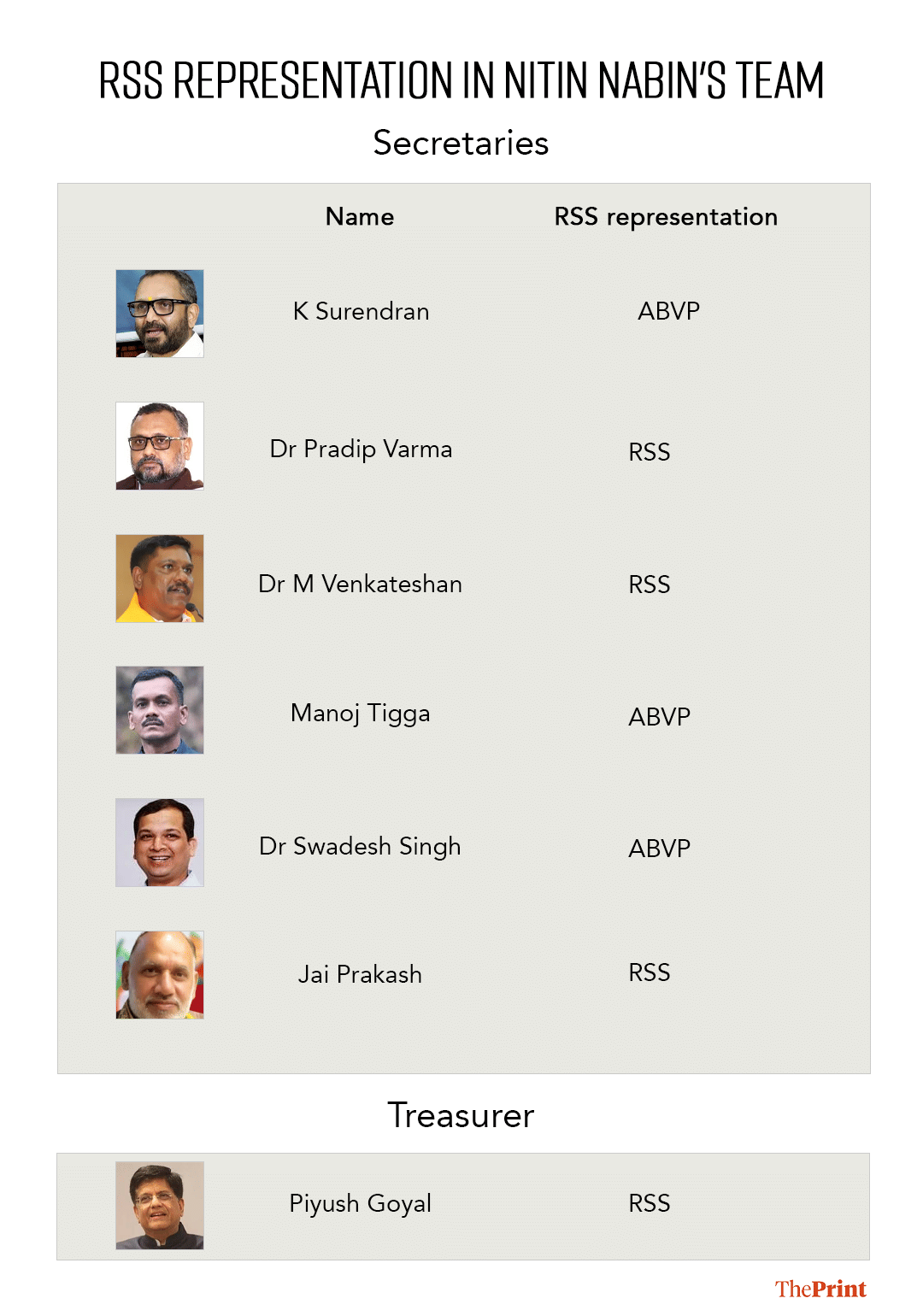
Among the 16 secretaries appointed by Nabin, at least six are associated with RSS or ABVP. These are K. Surendran, Dr Pradip Varma, Dr M. Venkateshan, Dr Swadesh Singh, Manoj Tigga and Jai Prakash. Venkateshan has also written a book titled Naan RSS SwayamSevakan, which translates to ‘I am an RSS Swayamsevak’.
Union Minister Piyush Goyal, who has spoken about how his association with RSS has been the best thing to happen to him, is the new Treasurer in Nabin’s team.
Additionally, among the four media convenors and co-convenors, three have been associated with the Sangh.
Also Read: Nitin Nabin’s team is not as ‘young’ as Nadda’s but why RSS and BJP leaders are happy about it
‘Changing’ composition of BJP
Dr Ratan Sharda, who has authored several books on RSS, put the numbers in context of BJP’s expansion from a “big party to a mammoth party”, and its changing composition.
“There are many highly qualified people who have joined the BJP during Modi ji’s time, who don’t have an RSS background. There are many important imports from other parties, which wasn’t very high earlier,” he told ThePrint.
“Before Modiji’s time, or let’s say when Atal ji was in power, BJP had very limited pull among non-BJP parties. It was still a politically avoidable party, virtually a pariah. But now that acceptability has increased and power also begets power, more people wish to be near the power as BJP becomes very dominant. The overall bench strength of BJP, in terms of leaders who are mid-level and new, and who are not from RSS, has naturally increased,” he explained. “And they have to be accommodated.”
Therefore, Sharda said, inclusion of fewer RSS-linked leaders in the national office-bearer team does not surprise him, but asserts that the party’s dependence on RSS remains.
“BJP is running on its own steam, like any other organisation that came with the support of RSS. Every organisation, like the BMS (Bharatiya Mazdoor Sangh), ABVP and VHP (Vishva Hindu Parishad), have their own cadre and leaders. So, it is obvious that something similar will happen with the BJP also,” he said.
On whether the reduction in RSS imprint in BJP’s national team reflects Nadda’s 2024 remark, Sharda asserted, “Even now, the spine of the RSS organisational people has to remain if BJP has to remain strong.”
He added, “BJP cannot become the Congress. Every time they have tried to become Congress, they’ve suffered… so they have to have that spine, or that inner nervous system, where RSS people and cadres are there, but overall the composition and the character of the party will change as it grows.”
However, political analyst Badri Narayan does not think that any conclusion can be drawn from the changing RSS imprint in BJP’s organisational leadership structure.
“There are leaders within BJP who are associated with the Sangh, and some of them are selected. Sometimes more are chosen, and at other times, fewer. It is likely not a highly calculated process, where a specific percentage must be drawn from the Sangh,” he told ThePrint.
Narayan asserted that this isn’t a part of the political strategy, adding that it is only the post of the General Secretary (Org) which assumes significance in terms of the coordination between RSS and BJP.
“There is a flow of ideas, there are many flows of ideas in it, and many BJP leaders are influenced by it. Those who are doing good work get a place in the organisation or in the ministry,” he said.
(Edited by Mannat Chugh)
Also Read: Over 50% of BJP office-bearers in Nitin Nabin’s new team come from ‘upper’ castes