






New Delhi: A father unable to apply for a US visa for his 10-year-old’s treatment; an aspirant living under the fear of adverse police verification getting in the way of her becoming an assistant teacher; another, having cleared NEET, waiting for adjudication to conclude to secure a medical seat. Stories behind names deleted from electoral rolls highlight how the Election Commission’s Special Intensive Revision (SIR) in West Bengal has affected much more than mere voting rights.
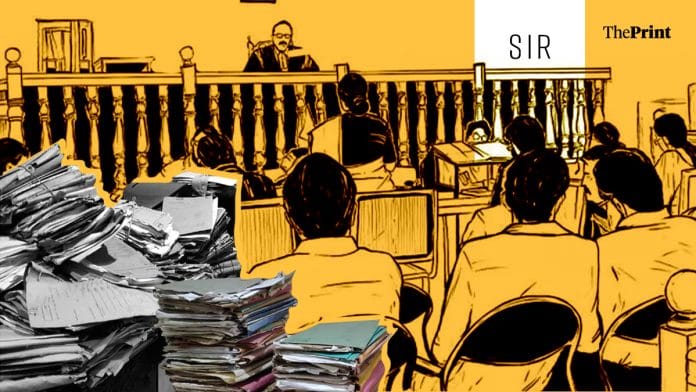
The Calcutta High Court is petitioned daily by such individuals who plead that the deletion of their names are affecting career and travel prospects. These ‘specially fixed matters’ are heard each day at 1 PM by Justice Krishna Rao’s bench. More than 40 such “SIR MATTERS” are listed before the bench on average each day.
Such is the extent of SIR-related matters that the High Court is now finding it tough to trace the physical files corresponding to every case.
Most of the petitioners before the High Court are seeking early disposal of their cases by the Appellate Tribunal.
The electoral roll verification exercise had resulted in the deletion of more than 90.80 lakh electors from the state’s electoral rolls. As ThePrint reported earlier, an RTI response has revealed that, of the more than 38 lakh appeals submitted in West Bengal following the SIR, 31 lakh remained unresolved as of 7 August.
Of the 38 lakh appeals, more than 20 lakh were filed by the EC itself, thereby challenging the inclusion of voters who had already been cleared by judicial officers during the adjudication phase. In the run-up to the West Bengal Assembly elections in April, a bench of Chief Justice of India Surya Kant and Justice Joymalya Bagchi had on 10 March directed the establishment of 19 Appellate Tribunals, presided over by judicial officers.
The administrative machinery operates as a three-tier system starting with the SIR, wherein local Booth Level Officers (BLOs) working under the ECI identify “discrepancies” and issue show-cause summons to voters. Voters must then appear in person before ECI registration officers to submit their legacy documentation proving their voter rights in that constituency. Next, the BLOs place the voters’ status into an “under adjudication” category, which culminates in their inclusion or deletion from the final voter list via a speaking order.
These deletions primarily affected electors classified under the ASDD (Absent, Shifted, Deleted, Displaced) categories during the initial draft revision phases.
The “logical discrepancy” category was introduced specifically in West Bengal to flag voters whose records showed inconsistencies requiring verification—like parent-child age gaps, mismatched names, or address-relation anomalies—leading to notices and hearings.
The Supreme Court, in its hearings also questioned the rationale for introducing this additional category only in West Bengal and emphasised the need for an effective appellate mechanism for people affected by the exercise.
Also Read: Nearly 98% of 38 lakh West Bengal SIR appeals pending, lakhs of voters in limbo as civic polls near
Exam cleared, job prospects in limbo
Kanika Das, a 38-year-old Hooghly resident is before High Court not merely because exclusion from the electoral roll denied her the voting right, but also because it is now threatening to spoil her career prospects. In her petition before the High Court, Das claimed that her name was deleted from the voter list based on the “logical discrepancy” tag since the age gap between her and her father was more than 50 years.
Das told the court that she submitted comprehensive documents—including her Aadhaar, father’s Aadhaar, and his Pension Payment Order issued by the EPFO—to prove that the age gap between them, 39 years, is “perfectly normal”. Despite this, her voter status was placed “under adjudication”and deleted without a speaking order.
She has termed the exclusion as highly discriminatory, pointing out that two of her sisters were allowed to remain on the same voter list without any objections.
Das approached the Calcutta High Court because her statutory appeal filed on 2 April, 2026 with the Appellate Tribunal remains undecided.
In her submission, Das told the High Court that she successfully qualified the 2nd State Level Selection Test (2nd SLST) for appointment as an assistant teacher (Classes 11-12) and is currently undergoing mandatory police verification.
However, since voter roll status is the primary document used to verify residence and identity, the deletion of her name threatens to trigger an adverse report from the police. She has, therefore, requested the High Court to direct the Appellate Tribunal to fast-track her appeal before it.
Mursalim S.K. finds himself in a similar predicament.
His petition states that the Murshidabad resident cleared the National Eligibility cum Entrance Test (NEET) but since his name was deleted from the voter roll, local authorities refused to issue him a domicile certificate, which is a mandatory prerequisite for state-quota medical college admissions and counseling. While he had already filed an appeal before the Appellate Tribunal challenging the deletion, the appeal remains pending.
His NEET admission counseling was scheduled to begin on 13 August.
On 7 August, the High Court requested the Appellate Tribunal to resolve his appeal within a week and directed the SDO of Jangipur to issue a temporary domicile certificate, valid for four weeks, so that he could participate in college admissions. However, the Appellate Tribunal is yet to adjudicate his appeal and Mursalim risks losing the seat if the adjudication does not conclude before the expiry of the temporary domicile certificate.
In yet another case, a 21-year-old told the High Court that he has not been able to apply for a professor’s job due to the deletion of his name from the voter list.
Firoj Alam had applied for the post of assistant professor in Dakhin Dinajpur under the West Bengal College Service Commission (WBCSC). But the High Court was informed that his candidature is not under consideration due to deletion of his name from the voter list.
On Thursday, Alam’s advocate Gopa Biswas told the High Court that the petitioner had already filed an appeal before the Appellate Tribunal and prayed for an order by the High Court directing an early disposal of his appeal “to enable him to appear in the process of appointment of assistant professor”. The bench ordered that Alam’s appeal be disposed of as early as possible, preferably within two weeks so that his career isn’t hampered.
On the same day Alam appeared before it, the High Court also heard an appeal by a West Bengal Civil Service (WBCS) aspirant who, arguing the matter personally, claimed he was facing issues with his job prospects due to the deletion of his name from the electoral roll after the SIR. The High Court listed his application on 31 August, provided his file could be traced in the stacks of West Bengal SIR-related case material.
SIR spillover: Can’t travel overseas
Jasimuddin Ahammed, a 40-year-old resident of Purba Bardhaman district, is due to join his Merchant Navy assignment in the first week of September.
Via his petition, he informed the High Court that since his profession as a seaman requires him to travel globally and remain outside India for more than nine months a year, he cannot afford to wait indefinitely for the “slow-moving administrative machinery”. The High Court also noted his advocate Soma Mal’s submission that Ahammed had already preferred an appeal before the Appellate Tribunal and sought “an expeditious disposal” of the appeal.
His name, the High Court was told, was removed from the voter roll on account of a “mismatch” regarding his deceased father’s name.
Despite personally appearing at a hearing in January, and submitting his Indian passport, birth documents, and his late father’s official name-change and death certificates as proof, his voter status was placed ‘Under Adjudication’ and his name was subsequently deleted from the voter roll in March without any avenue for further hearing.
Considering the submissions made, Justice Rao passed an order ‘requesting’ the Appellate Tribunal to dispose of the appeal “as early as possible, preferably within two weeks”.
In another case, the petitioner sought speedy disposal of his appeal against deletion of his name from the voter list citing his father’s serious medical condition for which he has to travel to Saudi Arabia. He informed the High Court that he was not being granted a visa despite holding his passport, solely due to the deletion of his name from the voter list since his electoral photo identity card (EPIC), the primary identity document for him, is in the “deleted” category.
The High Court, in this case, asked for the certificate of his father’s health condition to be placed on record for the matter to proceed further.
Another petition was filed by the father of a 10-year-old suffering from a lung disease. The petitioner sought from the High Court directions to the Appellate Tribunal to decide his case as soon as possible to enable him to apply for the visa so he could travel to the US for his son’s treatment.
On Thursday, the High Court also heard a petition by Nurjahan Begam who sought a direction to the Appellate Tribunal for disposal of her appeal against deletion. It was her submission that the Appellate Tribunal took up her appeal and excluded her name without “any notice or opportunity of hearing” even as her current writ petition was pending before the High Court.
Her counsel Sandip Das prayed before Justice Rao’s bench for an order directing the Appellate Tribunal to restore her appeal as early as possible. In light of the same, the High Court directed the Appellate Tribunal to restore her appeal filed in March and dispose of the same as early as possible.
(Edited by Amrtansh Arora)
Also Read: Bengal’s Matua factor: Fuming over SIR & slow citizenship drive, Matuas say ‘being used as pawns’