



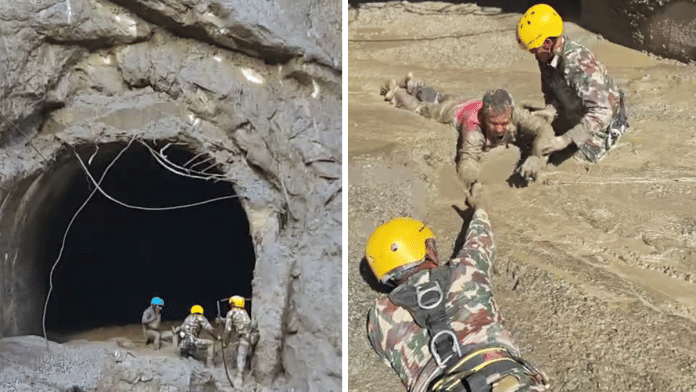
New Delhi: The Nepalese government Friday reversed an earlier decision to keep international search-and-rescue teams out of areas devastated by the Bhotekoshi flash floods, following mounting diplomatic pressure from countries whose citizens remain missing after the disaster.
The government has now agreed to accept limited foreign assistance, particularly for rescuing people trapped inside hydropower tunnels and for DNA testing and forensic examinations, The Kathmandu Post reported.
Based on an assessment by the National Disaster Management Centre, the Nepalese government, acting through an inter-ministerial coordination committee, has approved assistance from India, China, Australia and South Korea. The four countries will be permitted to send experts and technical teams with experience in tunnel rescues, DNA testing and forensic examinations.
Several other governments have offered relief assistance to Nepal and expressed a willingness to dispatch specialist teams. Nepal, however, has not accepted those requests.
The government had earlier said Nepal’s own rescuers had the capacity to conduct search-and-rescue operations and that it would not permit teams from other countries to participate.
The flash floods devastated communities along the Bhotekoshi and Trishuli Rivers. More than 600 people had been reported dead as of Friday, while at least 1,000 remained missing, including 517 foreigners from 31 countries.
According to the latest records from the Nepal Tourism Board, Indian nationals account for the largest number of missing foreigners, with 178 people. They are followed by 65 Americans, 53 Ukrainians, 35 Australians and 33 people from Britain, among others.
India has publicly offered to send specialised teams to Nepal.
Randhir Jaiswal, a spokesperson for India’s Ministry of External Affairs, said Friday that New Delhi had offered a tunnel-rescue team, a medical team and personnel from India’s National Disaster Response Force.
That same day, Indian Foreign Minister S. Jaishankar spoke to Nepal’s Foreign Minister Shisir Khanal about the disaster. “I spoke in the morning to the Nepal Foreign Minister. We have given them a range of support offers. They are evaluating them,” Jaishankar wrote on X.
India was also sending a fourth tranche of relief supplies to Nepal. An 11-member team of doctors, paramedics and tunnel-rescue specialists was included in the shipment, he said.
South Korea has also made a public offer of assistance. South Korean Foreign Minister Cho Hyun Thursday spoke with Khanal and expressed concern about the safety of South Korean nationals in Nepal, including nine people who remain out of contact.
Cho also asked the Nepalese government to cooperate with a prompt response team that had been dispatched to the disaster zone so that it could participate in search-and-rescue operations.
The foreign teams from India, China, Australia and South Korea will be allowed to assist with rescues inside hydropower tunnels in the districts of Rasuwa and Nuwakot.
(Edited by Viny Mishra)
Also read: How a Facebook post helped a teacher find two missing children after Nepal floods