



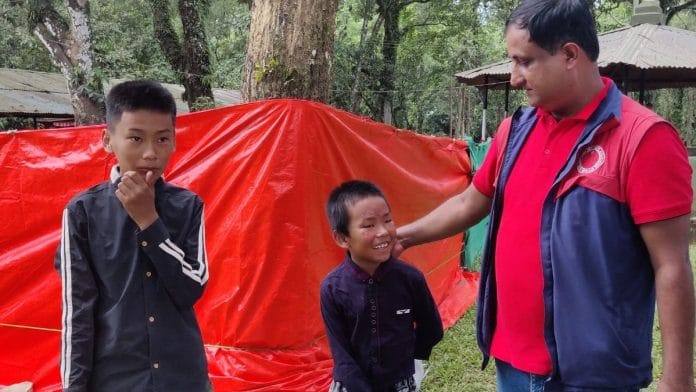
Bidur: Fifty-year-old Bishnu Prasad Paudel, who lives in the Battar area of Nepal’s Nuwakot district, had marked himself safe from the flash floods that were occurring just 3 km away from his home. That was until he was scrolling through Facebook on Thursday morning, a day after the floods, when he came across the names of two children reported missing from his village, Jibjiba, in Rasuwa, the district worst affected by the floods.
Nischal and Nirjal Tamang, aged 13 and 7 respectively, belonged to Jibjiba and were studying at Uttargaya School in Rasuwa, which was destroyed by the floods. A neighbour had posted their names, along with those of many others, on Facebook, hoping that someone would be able to locate them.
“I am a principal in a school in Battar, and I haven’t lived in Jibjiba in years, yet I felt something different when I read those names,” said Paudel. “I felt like I should recognise them – they’re from my hometown.”
Paudel knew that rescued civilians were being brought to Bidur in Nuwakot, and that is where he went looking. After checking around five hospitals, he found the children on Thursday evening, admitted to Chakradev Hospital with injuries to their faces and bodies.
A narrow escape
The two boys had narrowly escaped the deluge that destroyed their school after they managed to run uphill in time. In the rush, many of their classmates and teachers were swept away, and the brothers had only each other to count on as they walked through the jungle, away from the flooded school.
After more than four hours of walking, they were finally rescued by an ambulance near the Sherpa Highway and brought to Chakradev Hospital in Bidur on Wednesday night.
“I didn’t recognise them, of course. The hospital led me to them when I asked for their names,” said Paudel. “When I met them, I learnt they lived very close to my old house in Jibjiba.”
Nischal, 13, told Paudel that his father was working overseas in the construction business, while their mother was in Jibjiba village. As Paudel spoke to the boys about their home and family, he made another startling connection.
“More than 15 years ago, when I was teaching in Jibjiba, their father was one of my students,” said Paudel. “That’s how it is in Jibjiba; it’s a very small town, and we’re all neighbours in a sense. I’m glad I was able to help these boys.”
After they had been attended to at Chakradev Hospital, Paudel helped get the boys discharged and brought them to the Nepal Army’s base in Bidur, where rescue operations were underway. Although Jibjiba village itself was unharmed by the floods, the roads leading to it had been cut off, leaving a helicopter as the only way to return the children home.
He spoke to their mother on the phone, reassuring her that her sons were safe. He is now waiting with the boys, hoping to take them back to their village once the Army provides a helicopter.
Flood updates
The Army Training Centre in Bidur, where Paudel brought the children, has become the de facto headquarters of the Army’s rescue operations. On one side, tents have been set up to treat wounded civilians, while the helipad sees helicopters flying in and out with rescued civilians, supplies and army personnel.
Since the floods occurred on 26 August, the NDRRMA said it had rescued 3,500 people, while close to 500 bodies had been recovered from across the Trishuli River basin. Meanwhile, 977 people remained registered as missing, although sources said the number could be much higher.
“Currently, it’s the district administrations and municipalities providing numbers of missing people, but every day, families are coming forward with the names of relatives who remain missing,” said a Nepal government official on condition of anonymity. “It will take some time to collate all the numbers and get a real sense of how many people are actually missing.”
(Edited by Maryam Hassan)