



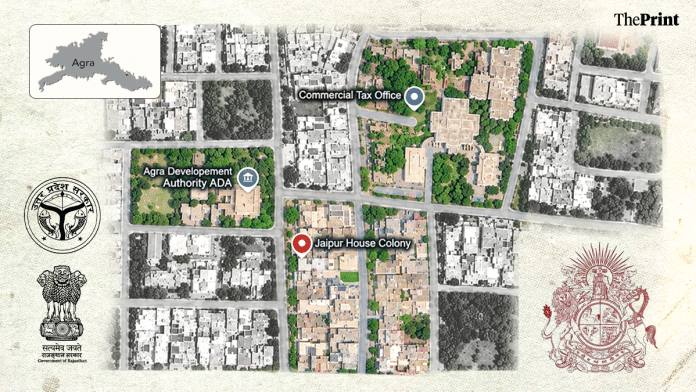
Agra: The Agra district administration in Uttar Pradesh is scrambling to find answers after correspondence from the state of Rajasthan claiming ownership over parts of Agra’s upscale Jaipur House area. The claim covers two historic bungalows housing the GST office and the Agra Development Authority, besides 100 bighas of land housing local offices of the BJP and its ideological parent, the RSS.
Rajasthan Chief Secretary, in a letter to Uttar Pradesh government last week, demanded that Uttar Pradesh transfer the title of this land parcel in the densely urbanised Jaipur House area, which it says belonged to the erstwhile princely state of Jaipur prior to creation of the United State of Rajasthan.
Records examined so far have not yielded any clarity over how the Uttar Pradesh government and Agra Municipal Corporation acquired the land, carved it up into plots, and sold it despite objections by Rajasthan.
The Rajasthan government has made similar claims on properties in Mathura, Prayagraj and Varanasi following a comprehensive review of the current status of properties it says belonged to the erstwhile princely state of Jaipur.
Agra Additional District Magistrate (administration) Azad Bhagat Singh told ThePrint that the question is not whether Jaipur state owned land in Agra, since that is established by historical records. Instead, the challenge is to ascertain the legal category the land fell under during 1949-1952, when 14 princely states including Jaipur merged to create the United State of Rajasthan.
Besides the two historic bungalows and 100 bighas of land, Rajasthan has also staked claim on a section of the Mankameshwar temple area and a strip of land along the main road in Agra’s Jaipur House.
The densely urbanised Jaipur House area also houses private residences of several prominent politicians, doctors and public figures.
Also Read: Jaipur royals vs Rajasthan: Can courts hear disputes over pre-Constitution covenants? SC to decide
Basis for Rajasthan’s claim
To support the state’s claim, the Rajasthan Chief Secretary in his letter cited Article VI(2)(c) of the Rajasthan Covenant—a pre-Constitution agreement signed in 1949 between the Government of India and rulers of 14 princely states.
The letter also referenced a gazette notification dated 16 February, 1952, which contained a list of properties of the Jaipur state, including the palace of Mirza Raja Jai Singh, which currently houses the GST Office in Agra.
The district magistrate of Agra has now ordered a detailed review of land records and subsequent transfers to ascertain whether the pre-Covenant ownership of said land was vested in the Jaipur Princely State, or the royal family. A team is also being sent to Lucknow to examine old land records.
If it is found that the land belonged to Jaipur state at the time in question, Article VI(2)(c) of the Rajasthan Covenant would apply here, vesting the title with the state of Rajasthan. On the other hand, if it is found that the land belonged to the royal family of Jaipur, authorities will need to ascertain if the Jaipur royals inventorised this property as their own and presented the list to the Government of India.
In such matters, one gazette document is not enough to resolve this issue and the entire title chain will have to be examined, not just the Rajasthan Covenant.
Article VI(2)(c) of the Rajasthan Covenant clearly states that all assets and liabilities of member states will become the assets and liabilities of the United State of Rajasthan. This article forms the crux of Rajasthan government’s claim, but it has yet to furnish any clarity on whether the tract of land belonged to the ruler’s private estate, or to the princely state of Jaipur.
Articles XI and XII of the Rajasthan Covenant clearly distinguish between both types of properties and establish the respective rights in both cases.
These rights were recognised by the Supreme Court in the case of Colonel His Highness Sawai Tej Singhji, Maharaja of Alwar v. Union of India (1978). The court established that pre-Covenant properties of the princely states were not subject to judicial review, and that Article XI of the Rajasthan Covenant protected the rulers’ private properties based on an inventory submitted to the Government of India.
What’s added another layer to this decades-old dispute is evidence of extensive correspondence between the Rajasthan and Uttar Pradesh governments between 1952 and 1955 regarding this prized land in Agra’s Jaipur House area.
Land carved out despite objection
In its correspondence from the time, Rajasthan had objected to Agra Improvement Trust’s acquisition of 100 bighas of land and two historic bungalows in Jaipur House area. It asked Uttar Pradesh to halt the acquisition and seek permission from Rajasthan to make use of any properties belonging to the erstwhile princely state of Jaipur. The Agra Improvement Trust had secured technical approval for the Jaipur House development scheme on 20 October, 1951.
But Jaipur state raised an objection when the Trust moved in to acquire the land. This is mentioned in a letter from July 1955.
Notably, the correspondence also mentions that the Trust had offered to buy the land for Rs 4 lakh and sell it at Rs 7 per square yard after developing it. It submitted that the scheme was financially viable despite the payment of the compensation.
However, the Uttar Pradesh government turned down this proposal over concerns that if the sale of developed land did not go as planned, compensation paid to Rajasthan for the land would become a major financial burden for the state.
Despite objections raised by the Jaipur state and Uttar Pradesh government’s refusal to pay compensation to Rajasthan, the Agra Municipal corporation went ahead and carved out 350 plots in the Jaipur House area in the 1960s. Of these, 110 plots were sold through cooperative societies.
Sources told ThePrint that documents examined so far have yet to yield any clue to how the Uttar Pradesh government and Agra Municipal Corporation acquired the land despite the objections of Jaipur state.
But the complexity of this issue goes beyond establishing the title.
No state can ‘constitutionally’ own an enclave inside another state, according to Article 1 and 3 of the Constitution which determine states and their territories, and give Parliament powers to determine their boundaries.
If Rajasthan is able to prove that said land in Agra’s Jaipur House area belongs to it, the issue would move into the territory of a constitutional question.
The Agra administration is facing similar claims concerning properties linked to erstwhile princely states, including the Kothi Meena Bazar, earmarked by the Uttar Pradesh government to be developed as a museum dedicated to Shivaji.
The title suit for this property is still pending in court.
(Edited by Amrtansh Arora)