



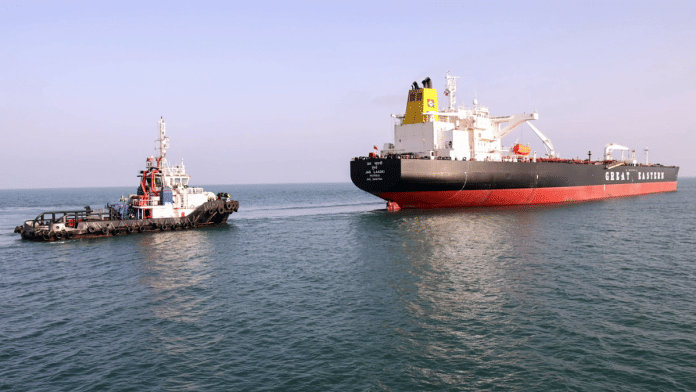
New Delhi: India’s oil refiners are finding it increasingly difficult to escape soaring tanker freight costs as the Gulf conflict, severe disruption around the Strait of Hormuz and the Bab el-Mandab blockade push up demand for crude tankers and alternative supplies.
Freight rates for Very Large Crude Carriers (VLCCs)—tankers capable of carrying roughly 2 million barrels of crude—have risen sharply, particularly on routes involving the Arabian Gulf, as fewer vessels are willing to sail through high-risk areas.
According to the estimates of Drewry Maritime Research, a maritime consultancy firm, VLCC freight on the Arabian Gulf-India route stood at $61.9 per tonne on 14 September, up from $34.6 per tonne in August and $10.6 per tonne in February.
The increase, according to Bulk Shipping Research at Drewry Maritime Research deputy director Rajesh Verma, reflects the higher risks and limited availability of vessels willing to transit the Strait of Hormuz.
“Spot freight rates have significantly surged in September from August levels,” Verma told ThePrint, adding that overall rates on Arabian Gulf routes had risen particularly sharply because of the war-risk premium.
Importantly, the Drewry spot rates (i.e., the current market price or interest rate for an immediate transaction, delivery, or settlement of a commodity) do not include the additional war-risk premium, which is paid separately by the charterer. The actual transportation cost for an oil importer is, therefore, higher than the headline freight rate.
Also Read: Why Bill allowing Trump to impose 100% tariff on Russian oil buyers is a double-edged sword
Alternative crude is getting costlier
The surge is particularly significant for India because a large share of its crude imports comes from West Asia and traditionally passes through the Strait of Hormuz.
The number of ships willing to enter or cross the Strait has fallen, as owners face higher security and insurance risks. While some crude is still moving through the region via ship-to-ship transfers, where cargo is transferred from one tanker to another, these arrangements add complexity to the supply chain.
The latest disruption around Bab el-Mandab has added another layer of pressure. The Houthi attacks on commercial vessels have made the Red Sea route more difficult, with some ships opting for longer journeys around the Cape of Good Hope.
For Indian refiners, alternative suppliers such as West Africa, Latin America and the US remain important. But, the latest freight movements show that shifting away from the Gulf does not necessarily mean escaping high shipping costs.
Drewry estimates show freight on the West Africa-India (West Africa-India) route has risen much faster than the Arabian Gulf-India (AG-India) route since August. Verma attributed this to increased demand for alternative supplies following disruption to Saudi Arabia’s East-West pipeline and the blockade around Bab el-Mandab.
“Effectively, the premium of WA-India route over AG-India, which narrowed after the war widened at the moment,” Verma said.
In other words, the disruption has pushed up freight not only on the original Gulf routes but also on some of the alternative routes that Indian refiners could turn to.
Indian oil companies, Verma said, should still look to maximise supplies from West Africa, Latin America and the US because Arabian Gulf shipments carry an additional war-risk premium.
“As there is a high premium for transporting Arabian Gulf crude due to war risk, they should seek to maximise imports from other sources, such as West Africa, Latin America, and the US, since rates on these routes are relatively lower in the absence of the war risk premium.”
Russia offers another potential source of crude, although sanctions remain a constraint. The disruptions to Black Sea loadings at Novorossiysk port have pushed more Russian crude towards Baltic ports such as Primorsk.
“Although the distance from India to Primorsk is significantly longer than to Novorossiysk, the freight rates will still be lower than on the Arabian Gulf route. However, the ongoing sanctions on Russian crude would be an issue,” Verma said.
Double blow for oil importers
The tanker shock comes as crude prices remain above $100 a barrel, leaving importers exposed to both higher crude prices and sharply higher transportation costs.
The pressure could intensify if the disruption persists. Alternative supplies from Africa and the Americas are facing greater competition, while spare export capacity remains limited.
In its September Oil Market Report, the International Energy Agency (IEA) said global observed oil inventories had fallen by 507 million barrels since the start of the war, equivalent to an average draw of 2.8 million barrels a day.
With inventories declining and the global refining system already stretched, the bandwidth available to absorb further supply disruptions is narrowing.
For India, the challenge is no longer simply finding alternative crude but securing sufficient barrels at a manageable transportation cost as disruption in the Gulf pushes up freight across both traditional and alternative shipping routes.
(Edited by Tony Rai)
Also Read: Will Saudi pipeline shutdown affect India? The answer is subject to market risks