



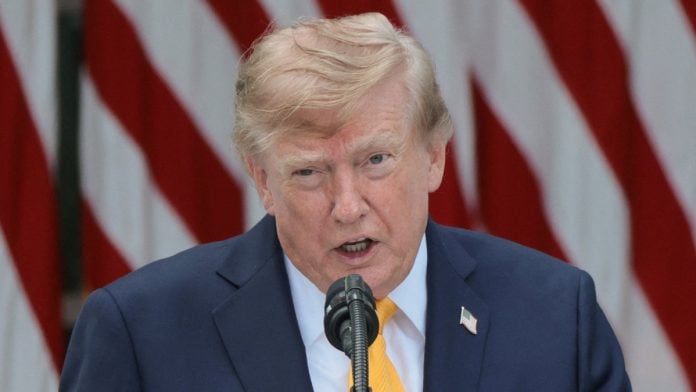
New Delhi: The passage of a Bill in the US House of Representatives targeting Russian oil buyers has added a fresh layer of uncertainty for Indian refiners already dealing with sharply higher crude costs. The Bill, awaiting his signature, will allow US President Donald Trump to impose tariffs of up to 100 percent on countries buying Russian energy.
The development comes at a politically sensitive time, with the US and India already engaged in difficult trade negotiations and Washington stepping up pressure on countries that continue to buy Russian energy.
Energy sector experts said the House vote appeared to be driven as much by politics as by the stated objective of cutting Russia’s energy revenues. It is unclear whether Trump will actually impose 100 percent tariffs just ahead of the mid-term polls, given how oil prices have already crossed $100 per barrel and any new tariff will push oil prices through the roof.
“Today’s House vote on Graham’s Bill tells me that politics is driving the decision, with little regard for the economic consequences. I see it largely as a reaction to BRICS’ recent success,” Natalia Katona, a commodity analyst based in Abu Dhabi, told ThePrint.
The US House of Representatives late Wednesday night (Thursday morning in India) passed the Lindsey O. Graham Sanctioning Russia and Iran Act of 2026 by 262-159, sending it to Trump for his signature. The US Senate had passed the legislation 86-11 last month.
Once signed, the 61-page legislation would allow Trump to impose tariffs of up to 100 percent on the five largest importers of Russian crude oil or natural gas. India and China, the two biggest buyers of Russian crude, could therefore come under its scope.
But the legislation does not automatically impose a 100 percent tariff on India. Instead, it gives the US President the legal authority to impose such measures and to decide whether and when to use those powers. The Bill also provides for a reassessment of the countries covered by the tariff provisions every 180 days.
This distinction could be important for India, as the threat of tariffs could give Washington additional leverage in trade negotiations with New Delhi.
Katona expects the threat to be used as a bargaining tool rather than immediately implemented in its broadest form. “I expect the threat to become a bargaining tool against China and India, especially in trade talks with New Delhi,” she said. “Sweeping implementation still looks unlikely to me. The damage to energy markets would be so severe that Washington would also pay a heavy price.”
Also Read: New India-US trade portal shows India is trying to liberalise and protect at the same time
India faces difficult choices
The timing is particularly challenging for Indian refiners because crude supplies are already under strain. Saudi Arabia has halted loadings at Yanbu port and is shipping crude exclusively from terminals inside the Gulf region, where tensions are already high.
Katona said Indian refiners are facing effective crude costs of $135-140 a barrel, while Urals crude is reportedly trading at an $8-a-barrel premium to ICE Brent, which is around $107-108 a barrel. “Trying to push more Russian oil out of this market is economically reckless,” Katona said.
The potential impact would not be limited to India. Katona said diesel refining margins in the US have already reached $114 a barrel, arguing that further restricting Russian supplies in an already stretched market could raise costs for American consumers as well.
For India, the central challenge is how quickly it can reduce its dependence on Russian crude, particularly when alternative supplies are already expensive.
“The key point is that India cannot replace roughly half its crude imports overnight, especially when alternatives are already scarce and expensive,” Katona said.
Russian crude has become a major part of India’s import basket since the Ukraine war, with refiners drawn to its availability and pricing. A sharp reduction in purchases could force them to compete for additional supplies from other producers, potentially raising the country’s import bill.
The legislation, therefore, leaves New Delhi facing a difficult choice: continue to buy Russian crude and risk possible US trade action, or shift towards alternative supplies at a higher cost.
Ultimately, Katona said, the question will be how much pressure India is willing to absorb, whether it chooses to reduce some Russian purchases to ease tensions with Washington, and how much extra it is prepared to pay to do so.
(Edited by Amrtansh Arora)
Also Read: 0% now, 100% in 2 years, 200% by 2029—US plan for generic pharma tariffs & what it means for India