





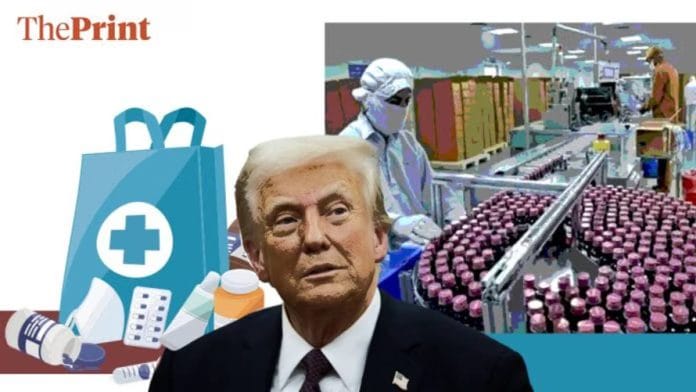


New Delhi: US President Donald Trump Tuesday announced that all generic pharmaceutical goods will remain at 0% tariff for a period of two years, following which the tariff will increase to 100% for one year, and then 200%, in a push to “reshore” manufacturing in the country.
The announcement is significant for India, as Indian pharmaceutical companies remain a key player in the generics industry in the US. While India’s pharma exporters get temporary relief, they face high costs if manufacturing operations are not shifted to US soil.
“Effective August 1st, 2026, all Generic Drugs being brought into the United States will continue to have a TARIFF of ZERO PERCENT for a two year period of time, after which the TARIFF will be raised to 100% for a one year period of time, and 200% thereafter,” Trump said on the social media platform Truth Social.
“This is done in order to RESHORE Generic Pharmaceutical Production into America, with a penalty to those Companies that decide not to build Plant and Equipment within the stated period of time given to them.”
The US President added that the policy on “patented, branded or innovative drugs” will remain as is, given its success.
Pharmaceutical products are India’s second largest merchandise export to the US. In the last financial year, India exported over $8.5 billion worth of pharmaceuticals to the US, which were largely driven by generic drugs. The year before (2024-2025), India exported over $9.7 billion worth of pharmaceutical goods to the US, according to government data.
A third of India’s total pharmaceutical exports were to the US alone. Pharma exports were worth roughly $25 billion in the last financial year, with the US market accounting for 34% of total exports. Pharmaceutical exports accounted for close to 10% of India’s total merchandise exports to the US in the last financial year, commerce ministry data shows.
Companies have been bracing for potential US tariffs in this area. Sun Pharmaceuticals this April announced its intention to set up manufacturing plants in the US through its $11.75 billion acquisition of New Jersey-based Organon & Co. Other Indian companies, including Aurobindo Pharma, Biocon Group, Cipla, Dr. Reddy’s Laboratories, Glenmark Pharmaceuticals, Granules India, Jubilant Group, Lupin, Piramal Pharma and Zydus Lifesciences have all announced plans to invest in the US.
Total investment promises made by Indian pharmaceutical companies this May stood at $19.1 billion. The Indian government also braced for such tariffs during its negotiations for the framework of an interim trade deal with the US.
Announced in February following a call between Prime Minister Narendra Modi and Trump, the India-US joint statement on the interim agreement specifically outlined that India will receive “negotiated outcomes” with respect to any change in the tariff structure on generic pharmaceuticals and ingredients, based on US findings during its Section 232 investigation into the sector.
Section 232 investigations refer to inquiries under the Trade Expansion Act of 1962, which investigate foreign imports that could threaten US national security. The US government had in April imposed new tariffs on pharmaceutical products that were set to come into force later this month in some instances and September in other instances.
(Edited by Nida Fatima Siddiqui)
Also Read: India moves to diversify pharma exports & cut US market dependence, eyes $130 billion target by 2030
Excellent news for India.
The Hyderabad and Ahmedabad based pharma giants making billions will have to actually invest in R & D now. Else, set up manufacturing facilities in the USA and compete with other companies.
So long they have had an easy shot at minting money. Using other people’s innovations and IPs they made fortunes.
Now they will have to work hard and come up with something of their own.