



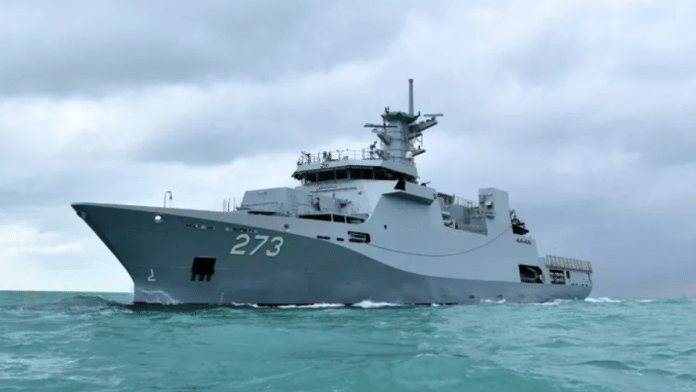
New Delhi: In dramatic developments on the high seas, Pakistan’s naval ship PNS Hunain (F-273) was involved in a collision with a frontline Indian Navy destroyer near the country’s Exclusive Economic Zone (EEZ), part of international waters, Tuesday evening.
The collision resulted in a massive dent on the front arch of the Pakistani vessel which has now returned to the harbour for repairs, while the Indian destroyer has continued with its operational deployment, escorting ship[s] coming in from the Gulf of Oman.
The incident in the North Arabian Sea came to light after the Ministry of External Affairs summoned Pakistan’s Charge d’Affaires early Wednesday and lodged a strong protest over the “unacceptable and unprofessional” conduct of the Pakistani naval units.
The MEA said that while the incident did not cause any major damage to the Indian ship, the Pakistani naval ship’s conduct was in direct contravention of Article 10 of the India-Pakistan Agreement on Advance Notice on Military Exercises, Manoeuvres and Troops Movements of April 1991.
“The Charge d’Affaires of Pakistan was advised to convey to the concerned Pakistani authorities the need for all military units to observe due care and respect the provisions of the relevant agreements between the two sides in order to prevent any repeat of such incidents,” it added.
India’s Charge d’Affaires in Islamabad has been instructed to lodge a similar protest with Pakistan’s Ministry of Foreign Affairs.
Late Wednesday, the Pakistan Foreign Office too summoned India’s Charge d’Affaires in Islamabad and lodged a protest over what it called a “highly provocative and unacceptable action by the vessel of the Indian Navy” in Pakistan’s EEZ.
In a statement, it added that Pakistan was undertaking its biennial exercise Seaspark-26, when the Indian vessel carried out “aggressive manoeuvres in dangerously close proximity of Pakistani [the] naval ship resulting in contact between the two vessels”.
Local Pakistani media reports quoted the Foreign Office as saying that the ship was INS Kolkata, which “increased its speed and left the area following the incident”.
What really happened?
Sources in the Indian defence and security establishment rubbished the Pakistani claims, stating that EEZs are international waters and legitimate routes for both military and commercial ships in transit.
They said that while the exercise may have been ongoing, the area was not designated as a “no go area”, which is done for live firing drills.
Sources further said that the Indian ship was operationally deployed to escort ships coming through the Gulf of Oman and was therefore positioned close to 120 NM from there.
They said that the Pakistani ship approached the Indian destroyer at high speed while attempting to intercept or follow it in international waters, before a close-range manoeuvre resulted in the two vessels grazing each other.
The incident resulted in “severe damages” to the Pakistani vessel which has returned to the harbour while the Indian ship continues its operational deployment.
The Indian captain is understood to have observed the approaching Pakistani vessel and issued warnings. Towards the end of the encounter, PNS Hunain attempted a close-range manoeuvre and grazed the starboard side of the Indian naval vessel, the sources said.
There was no major damage to the Indian ship, the sources said, adding that PNS Hunain suffered a huge dent and a possible crack, forcing it to return to harbour.
According to the sources, the incident appeared to have resulted from the Pakistani vessel’s high-speed handling and manoeuvring. They said the Pakistani ship was unable to steer clear of the Indian vessel in time and showed a lack of control.
They identified the Pakistani vessel as PNS Hunain, a multipurpose medium-sized offshore patrol vessel equipped with electronic warfare systems, anti-ship and anti-air warfare capabilities, sensors, self-protection systems and a terminal defence system.
Built by Damen Shipyards in Romania, the vessel was commissioned in July 2024. The vessel is based on Damen’s OPV 2600 design and measures about 98 m (322 ft) in length.
The Yarmook-class vessel can accommodate a helicopter and unmanned aerial systems, besides carrying rigid-hull inflatable boats for maritime-security and surveillance missions.
The ship has a fuel capacity of about 300 cubic metres and is powered by four Caterpillar diesel engines. It is also fitted with a 450-kilowatt bow thruster and two propellers.
The vessel, with a 60-member crew, has a reported top speed of about 22 knots (41 kmph), a range of around 6,000 nautical miles (11,112 km) and endurance of up to 40 days. Its weapons fit includes 30-mm and 12.7-mm remote weapon stations, surface-to-surface missile launchers and a 20-mm close-in weapon system.
Hunain is the third vessel in Pakistan’s Yarmook-class OPV programme. The first two vessels, PNS Yarmook and PNS Tabuk, are based on the smaller Damen OPV 2300 design and are about five metres shorter and roughly 600 tonnes lighter than Hunain.
(Edited by Gitanjali Das)