




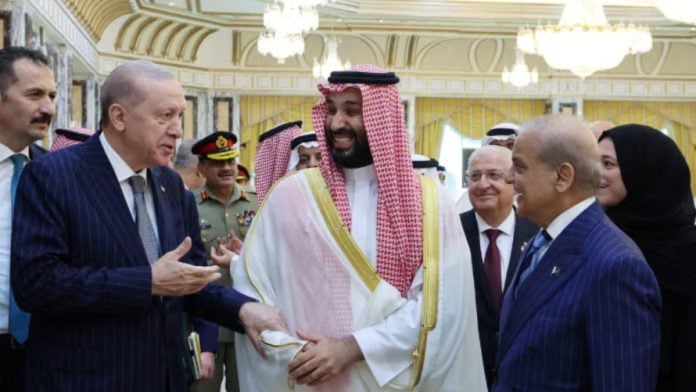

When the Houthis launched an offensive against Saudi Arabia in Yemen, analysts, observers and experts all had one question to ask—will the Makkah Joint Defence Agreement or the Mecca Pact be activated? It was not.
Nothing came out of the much-touted defence alliance apart from emotive tweets. Pakistan used adjectives, but no arsenal. Turkey could barely utter a condemnation while its ally Saudi scrambled for help. Even US President Donald Trump refused to indulge while Washington slyly had a discussion with the Houthis to keep their ships clear.
For all the will they, won’t they, should they, shouldn’t they that dominated debates and discussion, the Mecca Pact is our ‘Newsmaker of the Week’.
Security analyst Ahmed Saber Abbas, in his article for War on the Rocks, put the core dilemma of the defence pact succinctly: “Every alliance contains a struggle over who gets to decide what the alliance is for. The unusual thing about the Mecca Alliance is that all three of its members appear to believe they possess something that should give them that privilege: Saudi Arabia has the capital, Turkey has the defence industrial base, and Pakistan has the manpower and nuclear arsenal. Each can therefore imagine itself as the patron and the other two as clients. None of them, however, holds enough leverage to make that hierarchy stick.”
Years of bilateral cooperation should have led them to deal with the recent Houthi skirmish with cooperation and complementarity. That was not the case. Abbas labels it the ‘all client, all patron paradox’.
Signed on 7 August, the pact contains a NATO-like mutual defence provision under which the three countries agreed to regard an armed attack against one member as an attack against all three. Yet when the Houthis attacked, the pact remained in place but inactive after the Saudis intercepted a purported Houthi missile in the Islamic holy city of Mecca.
Amid global consternation, Pakistan scrambled toward what it does best—damage control. Having earlier declared that no direct military action or armed retaliation had been formally discussed, Pakistan Defence Minister Khawaja Asif said Thursday that the country is ready to retaliate, including military deployment. Turkey’s National Intelligence Organization (MIT) Chief Ibrahim Kalin visited Pakistan Thursday after a trip to Afghanistan. In Islamabad, he met Pakistan’s Army Chief Field Marshal Asim Munir, Inter-Services Intelligence Chief Asim Malik, and Prime Minister Shehbaz Sharif to discuss regional cooperation under the pact.
Yet two weeks after the Houthis captured most of the Red Sea islands and took control of the strategic maritime corridor of Bab-el-Mandeb and set fire to Saudi’s East-West Pipeline—Riyadh’s lifeline amid the indefinite blockade of the Strait of Hormuz and the escalating West Asia war—the pact is missing in action.
Also read: BRICS is bigger and more powerful. But what does the grouping actually want?
The patronage problem
Patronage, or the lack of it, is what analysts like Abbas say could come to define the pact. Riyadh can be the financier and make decisions on deployments and joint projects. It already has a precedent: after the 2025 Mutual Defence Pact with Islamabad, it invested in major economic reforms. In April 2026, Riyadh helped Pakistan with a loan of $3 billion to help pay off a UAE debt—the country Riyadh is competing with for regional hegemony.
Then there is Turkey and its booming defence production with the Bayraktar drones and its fifth-generation fighter jets. Ankara is also harping on its Ottoman legacy under President Recep Tayyip Erdoğan, who harbours hegemonic ambitions. The first meeting was convened in Istanbul with Turkish Foreign Minister Hakan Fidan essentially positioning the country as the pact’s architect. He also announced the technicalities: a Pakistani secretary general and a secretariat in Riyadh. Ironically, he declared the alliance would “reduce uncertainty and instability” in the region. His words did not age well.
Coming to Pakistan, the nuclear-armed country with the largest military force — 6,60,000 troops among the three. In the event of a crisis, Saudi could count on it for deployment in long-term operations. Mostly, both Ankara and Riyadh are eyeing nuclear and ballistic capability.
Islamabad, however, harbours regional ambitions too, especially with a field marshal who leaves no stone unturned to invoke their importance as a Muslim country, even declaring that ‘after Mecca, Pakistan is the only country created in the name of Islam’. They also perhaps are assured that all the recent diplomatic clout will give them the upper hand against India.
Moreover, Pakistan has navigated both the West Asia war and the Houthi-Saudi issue with diplomatic tact—adjectives over arsenal, condemnation over commitment. Despite a defence pact with Saudi, it did not wade into the war, rather playing the role of a mediator to gain bonus points from Trump, who has already labelled Asim Munir his ‘favourite field marshal’.
Pakistan knows how to play it cool. In 2015, it refused to send troops in alliance with Saudi Arabia in Yemen. Even in the recent offensive, Asif said nuclear weapons were not ‘on the radar’.
No one country is getting full control. Everyone wants to be the patron, viewing the other as a client, observing with caution, peppering their condemnation with multiple adjectives. Amid all this, Saudi seems to be caught in a diplomatic quagmire, isolated during what is perhaps their biggest military setback in Yemen in decades. In Bon Jovi’s lines, they ‘have no one to hold on to’.
(Edited by Saptak Datta)